
Motmot

White-tailed Eagle vs Common Buzzard

Haliaeetus albicilla versus Buteo buteo

Play a quiz with White-tailed Eagle and Common Buzzard
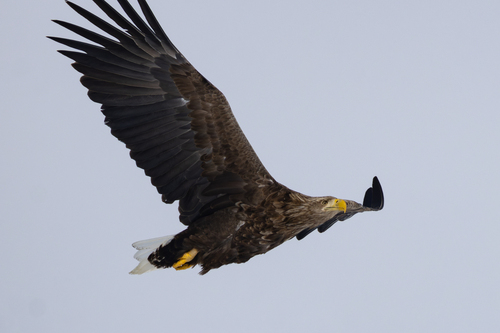
White-tailed Eagle (Haliaeetus albicilla) White-tailed Eagle
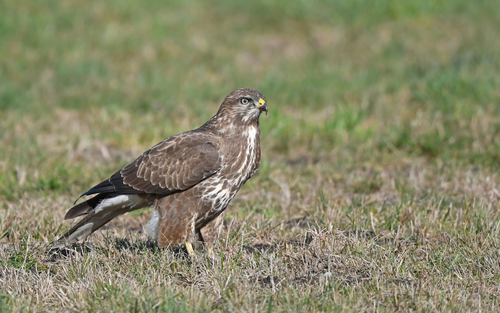
Common Buzzard (Buteo buteo) Common Buzzard

Media

Loading…

In short

The most reliable way to separate White-tailed Eagle from Common Buzzard is by overall structure and size: even at a distance, the eagle is vastly larger, with a massive bill, huge, broad wings, and a short, wedge-shaped tail, while the buzzard is much more compact and has proportionally shorter, rounded wings and a longer tail. Juvenile White-tailed Eagles in flight show a longer tail than adults, but it is still relatively short and often appears with a messy, pale base and dark tip, while buzzard tails are never so wedge-shaped or massive. In all plumages, the eagle's wings are extremely broad and deeply 'fingered', and their flight is heavy and shallow compared to the buzzard's more flexible, buoyant style. If you see the bird perched, the eagle's long neck, upright stance, and huge bill are unmistakable. Confusion is most likely with distant or immature birds in flight, but the sheer bulk and structure are always diagnostic.

Identification tips

  1. Size is the ultimate clincher: If you have any sense of scale, White-tailed Eagle is enormous—several times heavier than a Common Buzzard. Even at great distance, the eagle's bulk and wingspan are unmatched by any buzzard.
  2. Wing shape in flight: Eagles have extremely broad, plank-like wings with deep, widely spaced 'fingers' (at least six visible primaries). Buzzards' wings are shorter, more rounded, and less deeply fingered.
  3. Tail shape and length: Adult eagles have a short, wedge-shaped tail that can look stubby compared to their massive body. Juvenile eagles have a slightly longer tail, but it is still relatively short and often appears messy and pale with a dark tip. Buzzards always have a proportionally longer, more rounded tail—never wedge-shaped or stubby.
  4. Juvenile eagle tail pattern: Young White-tailed Eagles show a washed-out, dirty whitish or greyish tail with messy blackish tips—never seen in buzzards. Some may have faint barring, but the overall effect is a pale, uneven tail with dark edges.
  5. Head and bill: Eagles have a long neck and a massive, high-crowned bill that appears out of proportion to the head, especially when perched. Buzzards have a shorter neck and a much smaller, less prominent bill.
  6. Perched posture: Eagles perch very upright, often on exposed branches or rocks, with a long neck and a slightly vulturine appearance. Buzzards are more compact and less upright when perched.
  7. Flight style: Eagles use heavy, shallow wingbeats and long glides. Buzzards flap more quickly and flexibly, and often soar in a shallow dihedral (V-shape), sometimes hovering or kiting—behaviors not typical of eagles.
  8. Underwing pattern: Subadult eagles may show blotchy white mottling on the underwing and belly, especially in their third year, but this is highly variable. Buzzards never show such extensive white mottling.
  9. Plumage variability: Buzzards are famously variable, from very dark to very pale, but none match the eagle's combination of massive size, short wedge tail, and broad wings. Do not rely on color alone.
  10. Legs and feet: Both have feathered tibiae but bare tarsi; this is not a useful field mark at distance.
  11. Habitat context: If the bird is seen over large lakes, rivers, or coastal areas, especially in northern or eastern Europe, consider eagle. Buzzards are more likely in farmland, woods, or open country away from water.
  12. Confusion risk: At great distance or in poor light, a very dark buzzard may look larger and more eagle-like, but the structure (especially tail and wing shape) will always separate them.
  13. Age pitfalls: Immature eagles are more likely to be confused with buzzards due to their less contrasting plumage and longer tail, but they are still much larger and bulkier.
  14. Sex and season: There is little seasonal or sex-based overlap in field marks that would cause confusion; both sexes of each species are similar in the field.
  15. When in doubt: If you cannot judge size, focus on tail shape (wedge vs rounded), wing breadth, and head/bill proportions. These are reliable at all ages.

Size

White-tailed Eagle is a true giant among raptors: adults average about 4793 g, while Common Buzzard is much smaller at around 878 g [wikidata]. The eagle's wingspan and body length are dramatically greater, making even a distant eagle appear bulkier and longer-winged than any buzzard. In direct comparison, a buzzard would look crow-sized next to the eagle. Even juvenile eagles, which may appear slimmer and longer-tailed, are still far larger than any buzzard. The eagle's bill is also much more robust and prominent, especially when seen perched.

Plumage

Juvenile White-tailed Eagles (up to about 4 years) have a variable, mostly dark brown plumage with a washed-out, dirty whitish or greyish tail, often with a messy dark tip and sometimes faint barring. Their head is darker and more uniform than the rest of the body, and the bill is half dark, half dull yellowish or grey. As they age, white mottling increases on the underwing and body, peaking in subadults (third year), then fading as the bird matures. The fully white tail and pale head are not acquired until at least the eighth year. In flight, juveniles have a slightly longer tail than adults, but it is still relatively short and wedge-shaped, and the wings are extremely broad with at least six deep 'fingers'. Common Buzzards, by contrast, are highly variable in plumage but never show the combination of a massive, wedge-shaped tail and such broad wings. Buzzard tails are longer and more rounded, and their wings are shorter and less deeply fingered. Buzzards can be pale or dark, but their underwing pattern lacks the messy, pale-based, dark-tipped tail of young eagles. Buzzards also never show the extensive white mottling of subadult eagles. In all ages, the eagle's structure and tail shape are more distinctive than any plumage mark.

Behaviour

White-tailed Eagles often perch upright on exposed branches or rocks, with a long neck and a slightly vulturine look. On the ground, they sit more horizontally. In flight, they use shallow, heavy wingbeats interspersed with gliding, and their wings are held flat or slightly raised. Buzzards are more flexible in flight, often soaring in circles with wings held in a shallow 'V' (dihedral), and their wingbeats are quicker and lighter. Buzzards are more likely to be seen hovering or kiting in the wind, behaviors not typical of the eagle. The eagle's flight is always heavier and more ponderous, reflecting its much greater mass.

Habitat

Both species have wide ranges across Eurasia, but White-tailed Eagles are typically found near large bodies of water, such as lakes, rivers, or coasts, where they hunt fish and waterbirds. Common Buzzards are more generalist, found in a variety of habitats including forests, open countryside, and farmland, often far from water. While some overlap occurs, especially near wetlands, the eagle is much more closely associated with aquatic environments.

Submit a better description

Use the same sections as the comparison. Your text is published immediately.

The most reliable way to separate White-tailed Eagle from Common Buzzard is by overall structure and size: even at a distance, the eagle is vastly larger, with a massive bill, huge, broad wings, and a short, wedge-shaped tail, while the buzzard is much more compact and has proportionally shorter, rounded wings and a longer tail. Juvenile White-tailed Eagles in flight show a longer tail than adults, but it is still relatively short and often appears with a messy, pale base and dark tip, while buzzard tails are never so wedge-shaped or massive. In all plumages, the eagle's wings are extremely broad and deeply 'fingered', and their flight is heavy and shallow compared to the buzzard's more flexible, buoyant style. If you see the bird perched, the eagle's long neck, upright stance, and huge bill are unmistakable. Confusion is most likely with distant or immature birds in flight, but the sheer bulk and structure are always diagnostic.

  1. Size is the ultimate clincher: If you have any sense of scale, White-tailed Eagle is enormous—several times heavier than a Common Buzzard. Even at great distance, the eagle's bulk and wingspan are unmatched by any buzzard.
  2. Wing shape in flight: Eagles have extremely broad, plank-like wings with deep, widely spaced 'fingers' (at least six visible primaries). Buzzards' wings are shorter, more rounded, and less deeply fingered.
  3. Tail shape and length: Adult eagles have a short, wedge-shaped tail that can look stubby compared to their massive body. Juvenile eagles have a slightly longer tail, but it is still relatively short and often appears messy and pale with a dark tip. Buzzards always have a proportionally longer, more rounded tail—never wedge-shaped or stubby.
  4. Juvenile eagle tail pattern: Young White-tailed Eagles show a washed-out, dirty whitish or greyish tail with messy blackish tips—never seen in buzzards. Some may have faint barring, but the overall effect is a pale, uneven tail with dark edges.
  5. Head and bill: Eagles have a long neck and a massive, high-crowned bill that appears out of proportion to the head, especially when perched. Buzzards have a shorter neck and a much smaller, less prominent bill.
  6. Perched posture: Eagles perch very upright, often on exposed branches or rocks, with a long neck and a slightly vulturine appearance. Buzzards are more compact and less upright when perched.
  7. Flight style: Eagles use heavy, shallow wingbeats and long glides. Buzzards flap more quickly and flexibly, and often soar in a shallow dihedral (V-shape), sometimes hovering or kiting—behaviors not typical of eagles.
  8. Underwing pattern: Subadult eagles may show blotchy white mottling on the underwing and belly, especially in their third year, but this is highly variable. Buzzards never show such extensive white mottling.
  9. Plumage variability: Buzzards are famously variable, from very dark to very pale, but none match the eagle's combination of massive size, short wedge tail, and broad wings. Do not rely on color alone.
  10. Legs and feet: Both have feathered tibiae but bare tarsi; this is not a useful field mark at distance.
  11. Habitat context: If the bird is seen over large lakes, rivers, or coastal areas, especially in northern or eastern Europe, consider eagle. Buzzards are more likely in farmland, woods, or open country away from water.
  12. Confusion risk: At great distance or in poor light, a very dark buzzard may look larger and more eagle-like, but the structure (especially tail and wing shape) will always separate them.
  13. Age pitfalls: Immature eagles are more likely to be confused with buzzards due to their less contrasting plumage and longer tail, but they are still much larger and bulkier.
  14. Sex and season: There is little seasonal or sex-based overlap in field marks that would cause confusion; both sexes of each species are similar in the field.
  15. When in doubt: If you cannot judge size, focus on tail shape (wedge vs rounded), wing breadth, and head/bill proportions. These are reliable at all ages.

White-tailed Eagle is a true giant among raptors: adults average about 4793 g, while Common Buzzard is much smaller at around 878 g [wikidata]. The eagle's wingspan and body length are dramatically greater, making even a distant eagle appear bulkier and longer-winged than any buzzard. In direct comparison, a buzzard would look crow-sized next to the eagle. Even juvenile eagles, which may appear slimmer and longer-tailed, are still far larger than any buzzard. The eagle's bill is also much more robust and prominent, especially when seen perched.

Juvenile White-tailed Eagles (up to about 4 years) have a variable, mostly dark brown plumage with a washed-out, dirty whitish or greyish tail, often with a messy dark tip and sometimes faint barring. Their head is darker and more uniform than the rest of the body, and the bill is half dark, half dull yellowish or grey. As they age, white mottling increases on the underwing and body, peaking in subadults (third year), then fading as the bird matures. The fully white tail and pale head are not acquired until at least the eighth year. In flight, juveniles have a slightly longer tail than adults, but it is still relatively short and wedge-shaped, and the wings are extremely broad with at least six deep 'fingers'. Common Buzzards, by contrast, are highly variable in plumage but never show the combination of a massive, wedge-shaped tail and such broad wings. Buzzard tails are longer and more rounded, and their wings are shorter and less deeply fingered. Buzzards can be pale or dark, but their underwing pattern lacks the messy, pale-based, dark-tipped tail of young eagles. Buzzards also never show the extensive white mottling of subadult eagles. In all ages, the eagle's structure and tail shape are more distinctive than any plumage mark.

White-tailed Eagles often perch upright on exposed branches or rocks, with a long neck and a slightly vulturine look. On the ground, they sit more horizontally. In flight, they use shallow, heavy wingbeats interspersed with gliding, and their wings are held flat or slightly raised. Buzzards are more flexible in flight, often soaring in circles with wings held in a shallow 'V' (dihedral), and their wingbeats are quicker and lighter. Buzzards are more likely to be seen hovering or kiting in the wind, behaviors not typical of the eagle. The eagle's flight is always heavier and more ponderous, reflecting its much greater mass.

Both species have wide ranges across Eurasia, but White-tailed Eagles are typically found near large bodies of water, such as lakes, rivers, or coasts, where they hunt fish and waterbirds. Common Buzzards are more generalist, found in a variety of habitats including forests, open countryside, and farmland, often far from water. While some overlap occurs, especially near wetlands, the eagle is much more closely associated with aquatic environments.

Discard your changes?

You have unsaved edits. If you leave now, those changes will be lost.

White-tailed Eagle · Common Buzzard · My Tricky Birds