
Motmot

White-tailed Eagle vs Long-legged Buzzard

Haliaeetus albicilla versus Buteo rufinus

Play a quiz with White-tailed Eagle and Long-legged Buzzard
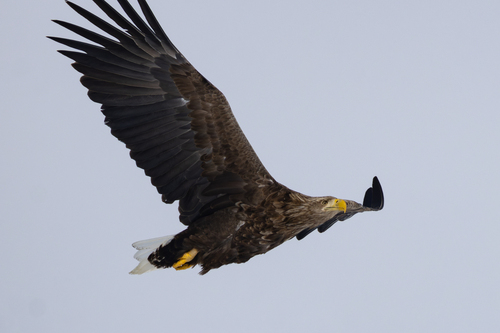
White-tailed Eagle (Haliaeetus albicilla) White-tailed Eagle
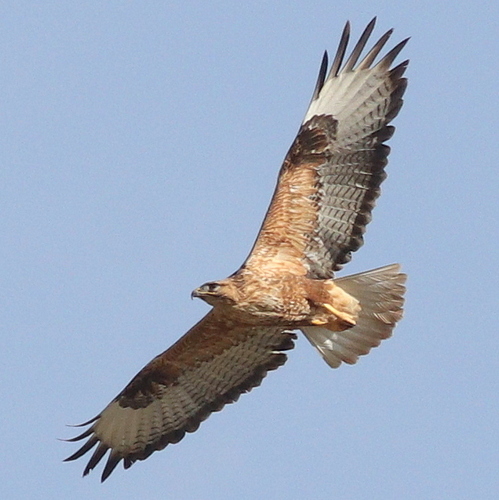
Long-legged Buzzard (Buteo rufinus) Long-legged Buzzard

Media

Loading…

In short

The most reliable field mark between White-tailed Eagle and Long-legged Buzzard, especially in flight, is the eagle's massive size and extremely broad, deeply fingered wings compared to the buzzard's more compact, five-fingered hand and slimmer profile. Juvenile White-tailed Eagles show a longer, washed-out tail with messy dark markings, while juvenile Long-legged Buzzards have a paler, banded tail with neater pale edging on the upperwing coverts. Structure is a major separator: the eagle appears vulturine and heavy, with a short, wedge-shaped tail and a long neck, while the buzzard is long-legged, long-tailed, and more buteo-like in silhouette. Both can perch upright and in open locations, but the eagle's sheer bulk and proportions are unmistakable at any range.

Identification tips

  1. Size is the most immediate clue: White-tailed Eagle is enormous, much larger than any buzzard, with a massive body and long wings. If you see a raptor that looks 'too big' for a buzzard, especially in direct comparison, it's likely an eagle (all ages).
  2. Wing shape in flight: Eagles have extremely broad wings with deep 'fingers' (usually six visible), while Long-legged Buzzards have straighter-edged wings with only five fingers and a more compact hand (all ages).
  3. Tail shape and length: Juvenile eagles have a relatively long, washed-out tail with messy dark markings, while juvenile buzzards have a paler, more neatly banded tail that is longer and more rounded in shape (juveniles/subadults).
  4. Head and neck: White-tailed Eagles show a long neck and large, high-crowned head, giving a vulturine look, especially when perched or in flight. Buzzards have a smaller head, less protruding neck, and a more typical buteo profile (all ages).
  5. Bill size: The eagle's bill is massive and high-arched, much larger relative to the head than the buzzard's, which is large for a Buteo but still much smaller (all ages).
  6. Juvenile upperwing pattern: Juvenile buzzards show neat, pale edging on the greater and median coverts, creating a more patterned upperwing, while juvenile eagles are uniformly dark above with variable blackish tips but little contrast (juveniles).
  7. Plumage contrast: Subadult eagles can show extensive white mottling on the underwing and body, but this is never as patterned or streaked as the buzzard's pale morphs. Buzzards are highly variable, but even dark morphs lack the eagle's heavy, blocky look (subadults/adults).
  8. Tail in adults: Adult White-tailed Eagles have a short, wedge-shaped, pure white tail, while adult buzzards have a longer, rounded tail that is rufous, grey, or banded depending on morph (adults).
  9. Perched posture: Both can perch upright, but the eagle often looks bulkier, with a longer neck and a more massive bill. On the ground, the eagle sits more horizontally, while the buzzard may waddle or stand more upright (all ages).
  10. Flight jizz: Eagles fly with shallow, sometimes surprisingly fast wingbeats, interspersed with long glides. Buzzards are more agile, with a protruding head and long tail, and their flight is less ponderous (all ages).
  11. Eye color: Not a strong field mark at distance, but juvenile buzzards have pale grey to yellowish eyes, while juvenile eagles have dark brown eyes (juveniles).
  12. Legs and feet: Both have yellow legs, but the eagle's feet are much more massive; this is rarely visible except at close range (all ages).
  13. Habitat context: If seen near large water bodies or coasts, eagle is more likely; in dry, open steppe or semi-desert, buzzard is more likely, but overlap does occur (all ages).
  14. Plumage variability: Buzzards are highly variable (pale, rufous, dark morphs), which can cause confusion, but the eagle's uniform dark juvenile plumage and later blotchy subadult phase are distinctive (all ages).
  15. Sex and age effects: Male juvenile eagles may be slightly darker and less speckled, but this is subtle and not reliable for field separation. Buzzard morphs are not sex-linked.

Size

White-tailed Eagle is vastly larger, with an average body mass of nearly 4.8 kg [wikidata], making it one of the heaviest raptors in Eurasia. Long-legged Buzzard is a large Buteo but is still dwarfed by the eagle, with a much lighter build and smaller overall proportions. In the field, the eagle's size is often the first thing noticed, especially when seen near other birds or objects for scale.

Plumage

Juvenile White-tailed Eagles have a washed-out greyish-cream tail with messy blackish edges and tips, sometimes faintly barred, and a uniformly dark, blackish-brown head. Their upperwing is dark brown, with variable blackish tips to the mantle and coverts, and little contrast. As they age, white mottling increases on the underwing and body, peaking in subadults, but fades again before full adulthood, when the tail becomes fully white and the head pale. Juvenile Long-legged Buzzards, regardless of morph, show a paler head and breast with more streaking, and upperwing coverts with neat, pale edging. Their tail is pale whitish, darkening outward to grey-brown, with irregular faint brown bars—never the messy, dirty look of the eagle's tail. Adults are highly variable: pale morphs have a sandy head and rufous tail, while dark morphs are all blackish-brown with a greyish, banded tail. In flight, the buzzard's underwing is less blotched and lacks the eagle's extensive white mottling in subadults. The eagle's wings are broader and more deeply fingered (six visible), while the buzzard's are straighter-edged with five fingers and a rounded tail.

Behaviour

Both species perch openly and upright on prominent vantage points, but White-tailed Eagles often appear more horizontal when on the ground and are more likely to be seen sitting with a long neck and vulturine posture. Eagles fly with shallow, sometimes surprisingly fast wingbeats interspersed with glides, and their flight is ponderous and powerful. Long-legged Buzzards can appear sluggish and often walk on the ground with a waddling gait. In flight, buzzards are more agile, with a protruding head, long tail, and less deep-fingered wings. Both may perch on artificial structures, but the eagle's bulk and posture are distinctive.

Habitat

Both species are widespread across Eurasia and can overlap in range, but White-tailed Eagles are more associated with large bodies of water, coasts, and wetlands, while Long-legged Buzzards favor open country, steppe, and semi-desert, often away from water. However, both can be seen in a variety of open habitats, so context alone is not always diagnostic.

Submit a better description

Use the same sections as the comparison. Your text is published immediately.

The most reliable field mark between White-tailed Eagle and Long-legged Buzzard, especially in flight, is the eagle's massive size and extremely broad, deeply fingered wings compared to the buzzard's more compact, five-fingered hand and slimmer profile. Juvenile White-tailed Eagles show a longer, washed-out tail with messy dark markings, while juvenile Long-legged Buzzards have a paler, banded tail with neater pale edging on the upperwing coverts. Structure is a major separator: the eagle appears vulturine and heavy, with a short, wedge-shaped tail and a long neck, while the buzzard is long-legged, long-tailed, and more buteo-like in silhouette. Both can perch upright and in open locations, but the eagle's sheer bulk and proportions are unmistakable at any range.

  1. Size is the most immediate clue: White-tailed Eagle is enormous, much larger than any buzzard, with a massive body and long wings. If you see a raptor that looks 'too big' for a buzzard, especially in direct comparison, it's likely an eagle (all ages).
  2. Wing shape in flight: Eagles have extremely broad wings with deep 'fingers' (usually six visible), while Long-legged Buzzards have straighter-edged wings with only five fingers and a more compact hand (all ages).
  3. Tail shape and length: Juvenile eagles have a relatively long, washed-out tail with messy dark markings, while juvenile buzzards have a paler, more neatly banded tail that is longer and more rounded in shape (juveniles/subadults).
  4. Head and neck: White-tailed Eagles show a long neck and large, high-crowned head, giving a vulturine look, especially when perched or in flight. Buzzards have a smaller head, less protruding neck, and a more typical buteo profile (all ages).
  5. Bill size: The eagle's bill is massive and high-arched, much larger relative to the head than the buzzard's, which is large for a Buteo but still much smaller (all ages).
  6. Juvenile upperwing pattern: Juvenile buzzards show neat, pale edging on the greater and median coverts, creating a more patterned upperwing, while juvenile eagles are uniformly dark above with variable blackish tips but little contrast (juveniles).
  7. Plumage contrast: Subadult eagles can show extensive white mottling on the underwing and body, but this is never as patterned or streaked as the buzzard's pale morphs. Buzzards are highly variable, but even dark morphs lack the eagle's heavy, blocky look (subadults/adults).
  8. Tail in adults: Adult White-tailed Eagles have a short, wedge-shaped, pure white tail, while adult buzzards have a longer, rounded tail that is rufous, grey, or banded depending on morph (adults).
  9. Perched posture: Both can perch upright, but the eagle often looks bulkier, with a longer neck and a more massive bill. On the ground, the eagle sits more horizontally, while the buzzard may waddle or stand more upright (all ages).
  10. Flight jizz: Eagles fly with shallow, sometimes surprisingly fast wingbeats, interspersed with long glides. Buzzards are more agile, with a protruding head and long tail, and their flight is less ponderous (all ages).
  11. Eye color: Not a strong field mark at distance, but juvenile buzzards have pale grey to yellowish eyes, while juvenile eagles have dark brown eyes (juveniles).
  12. Legs and feet: Both have yellow legs, but the eagle's feet are much more massive; this is rarely visible except at close range (all ages).
  13. Habitat context: If seen near large water bodies or coasts, eagle is more likely; in dry, open steppe or semi-desert, buzzard is more likely, but overlap does occur (all ages).
  14. Plumage variability: Buzzards are highly variable (pale, rufous, dark morphs), which can cause confusion, but the eagle's uniform dark juvenile plumage and later blotchy subadult phase are distinctive (all ages).
  15. Sex and age effects: Male juvenile eagles may be slightly darker and less speckled, but this is subtle and not reliable for field separation. Buzzard morphs are not sex-linked.

White-tailed Eagle is vastly larger, with an average body mass of nearly 4.8 kg [wikidata], making it one of the heaviest raptors in Eurasia. Long-legged Buzzard is a large Buteo but is still dwarfed by the eagle, with a much lighter build and smaller overall proportions. In the field, the eagle's size is often the first thing noticed, especially when seen near other birds or objects for scale.

Juvenile White-tailed Eagles have a washed-out greyish-cream tail with messy blackish edges and tips, sometimes faintly barred, and a uniformly dark, blackish-brown head. Their upperwing is dark brown, with variable blackish tips to the mantle and coverts, and little contrast. As they age, white mottling increases on the underwing and body, peaking in subadults, but fades again before full adulthood, when the tail becomes fully white and the head pale. Juvenile Long-legged Buzzards, regardless of morph, show a paler head and breast with more streaking, and upperwing coverts with neat, pale edging. Their tail is pale whitish, darkening outward to grey-brown, with irregular faint brown bars—never the messy, dirty look of the eagle's tail. Adults are highly variable: pale morphs have a sandy head and rufous tail, while dark morphs are all blackish-brown with a greyish, banded tail. In flight, the buzzard's underwing is less blotched and lacks the eagle's extensive white mottling in subadults. The eagle's wings are broader and more deeply fingered (six visible), while the buzzard's are straighter-edged with five fingers and a rounded tail.

Both species perch openly and upright on prominent vantage points, but White-tailed Eagles often appear more horizontal when on the ground and are more likely to be seen sitting with a long neck and vulturine posture. Eagles fly with shallow, sometimes surprisingly fast wingbeats interspersed with glides, and their flight is ponderous and powerful. Long-legged Buzzards can appear sluggish and often walk on the ground with a waddling gait. In flight, buzzards are more agile, with a protruding head, long tail, and less deep-fingered wings. Both may perch on artificial structures, but the eagle's bulk and posture are distinctive.

Both species are widespread across Eurasia and can overlap in range, but White-tailed Eagles are more associated with large bodies of water, coasts, and wetlands, while Long-legged Buzzards favor open country, steppe, and semi-desert, often away from water. However, both can be seen in a variety of open habitats, so context alone is not always diagnostic.

Discard your changes?

You have unsaved edits. If you leave now, those changes will be lost.

White-tailed Eagle · Long-legged Buzzard · My Tricky Birds