

Wilson's Phalarope vs Red-necked Phalarope
Phalaropus tricolor versus Phalaropus lobatus
Play a quiz with Wilson's Phalarope and Red-necked Phalarope
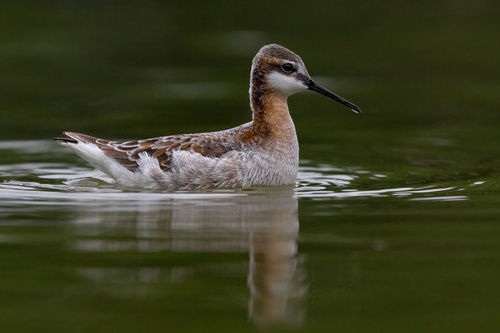 Wilson's Phalarope
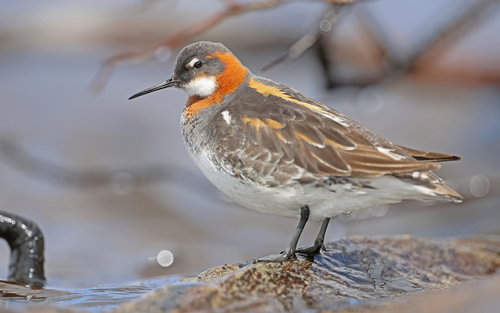 Red-necked Phalarope
In short
The most reliable field mark to separate Wilson's Phalarope from Red-necked Phalarope in the field is the presence of a bold white wing stripe on Red-necked Phalarope (all ages, especially visible in flight), which Wilson's Phalarope lacks. Juvenile and nonbreeding birds of both species can look similar, but Red-necked always shows this white wing stripe, while Wilson's appears plainer-winged. Wilson's is noticeably larger and longer-necked, with a heavier, straighter bill and a more elegant, upright stance. In breeding plumage, Wilson's females show extensive reddish on the neck and flanks, while Red-necked has a chestnut neck but a black face and white throat. Both species often spin in circles while feeding, but their preferred habitats and migration strategies differ significantly.
Identification tips
- White wing stripe in flight (all ages): Red-necked Phalarope always shows a bold white wing stripe, especially obvious in flight or when stretching wings. Wilson's Phalarope lacks this stripe and appears plain gray above.
- Size and structure: Wilson's is larger, longer-necked, and heavier-bodied than Red-necked. The difference is most obvious in direct comparison or in mixed flocks.
- Bill shape: Wilson's has a longer, heavier, and straighter bill, while Red-necked's bill is finer and more needle-like. This is subtle at distance but can help with close views.
- Breeding female plumage: Wilson's female shows a reddish neck and reddish flanks, with a gray and brown back. Red-necked female has a chestnut neck and upper breast, a black face, and a white throat—very different facial pattern.
- Breeding male plumage: Both are duller than females, but the same pattern applies: Wilson's males are brown-backed with little or no reddish, Red-necked males are paler but keep the white wing stripe and facial contrast.
- Nonbreeding/juvenile plumage: Both species are gray above and white below with a dark eyepatch, but only Red-necked has the white wing stripe. Wilson's is plainer and more uniform above.
- Face pattern: Red-necked in breeding plumage has a black face and white throat, while Wilson's is more uniform with a dark eyepatch but no sharp facial contrast.
- Feeding behavior: Both spin in circles, so this is not useful for separation.
- Habitat context: On open ocean, expect Red-necked; on inland saline lakes or prairie marshes, especially in western North America, expect Wilson's.
- Flock composition: Large, dense flocks on saline lakes in migration are likely Wilson's. Red-necked is more scattered or found in smaller groups, especially at sea.
- Sexual dimorphism: Both species have reversed sex roles, but Wilson's females are especially large and colorful compared to males; Red-necked shows less size difference.
- Jizz: Wilson's often appears more upright and elegant, with a longer neck and body. Red-necked is more compact and round-bodied.
- Vocalization: If you hear a sharp 'whit' or 'twit,' it is likely Red-necked, but silence is not diagnostic for Wilson's.
- Pitfalls: Immature and nonbreeding birds can look very similar, but always look for the white wing stripe in Red-necked. Do not rely solely on the eyepatch, as both species show it.
- When in doubt: Wait for a flight view or wing stretch to check for the wing stripe, and consider habitat and size if the plumage is ambiguous.
Size
Wilson's Phalarope is distinctly larger and heavier than Red-necked Phalarope. Wilson's averages about 23 cm in length and 59 g in mass, while Red-necked is about 18 cm and 37 g. This size difference is evident in direct comparison, with Wilson's looking longer-necked, more elongated, and generally bulkier. The bill of Wilson's is also proportionally longer and heavier. In mixed flocks, Wilson's stands out as the largest phalarope.
Plumage
- Juvenile and nonbreeding plumage (fall/winter, all ages): Red-necked Phalarope always shows a strong white wing stripe in flight, which is absent in Wilson's. Both species have a dark eyepatch, but Red-necked's is set off by a paler face and the wing stripe, while Wilson's is more uniformly gray above and lacks the wing stripe, appearing plainer.
- Breeding plumage: Female Wilson's Phalarope is mostly gray and brown above with white underparts, a reddish neck, and reddish flanks. Female Red-necked Phalarope is dark gray above with a chestnut neck and upper breast, a black face, and a white throat. Breeding males of both species are duller versions of the females, but the color patterns remain: Wilson's males have less or no reddish, Red-necked males are less intensely marked but retain the wing stripe and face pattern.
- Flight views: The white wing stripe of Red-necked is the key field mark in all plumages and ages. Wilson's shows plain gray upperwings without a contrasting stripe.
Behaviour
Both species are famous for spinning in tight circles on the water to stir up food, so this behavior is not diagnostic. However, Wilson's is more likely to be seen feeding in shallow, saline inland lakes, especially during migration, often in large, dense flocks. Red-necked Phalarope is more often found on open water, including at sea during migration and winter, and tends to forage further from shore. Both species feed by picking at the water surface, but Red-necked often reaches into the center of its vortex, while Wilson's tends to pick at the edges.
Habitat
Wilson's Phalarope breeds in prairie wetlands of western North America and migrates to inland salt lakes in South America. Red-necked Phalarope breeds in Arctic tundra regions of North America and Eurasia, and winters at sea on tropical oceans. During migration, Wilson's is found on saline lakes and marshes, while Red-necked is more likely on open water, including coastal and pelagic zones. If you see a phalarope far from land or on the open ocean, it is almost certainly Red-necked; if on a prairie lake or marsh, especially in the interior, Wilson's is more likely.
Voice
Red-necked Phalarope has a sharp call described as a 'whit' or 'twit.' There is no distinctive vocalization noted for Wilson's Phalarope in the provided sources, so voice is not a reliable separation feature in this context.