

Bindenfregattvogel vs Weißbauch-Fregattvogel
Fregata minor gegen Fregata andrewsi
Ein Quiz mit Bindenfregattvogel und Weißbauch-Fregattvogel spielen
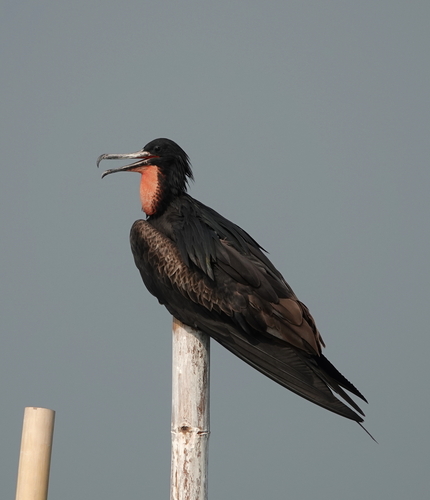
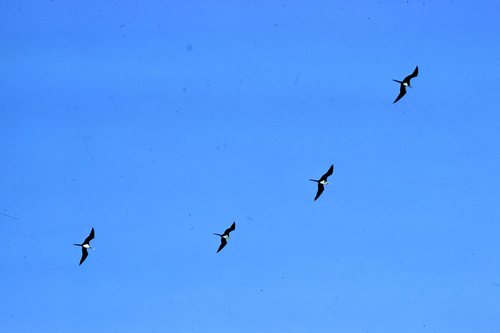 Bindenfregattvogel
 Weißbauch-Fregattvogel
Kurz gesagt
The most reliable field mark between Great Frigatebird and Christmas Island Frigatebird is the male's underpart pattern: adult male Christmas Island Frigatebirds have a bold white belly patch, while male Great Frigatebirds are entirely black below. Females of both species show extensive white on the breast and belly, but Christmas Island Frigatebird females have more white extending further down the belly. Juvenile and immature birds are best separated by the extent and distribution of white on the underparts and underwing, with Christmas Island Frigatebird showing more extensive white. Both species are large, long-winged, and deeply forked-tailed, but Christmas Island Frigatebird is slightly heavier and restricted to Christmas Island, while Great Frigatebird is widespread across tropical oceans.
Bestimmungstipps
- Adult male underpart pattern: Christmas Island Frigatebird males have a bold white belly patch; Great Frigatebird males are entirely black below. This is the single most reliable field mark for adult males.
- Female underpart pattern: Both species' females have white on the throat and breast, but Christmas Island Frigatebird females have white extending further down the belly, while Great Frigatebird females have more restricted white (mainly throat and breast).
- Juvenile/immature underparts: Immature Christmas Island Frigatebirds show more extensive white on the belly and longer white spurs into the underwing, while Great Frigatebird immatures have a rust-tinged white face, head, and throat, with less white on the belly.
- Underwing pattern in flight (immatures/females): Christmas Island Frigatebird shows longer, more prominent white spurs into the underwing; Great Frigatebird's white is less extensive and more confined.
- Head and face (juveniles): Great Frigatebird juveniles have a distinctive rust-tinged white face and throat; Christmas Island Frigatebird juveniles lack this rusty tinge.
- Gular sac (males): Both have a red gular sac, but this is only visible during display and not useful for most field encounters.
- Size and structure: Christmas Island Frigatebird is slightly heavier and may look bulkier, but size overlap is considerable and not reliable unless birds are side by side.
- Location: Christmas Island Frigatebird is almost exclusively found on or near Christmas Island; elsewhere, Great Frigatebird is vastly more likely.
- Tail and wing shape: Both species have long, narrow wings and a deeply forked tail; these are not useful for separating the two.
- Iridescence: Male Great Frigatebird may show green iridescence on scapulars in good light, lacking in Christmas Island Frigatebird.
- Behavior: Both species forage by snatching prey in flight and may harass other seabirds; Christmas Island Frigatebird is especially noted for kleptoparasitism, but this is not a reliable field mark.
- Plumage overlap: Be cautious with females and immatures, as both can show extensive white below; focus on the extent and shape of the white belly and underwing spurs.
- Pitfalls: Immature and female Great Frigatebirds can be confused with Christmas Island Frigatebird if only the white underparts are seen; always try to assess the shape and extent of white, and consider location.
- Not diagnostic: Bill shape, tail length, and flight style are similar and not useful for separation.
- Season: Both species have similar breeding and non-breeding plumages; age and sex differences are more important than season for identification.
Größe
Both species are very large frigatebirds with similar wingspans (205–230 cm), but Christmas Island Frigatebird is slightly heavier (average adult mass ~1,475–1,550 g) than Great Frigatebird (male 1,000–1,450 g; female 1,215–1,590 g). In length, Great Frigatebird ranges from 85–105 cm, while Christmas Island Frigatebird is 89–100 cm. In the field, size difference is subtle and not reliable for separation unless seen together, but Christmas Island Frigatebird may appear slightly bulkier.
Gefieder
Juvenile and immature birds of both species are mostly black with white on the head and underparts, but Christmas Island Frigatebird immatures show more extensive white on the belly and longer white spurs into the underwing, while Great Frigatebird juveniles have a rust-tinged white face, head, and throat with less white on the belly. Adult males are best separated by the underpart pattern: Christmas Island Frigatebird males have a conspicuous white belly patch, while Great Frigatebird males are entirely black below (with possible green iridescence on the scapulars). Females of both species have white on the breast and belly, but Christmas Island Frigatebird females have more extensive white reaching further down the belly, whereas Great Frigatebird females have a white throat and breast but less white on the belly. Both species have a red gular sac in males, but this is not a useful field mark outside of display. In flight, the white underwing spurs of Christmas Island Frigatebird (all ages except adult males) are longer and more prominent than in Great Frigatebird.
Verhalten
Both species are highly aerial, rarely landing on the water, and forage by snatching prey from the ocean surface or harassing other seabirds. Christmas Island Frigatebird is known for kleptoparasitism (stealing food from other birds), while Great Frigatebird females may hunt seabird chicks at colonies. Both display elaborate courtship with males inflating a red gular sac, but this is only seen at breeding colonies. Flight style is similar: buoyant, with long, narrow wings and deep forked tail.
Lebensraum
Great Frigatebird is widespread across tropical oceans, breeding on islands in the Pacific, Indian, and South Atlantic Oceans. Christmas Island Frigatebird is endemic to Christmas Island in the Indian Ocean and breeds only there. Away from breeding, Christmas Island Frigatebird may wander but is rarely seen far from Christmas Island, making location a strong clue. Great Frigatebird is much more likely outside Christmas Island.
Bindenfregattvogel · Weißbauch-Fregattvogel · Meine schwierigen Vögel