

Rötelspecht vs Tukkispecht
Micropternus brachyurus gegen Meiglyptes tukki
Ein Quiz mit Rötelspecht und Tukkispecht spielen
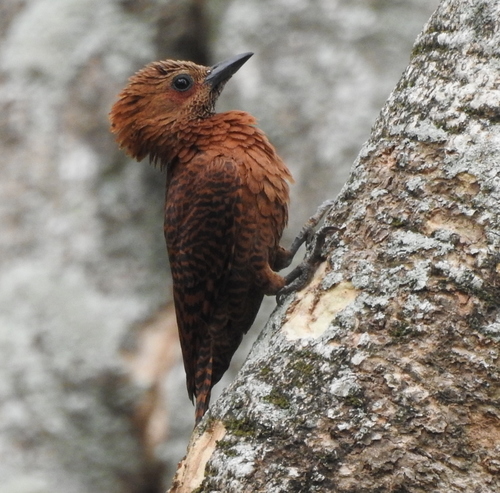 Rötelspecht
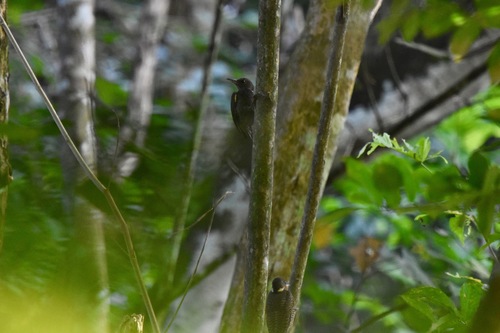 Tukkispecht
Kurz gesagt
The most reliable field mark between Rufous Woodpecker and Buff-necked Woodpecker is the overall plumage tone and head/neck pattern: Rufous Woodpecker is a uniform dark rufous-brown with a paler head and no pale neck stripe, while Buff-necked Woodpecker is dark brown with a contrasting dirty-cream stripe on the neck. In the field, Rufous Woodpecker looks more uniform and 'sooty' with fine black barring, whereas Buff-necked Woodpecker shows a distinct pale neck stripe and paler wing barring. Bill shape and tail length also differ: Rufous is short-billed and short-tailed, Buff-necked has a longer, more pointed bill and a longer tail. Sex and age differences are subtle, but juvenile Rufous can show some throat streaking. Both species can be found in similar lowland forest habitats in Southeast Asia, so careful attention to these structural and plumage details is essential.
Bestimmungstipps
- Pale neck stripe (Buff-necked only): Look for a dirty-cream or pale stripe on the side of the neck in Buff-necked Woodpecker; Rufous Woodpecker never shows this, regardless of age or sex.
- Overall color tone: Rufous Woodpecker is a uniform dark rufous-brown with a paler head and fine black barring; Buff-necked is dark brown, not rufous, and the contrast with the pale neck stripe is striking.
- Wing and tail barring: Both species have barred wings and tails, but Rufous's barring is finer and more uniform, while Buff-necked shows paler, more contrasting barring.
- Head and face pattern: Rufous Woodpecker has an unmarked neck, ear coverts, and lore; Buff-necked has the pale neck stripe and a generally more patterned appearance around the head/neck.
- Bill shape: Rufous has a short, slightly curved black bill; Buff-necked's bill is longer, more pointed, and also curved along the culmen. This is best seen in profile or close views.
- Tail length: Buff-necked Woodpecker has a noticeably longer tail than Rufous, which is short-tailed and compact. This difference is subtle but can be seen when perched or in flight.
- Crest: Rufous Woodpecker has a weak, erectile crest; Buff-necked lacks a nuchal crest altogether. The crest is rarely obvious but can help in close views.
- Sex differences: Male Rufous Woodpecker may show red-tipped feathers under the eye and on the malar region; females and young lack these. Buff-necked does not show this feature.
- Juvenile throat streaking (Rufous only): Juvenile Rufous Woodpecker may show some streaking on the throat, but this is subtle and not always present. Buff-necked juveniles are not described, but the pale neck stripe should be visible from a young age.
- 'Soiled' appearance (Rufous): Rufous Woodpecker may look dirty or sticky, especially when nesting, due to ant secretions. This is unique to Rufous and can be a clue in close views.
- Foraging behavior: Rufous is often seen on or near arboreal ant nests, sometimes with ants or debris on its plumage. Buff-necked is less closely tied to ants.
- Habitat tolerance: Rufous may be found in more disturbed or open habitats, including plantations, while Buff-necked is more restricted to intact forest.
- Voice: If heard, Rufous's sharp nasal calls and distinctive drumming can confirm the ID; Buff-necked's voice is not described here.
- Flight and jizz: Rufous appears compact and short-tailed in flight; Buff-necked looks longer-tailed and more slender.
- Pitfalls: In poor light, Buff-necked's pale neck stripe can be missed, making it look more uniform and potentially confusing it with Rufous. Always try to confirm the presence or absence of the neck stripe and check for the bill and tail proportions.
Größe
Rufous Woodpecker is about 25 cm in length and appears medium-sized for a woodpecker, with a short tail and compact build. Buff-necked Woodpecker is slightly smaller and lighter (mean mass 53g, wing length 101mm), but has a noticeably longer tail and a more slender, pointed bill. In the field, the longer tail and bill of Buff-necked can make it look more elongated and less compact than Rufous. These differences are subtle and best used in combination with plumage and head pattern.
Gefieder
- Juvenile/immature birds: Juvenile Rufous Woodpecker may show some streaking on the throat (sometimes also in some subspecies as adults), but otherwise resembles adults in overall dark rufous-brown coloration with black barring on wings and tail. Juvenile Buff-necked Woodpecker is not specifically described, but the key pale neck stripe is expected to be present from a young age.
- Adults: Rufous Woodpecker is overall dark rufous-brown, with black bars on wings and tail, a paler head, and unmarked neck and ear coverts. Males have subtle red feather tips on the face, absent in females and young. Buff-necked Woodpecker is dark brown with pale barring on the wings and a distinctive dirty-cream stripe on the neck. It lacks a nuchal crest (unlike some relatives), and the bill is longer and more pointed. The pale neck stripe is the most obvious field mark in all plumages. Both species have some degree of wing barring, but the contrast and pattern differ: Rufous's barring is finer and more uniform, Buff-necked's is paler and more contrasting.
Verhalten
Rufous Woodpecker is often seen foraging in pairs, especially on arboreal ant nests, fallen logs, or termite mounds, and is famous for nesting inside ant nests. Buff-necked Woodpecker's foraging behavior is less detailed in the notes, but it is also a forest woodpecker likely to forage on trunks and branches. Rufous may appear more 'soiled' or disheveled due to its association with ant nests, sometimes with sticky or dirty-looking plumage. Both species are likely to be seen in the mid to lower levels of the forest, but Rufous's close association with ant nests is distinctive.
Lebensraum
Both species occur in lowland and hill forests of Southeast Asia, including scrub, evergreen, and deciduous forests. Rufous Woodpecker is notably adaptable, persisting even in disturbed habitats such as oil palm plantations, and ranges up to 3000 m in some areas. Buff-necked Woodpecker is also a forest species but is not described as tolerant of such a wide range of habitats. In areas where both occur, habitat alone is not a reliable separator, but Rufous may be found in more open or disturbed sites.
Stimme
Rufous Woodpecker has a sharp, nasal three-note call (keenk-keenk-keenk), a long wicka, and a series of wick-wick notes, plus a distinctive drumming that starts rapidly and slows down. No vocalizations are described for Buff-necked Woodpecker in the notes, so voice is not a reliable separator unless Rufous's calls or drumming are recognized.