
Weißscheitel-Scherenschwanz vs Borneoscherenschwanz
Enicurus leschenaulti gegen Enicurus borneensis
Ein Quiz mit Weißscheitel-Scherenschwanz und Borneoscherenschwanz spielen
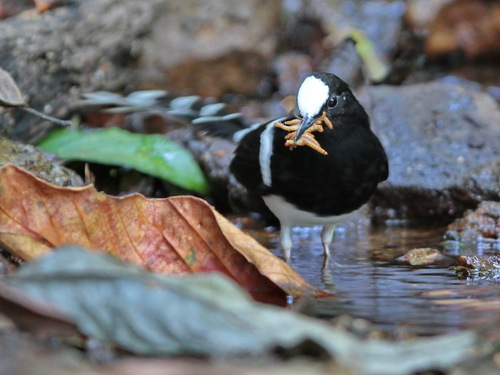 Weißscheitel-Scherenschwanz
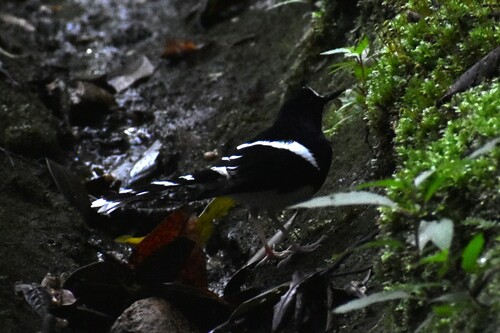 Borneoscherenschwanz
Kurz gesagt
The most reliable field mark between White-crowned Forktail and Bornean Forktail is the extent of white on the head: White-crowned Forktail shows a prominent white crown patch, while Bornean Forktail has a reduced white forehead that does not extend over the crown. Tail pattern is also diagnostic—White-crowned Forktail has five white tail patches, Bornean Forktail has four. Both are striking black-and-white streamside birds with long, deeply forked tails, but White-crowned Forktail is larger and occurs in lowland to montane forests across a wide Asian range, while Bornean Forktail is endemic to Borneo’s montane streams. Juvenile plumages are not described in detail for Bornean Forktail, but White-crowned Forktail juveniles lack the white crown and are browner overall, which may cause confusion.
Bestimmungstipps
- White on Head (Adults): White-crowned Forktail has a bold white crown and forehead patch, while Bornean Forktail’s white is restricted to the forehead and does not extend over the crown. This is the most consistent mark in adults.
- Tail Patch Count: Count the white patches on the tail—White-crowned Forktail has five, Bornean Forktail has four. This is best seen when the tail is spread or in flight.
- Tail Length and Structure: Both have long, deeply forked tails, but Bornean Forktail’s tail is proportionally longer relative to its smaller body. White-crowned Forktail is overall larger and bulkier.
- Juvenile Pitfall: Juvenile White-crowned Forktail lacks the white crown and is browner above and on the flanks, potentially resembling Bornean Forktail if only head pattern is checked. However, tail patch count and overall size still help separate them.
- Mantle Color: Both have a solid black mantle, so this is not a separation point between these two (but useful against other forktails).
- Wing Pattern: White-crowned Forktail has a strong white band across the greater coverts; Bornean Forktail is not described in detail, but likely similar—do not rely on this alone.
- Bill and Feet: Both have black bills and pinkish feet; these are not helpful for separation.
- Voice: Calls differ subtly, but unless you are familiar with both, do not rely on voice for separation.
- Habitat and Range: If you are on Borneo in montane forest above the lowlands, Bornean Forktail is expected. In lowland forest or outside Borneo, it is almost certainly White-crowned Forktail.
- Subspecies Variation: Some White-crowned Forktail subspecies (e.g., frontalis) have a smaller white crown patch, which may approach Bornean Forktail in appearance—use tail patch count and size for confirmation.
- Context: White-crowned Forktail may be found in a wider variety of wet habitats, including animal wallows and ditches, while Bornean Forktail is tied to pristine montane streams.
- Flight Views: In flight, focus on tail patch count and extent of white on the head; these are visible even at a distance.
- Perched Views: Look for the white crown (White-crowned Forktail) versus just a white forehead (Bornean Forktail) and overall bulk.
- Seasonality: White-crowned Forktail may shift elevation seasonally and is more likely to be encountered in winter in some parts of its range; Bornean Forktail is resident in montane Borneo.
- Common Pitfall: Immature White-crowned Forktail can be misidentified as Bornean Forktail due to lack of white crown—use size, habitat, and especially tail patch count to avoid this mistake.
Größe
White-crowned Forktail is the largest forktail, measuring 25–28 cm in length and averaging 34 g in mass ([wikipedia], [wikidata]). Bornean Forktail is described as smaller, but precise measurements are not provided; however, it is noted to have a longer tail relative to body size. In direct comparison, White-crowned Forktail will appear bulkier and longer overall, especially when perched or in flight.
Gefieder
- Juveniles: White-crowned Forktail juveniles are brownish-black above, with brown flanks and mottled bellies, and lack the white crown patch. Bornean Forktail juvenile plumage is not described, but absence of the white crown in immatures may cause confusion.
- Adults: White-crowned Forktail adults have a bold white crown and forehead patch, sharply contrasting with a black face and throat, and a completely black mantle. The tail is long, deeply forked, with five white patches (created by white tips on the tail feathers). The wings are mostly black with a strong white band across the greater coverts. Bornean Forktail adults have a reduced white forehead (not extending onto the crown), and only four white tail patches. Both species have white rumps and bellies, but the head pattern and tail patch count are the best separation points.
Verhalten
Both species frequent fast-flowing streams and rivers, often seen bobbing their tails and foraging along the water’s edge. There is no strong behavioral difference noted in the sources, but White-crowned Forktail may be found at a wider range of elevations and sometimes in denser lowland vegetation, while Bornean Forktail is restricted to montane forest streams.
Lebensraum
White-crowned Forktail occupies a broad range of subtropical and tropical moist lowland and montane forests, typically along rivers, waterfalls, and streams, but can also be found in swampy or slow-moving water in winter. Its range spans much of South and Southeast Asia. Bornean Forktail is endemic to Borneo and strictly tied to montane primary forest streams, replacing White-crowned Forktail at higher elevations on the island. If seen in lowland forest or outside Borneo, it is almost certainly not Bornean Forktail.
Stimme
White-crowned Forktail gives high-pitched, ringing whistles ('tseee, tseee' or 'zweeet'), with harsher alarm calls ('scree chit chit') and a complex whistled song in display. Bornean Forktail has different calls, but specifics are not detailed in the sources. Subtle differences in call may be apparent to experienced birders, but are not the most reliable field separation.
Weißscheitel-Scherenschwanz · Borneoscherenschwanz · Meine schwierigen Vögel