

Motmot

Woestijnoehoe vs Maghrebbosuil

Bubo ascalaphus versus Strix mauritanica

Speel een quiz met Woestijnoehoe en Maghrebbosuil
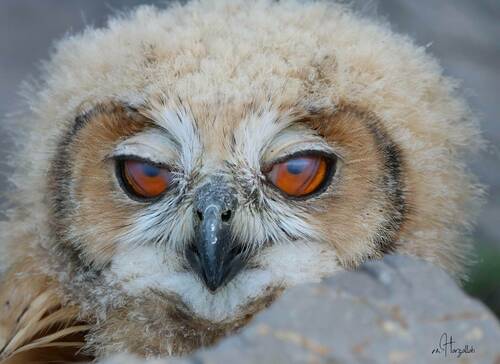
Woestijnoehoe (Bubo ascalaphus) Woestijnoehoe
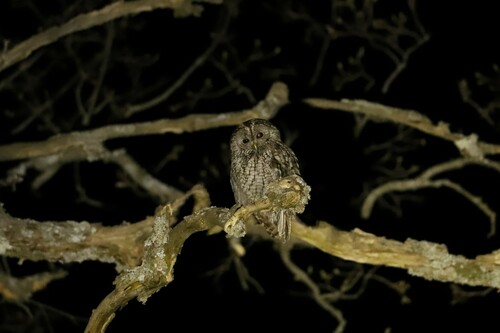
Maghrebbosuil (Strix mauritanica) Maghrebbosuil

Media

Laden…

Kort gezegd

The most reliable field mark to separate Pharaoh Eagle Owl from Maghreb Owl is the presence of prominent ear tufts and large orange-yellow eyes in the eagle owl, versus the Maghreb Owl's rounded, ear-tuftless head and dark brown eyes. In flight or perched, Pharaoh Eagle Owl shows a tawny, heavily blotched upperpart pattern and pale underparts with bold streaks, while Maghreb Owl (a form of Tawny Owl) is more uniformly brown or grey above and streaked below, with a plain facial disc. Size and structure also help: Pharaoh Eagle Owl is bulkier and longer, but beware overlap with large female Maghreb Owls. Immature-specific wing patterns are not described for either species, so focus on head shape and facial features for all ages.

Herkenningstips

  1. Ear tufts: Pharaoh Eagle Owl always shows small but visible ear tufts; Maghreb Owl never has ear tufts. This is the fastest and most reliable mark at any distance or age.
  2. Eye color: Pharaoh Eagle Owl has striking orange-yellow eyes, easily seen in good light; Maghreb Owl's eyes are dark brown and less conspicuous.
  3. Facial disc: The eagle owl's face is strongly outlined by a dark rim, giving a bold disc appearance; Maghreb Owl's facial disc is plain and less sharply defined.
  4. Head shape: Pharaoh Eagle Owl's head appears angular due to ear tufts; Maghreb Owl's head is smoothly rounded and compact.
  5. Upperparts pattern: Look for dense black and creamy-white blotches and streaks on the tawny upperparts of the eagle owl; Maghreb Owl is more uniform above, either rufous or greyish brown depending on morph, with less contrast.
  6. Underparts: Both species have pale underparts with streaking, but eagle owl's streaks are bold and mostly on the upper breast, with fine reddish-brown vermiculations lower down; Maghreb Owl has finer, browner streaks more evenly spread.
  7. Bill color: Pharaoh Eagle Owl has a robust, black, hooked bill; Maghreb Owl's bill is less prominent and not described as black.
  8. Size and bulk: Eagle owl is generally larger and bulkier, but beware overlap with large female Maghreb Owls; use in combination with other marks.
  9. Perched posture: Pharaoh Eagle Owl often sits more upright and appears more imposing; Maghreb Owl is more squat and rounded.
  10. Flight jizz: Maghreb Owl flies with long, slow glides and heavy takeoff; eagle owl is more powerful and direct, but flight style is less diagnostic than head and face features.
  11. Habitat: Pharaoh Eagle Owl is found in open, rocky, or desert habitats; Maghreb Owl is a woodland specialist. Context can help but is not definitive.
  12. Sexual dimorphism: Only Maghreb Owl shows strong sexual size dimorphism; if you see a pair and one is much larger, it's likely Maghreb Owl.
  13. Plumage morphs: Maghreb Owl can be rufous or greyish brown above, but both morphs lack ear tufts and have dark eyes. Eagle owl is always tawny and blotched.
  14. Juvenile/immature marks: No distinctive age-specific upperwing or flight marks are described for either species, so rely on head and face features for all ages.
  15. Common pitfalls: In poor light, ear tufts may be hard to see; always check eye color and facial disc shape as backup. Large female Maghreb Owls can appear quite big, so do not rely on size alone.

Grootte

Pharaoh Eagle Owl is larger overall, with a body length of 46–50 cm, compared to Maghreb Owl's 37–46 cm. The eagle owl is also more robust and longer-winged, though the largest female Maghreb Owls can approach the smallest eagle owls in length. Maghreb Owl is sexually dimorphic, with females being up to 25% heavier and 5% longer than males, so size alone is not always diagnostic, but the eagle owl generally appears bulkier and more imposing.

Verenkleed

No age-specific upperwing or flight pattern marks are described for either species, so focus on overall plumage and head features. Pharaoh Eagle Owl of all ages shows a tawny ground color with dense black and creamy-white streaks and blotches above, and pale creamy-white underparts with bold black streaks on the upper breast and fine reddish-brown vermiculations on the belly. Its face is strongly defined by a dark rim and features large orange-yellow eyes and small but distinct ear tufts. Maghreb Owl (as a Tawny Owl form) is more uniform, with either rufous brown or greyish brown upperparts (depending on morph), and whitish underparts streaked with brown. Its facial disc is plain, and the eyes are dark brown. The head is smoothly rounded, lacking ear tufts entirely. Both species have pale underparts with streaking, but the eagle owl's streaks are bolder and more confined to the upper breast, while the Maghreb Owl's streaking is finer and more evenly distributed.

Gedrag

In flight, Maghreb Owl is described as flying with long glides on rounded wings, with a heavy and slow takeoff. Pharaoh Eagle Owl, while not described in detail, is generally more powerful and direct in flight, befitting its larger size and eagle-owl build. Perched, the eagle owl's upright stance and ear tufts are distinctive, while Maghreb Owl appears more compact and rounded. Both are nocturnal and secretive, but the eagle owl may be seen in more open or rocky habitats, while Maghreb Owl prefers woodland.

Habitat

Pharaoh Eagle Owl is native to arid and semi-arid regions of the Middle East and North Africa, often found in rocky deserts, cliffs, and open landscapes. Maghreb Owl, as a form of Tawny Owl, is typically associated with woodland habitats, including forests and groves. Habitat context can help: an owl seen in open, rocky terrain is more likely to be Pharaoh Eagle Owl, while one in dense woodland is likely Maghreb Owl.

Stuur een betere beschrijving

Gebruik dezelfde onderdelen als de vergelijking. Je tekst staat meteen live.

The most reliable field mark to separate Pharaoh Eagle Owl from Maghreb Owl is the presence of prominent ear tufts and large orange-yellow eyes in the eagle owl, versus the Maghreb Owl's rounded, ear-tuftless head and dark brown eyes. In flight or perched, Pharaoh Eagle Owl shows a tawny, heavily blotched upperpart pattern and pale underparts with bold streaks, while Maghreb Owl (a form of Tawny Owl) is more uniformly brown or grey above and streaked below, with a plain facial disc. Size and structure also help: Pharaoh Eagle Owl is bulkier and longer, but beware overlap with large female Maghreb Owls. Immature-specific wing patterns are not described for either species, so focus on head shape and facial features for all ages.

  1. Ear tufts: Pharaoh Eagle Owl always shows small but visible ear tufts; Maghreb Owl never has ear tufts. This is the fastest and most reliable mark at any distance or age.
  2. Eye color: Pharaoh Eagle Owl has striking orange-yellow eyes, easily seen in good light; Maghreb Owl's eyes are dark brown and less conspicuous.
  3. Facial disc: The eagle owl's face is strongly outlined by a dark rim, giving a bold disc appearance; Maghreb Owl's facial disc is plain and less sharply defined.
  4. Head shape: Pharaoh Eagle Owl's head appears angular due to ear tufts; Maghreb Owl's head is smoothly rounded and compact.
  5. Upperparts pattern: Look for dense black and creamy-white blotches and streaks on the tawny upperparts of the eagle owl; Maghreb Owl is more uniform above, either rufous or greyish brown depending on morph, with less contrast.
  6. Underparts: Both species have pale underparts with streaking, but eagle owl's streaks are bold and mostly on the upper breast, with fine reddish-brown vermiculations lower down; Maghreb Owl has finer, browner streaks more evenly spread.
  7. Bill color: Pharaoh Eagle Owl has a robust, black, hooked bill; Maghreb Owl's bill is less prominent and not described as black.
  8. Size and bulk: Eagle owl is generally larger and bulkier, but beware overlap with large female Maghreb Owls; use in combination with other marks.
  9. Perched posture: Pharaoh Eagle Owl often sits more upright and appears more imposing; Maghreb Owl is more squat and rounded.
  10. Flight jizz: Maghreb Owl flies with long, slow glides and heavy takeoff; eagle owl is more powerful and direct, but flight style is less diagnostic than head and face features.
  11. Habitat: Pharaoh Eagle Owl is found in open, rocky, or desert habitats; Maghreb Owl is a woodland specialist. Context can help but is not definitive.
  12. Sexual dimorphism: Only Maghreb Owl shows strong sexual size dimorphism; if you see a pair and one is much larger, it's likely Maghreb Owl.
  13. Plumage morphs: Maghreb Owl can be rufous or greyish brown above, but both morphs lack ear tufts and have dark eyes. Eagle owl is always tawny and blotched.
  14. Juvenile/immature marks: No distinctive age-specific upperwing or flight marks are described for either species, so rely on head and face features for all ages.
  15. Common pitfalls: In poor light, ear tufts may be hard to see; always check eye color and facial disc shape as backup. Large female Maghreb Owls can appear quite big, so do not rely on size alone.

Pharaoh Eagle Owl is larger overall, with a body length of 46–50 cm, compared to Maghreb Owl's 37–46 cm. The eagle owl is also more robust and longer-winged, though the largest female Maghreb Owls can approach the smallest eagle owls in length. Maghreb Owl is sexually dimorphic, with females being up to 25% heavier and 5% longer than males, so size alone is not always diagnostic, but the eagle owl generally appears bulkier and more imposing.

No age-specific upperwing or flight pattern marks are described for either species, so focus on overall plumage and head features. Pharaoh Eagle Owl of all ages shows a tawny ground color with dense black and creamy-white streaks and blotches above, and pale creamy-white underparts with bold black streaks on the upper breast and fine reddish-brown vermiculations on the belly. Its face is strongly defined by a dark rim and features large orange-yellow eyes and small but distinct ear tufts. Maghreb Owl (as a Tawny Owl form) is more uniform, with either rufous brown or greyish brown upperparts (depending on morph), and whitish underparts streaked with brown. Its facial disc is plain, and the eyes are dark brown. The head is smoothly rounded, lacking ear tufts entirely. Both species have pale underparts with streaking, but the eagle owl's streaks are bolder and more confined to the upper breast, while the Maghreb Owl's streaking is finer and more evenly distributed.

In flight, Maghreb Owl is described as flying with long glides on rounded wings, with a heavy and slow takeoff. Pharaoh Eagle Owl, while not described in detail, is generally more powerful and direct in flight, befitting its larger size and eagle-owl build. Perched, the eagle owl's upright stance and ear tufts are distinctive, while Maghreb Owl appears more compact and rounded. Both are nocturnal and secretive, but the eagle owl may be seen in more open or rocky habitats, while Maghreb Owl prefers woodland.

Pharaoh Eagle Owl is native to arid and semi-arid regions of the Middle East and North Africa, often found in rocky deserts, cliffs, and open landscapes. Maghreb Owl, as a form of Tawny Owl, is typically associated with woodland habitats, including forests and groves. Habitat context can help: an owl seen in open, rocky terrain is more likely to be Pharaoh Eagle Owl, while one in dense woodland is likely Maghreb Owl.

Wijzigingen weggooien?

Je hebt niet-opgeslagen wijzigingen. Als je nu weggaat, gaan die verloren.

Woestijnoehoe · Maghrebbosuil · Mijn lastige vogels