

Bandstaartslangenarend vs Vleermuiswouw
Circaetus cinerascens versus Macheiramphus alcinus
Speel een quiz met Bandstaartslangenarend en Vleermuiswouw
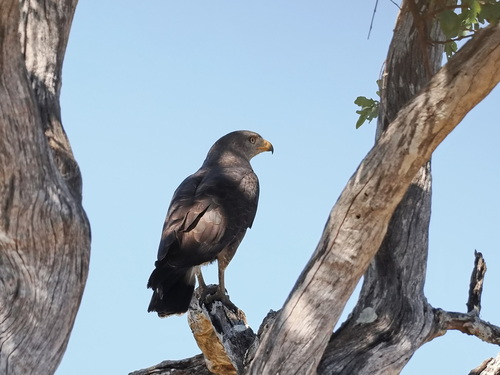 Bandstaartslangenarend
 Vleermuiswouw
Kort gezegd
The most reliable field mark between Western Banded Snake-Eagle and Bat Hawk is overall structure and flight silhouette: Bat Hawk is slender with long, pointed wings and a falcon-like jizz, while Western Banded Snake-Eagle is bulkier with a short tail and broad wings. Juvenile plumages can be confusing, but Bat Hawk juveniles are more mottled and show more white than the paler, white-edged juvenile Snake-Eagle. In perched views, Bat Hawk's white throat patch and facial streaks are distinctive, while Snake-Eagle shows a large head and dark-streaked breast. In flight, Bat Hawk's long wings and rapid, agile flight at dusk are unlike the heavier, slower wingbeats of Snake-Eagle. Habitat and timing can help: Bat Hawk is almost always seen hunting at dusk near bat roosts, while Snake-Eagle is a diurnal raptor of woodland and forest edge.
Herkenningstips
- Flight silhouette: Bat Hawk is slender with long, pointed wings and a falcon-like shape in flight; Snake-Eagle is bulkier, with broader wings and a short tail. This is most obvious in flight, especially against the evening sky.
- Perched structure: Snake-Eagle has a large, blocky head and short tail, giving it a thick-necked, heavy look. Bat Hawk is more slender and upright, with a smaller head relative to body.
- Juvenile plumage: Juvenile Snake-Eagles are paler brown above with white-edged feathers and streaked head/breast; Bat Hawk juveniles are more mottled brown and show more extensive white, especially on the underparts, but lack the streaked breast.
- Adult underparts: Adult Snake-Eagle has white underparts with pale brown streaks, especially on the belly and thighs. Bat Hawk adults are dark below except for a sharp white throat patch and chest, with the rest of the underparts dark brown or black.
- Facial pattern: Bat Hawk has a distinctive white patch on the throat and chest, plus a white streak above and below each eye, giving a masked look. Snake-Eagle lacks these facial marks and is more uniformly colored on the face, with dark streaking.
- Eye, leg, and bare part color: Snake-Eagle has yellow eyes, ears, and legs; Bat Hawk's bare part coloration is not described as diagnostic in the notes.
- Crested chest: Snake-Eagle is described as having a 'crested chest,' which may refer to the feathering or shape, but this is subtle and best used in combination with other marks.
- Behavior at dusk: Bat Hawk is almost exclusively seen hunting at dusk, flying rapidly near bat roosts. If you see a raptor at dusk chasing bats, it is almost certainly a Bat Hawk. Snake-Eagle is diurnal and rarely active at dusk.
- Feeding behavior: Bat Hawk catches and swallows bats whole in flight, often with rapid, repeated captures. Snake-Eagle hunts snakes and other prey, usually from a perch or slow soar.
- Habitat context: Bat Hawk is often near open areas adjacent to bat colonies or cave entrances; Snake-Eagle is more often in woodland or forest edge during the day.
- Wingbeat and flight style: Bat Hawk is agile, fast, and maneuverable in flight, resembling a large falcon. Snake-Eagle has slower, heavier wingbeats and is less agile.
- Size impression: Snake-Eagle appears larger and more robust, especially when perched; Bat Hawk is more slender and elongated.
- Confusion risk: Subadult Snake-Eagles may appear all dark below, which could overlap with Bat Hawk, but structure and facial pattern remain reliable. Juvenile Bat Hawks are more white below, but lack the streaked breast of juvenile Snake-Eagle.
- Voice: No diagnostic vocalizations are described in the notes; do not rely on voice for separation.
- Season and timing: If you see a raptor hunting bats at dusk, especially in a swarm, it is almost always Bat Hawk. Daytime sightings in woodland or forest edge are more likely Snake-Eagle.
Grootte
Western Banded Snake-Eagle is larger and bulkier, measuring 50–58 cm in length with a wingspan of 120–134 cm [wikipedia]. Bat Hawk is slightly smaller and much more slender, at about 45 cm long and weighing 600–650 grams [wikipedia]. The Bat Hawk's wings are proportionally longer and narrower, giving it a falcon-like appearance, while the Snake-Eagle is more compact with broader wings and a noticeably short tail.
Verenkleed
- Juveniles: Juvenile Snake-Eagles are paler and browner above than adults, with white-edged feathers and dark streaking on the head, neck, and breast. Their underparts are white with pale brown streaks, especially on the belly and thighs. Juvenile Bat Hawks are mottled brown and show more white overall than adults, especially in the plumage, but lack the streaked breast of the Snake-Eagle.
- Adults: Adult Snake-Eagles are grey-brown above with a large head, short tail, and dark-streaked head, neck, and breast. Underparts are white with pale brown streaks. Bat Hawks are dark brown or black overall, with a conspicuous white patch on the throat and chest, and a white streak above and below each eye. The Bat Hawk's face is more patterned, while the Snake-Eagle's is plainer but with a bulkier head.
- Subadults/Transitions: Subadult Snake-Eagles may appear all dark grey-brown below, lacking the streaks, which can be confusing, but the structure remains different. Bat Hawks do not show this all-dark underpart phase.
Gedrag
Bat Hawk is highly specialized for crepuscular hunting, almost always seen at dusk chasing bats in rapid, agile flight, often near bat roosts. It captures prey in flight with small talons and swallows them whole, sometimes catching multiple bats in a single hunting session. Snake-Eagle is a diurnal raptor, hunting mainly during the day, and is less aerially agile, often seen perched or soaring with slower, heavier wingbeats. Bat Hawk's feeding is extremely rapid due to its large gape, while Snake-Eagle feeds more conventionally.
Habitat
Bat Hawk is found in open areas near bat roosts, including forest edges, savanna, and even near human settlements, but is most reliably seen at dusk when bats emerge. Western Banded Snake-Eagle prefers woodland, forest edge, and riverine habitats and is active during the day. Overlap is possible, but Bat Hawk's crepuscular activity and association with bat colonies are strong context clues.
Bandstaartslangenarend · Vleermuiswouw · Mijn lastige vogels