

Witkruinduif vs Roodsnavelduif
Patagioenas leucocephala versus Patagioenas flavirostris
Speel een quiz met Witkruinduif en Roodsnavelduif
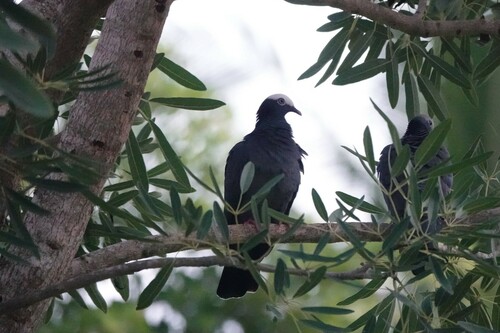 Witkruinduif
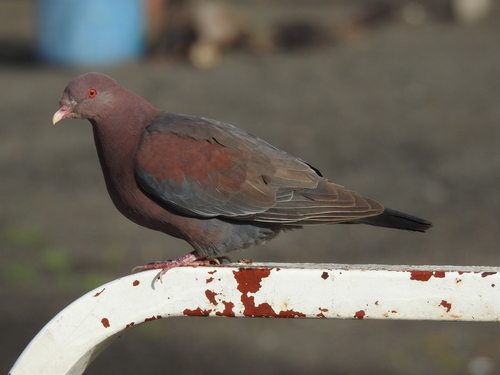 Roodsnavelduif
Kort gezegd
Het meest betrouwbare veldkenmerk tussen Witkruinduif en Roodsnavelduif is de aanwezigheid van een witte of grijs-witte kroonvlek op volwassen Witkruinduiven, die altijd afwezig is bij Roodsnavelduiven. In de vlucht of zittend, let op de iriserende kraag op Witkruin (alleen volwassenen, en alleen bij goed licht), versus het uniforme kastanjebruine tot paarse hoofd en nek van Roodsnavel. Juvenielen van beide zijn doffer, maar Witkruin juvenielen kunnen een paar bleke kroonveren tonen terwijl Roodsnavel juvenielen dat nooit doen. De kleur van de snavel is ook kenmerkend: Roodsnavel heeft een rode snavel met een gele punt, terwijl Witkruin een rode snavel met een bleke punt toont. Beide zijn grote, robuuste duiven, maar Witkruin is minder fors en heeft een langere, vierkante staart. Habitat kan helpen: Witkruin geeft de voorkeur aan mangroven en Caribische eilanden, terwijl Roodsnavel voornamelijk wordt aangetroffen in droge laaglandbossen en rivieroevers van Mexico en Midden-Amerika.
Herkenningstips
- Kroonvlek (Volwassenen): Alleen Witkruinduif toont een witte of grijs-witte kroonvlek; Roodsnavelduif doet dat nooit. Dit is het meest betrouwbare kenmerk voor volwassenen, vooral bij zittende vogels.
- Kroonvlek (Juvenielen): Juveniele Witkruin kan een paar bleke kroonveren tonen, maar nooit een volledige vlek. Juveniele Roodsnavel toont nooit bleke kroonveren; de kroon is altijd dof en uniform.
- Iriserende Kraag (Volwassenen): Witkruinduif kan een groen-gemarkeerde iriserende kraag tonen bij goed licht; Roodsnavelduif mist elke iriserende kraag. Dit is subtiel en niet altijd zichtbaar.
- Hoofd- en Nekkleur: Roodsnavelduif heeft een kastanjebruin tot paarse hoofd, nek en vleugelbedekking; Witkruinduif is leisteengrijs tot bijna zwart, zonder kastanjebruine of paarse tinten.
- Snavelkleur: Roodsnavelduif heeft een rode snavel met een gele punt; Witkruinduif heeft een rode snavel met een bleke (niet gele) punt. Dit kan moeilijk te zien zijn op afstand.
- Oogkleur: Witkruinduif heeft een witte iris; Roodsnavelduif heeft een bleke rode iris met een oranje orbitale ring. Nuttig op korte afstand.
- Staartvorm: Witkruinduif heeft een langere, vierkante staart; Roodsnavelduif is robuuster en minder langwerpig in de staart.
- Lichaamsstructuur: Witkruin lijkt minder fors en slanker; Roodsnavel is zwaarder en robuuster.
- Juveniele Bovenkant: Juveniele Roodsnavel is bruiner met doffe schouders en een bruine mantel; juvenile Witkruin is grijsbruin maar mist de sterke bruine tinten van Roodsnavel.
- Vluchtpatroon: Er zijn geen unieke bovenvleugel- of achterrandkenmerken beschreven voor beide; vertrouw op de algemene kleur en kroonvlek (indien zichtbaar) in de vlucht.
- Vocalisaties: Witkruin geeft een diepe, driedubbele coo; Roodsnavel geeft een hogere, complexere coooo-cuk-c'-c'-coo. Gebruik de stem als deze duidelijk te horen is.
- Habitat: Witkruin is bijna altijd in mangroven of nabijgelegen bossen in het Caribisch gebied of het zuiden van Florida; Roodsnavel is in droge bossen en rivieroevers van Mexico en Midden-Amerika. Als gezien in de Florida Keys of Caribische eilanden, is het bijna zeker Witkruin.
- Gedrag: Witkruin is zeer voorzichtig en snel om op te vliegen; Roodsnavel kan minder schuw zijn maar kan een vleugelslag produceren bij het opstijgen.
- Geslachtsverschillen: Vrouwelijke Witkruin heeft een doffere grijs-witte kroon; vrouwelijke Roodsnavel heeft een doffere kastanjebruine hoofd/nek, maar geen kroonvlek.
- Seizoenscontext: Roodsnavel is zeldzaam in de winter in zijn verspreidingsgebied; Witkruin kan het hele jaar door aanwezig zijn in het Caribisch gebied. Gebruik het seizoen als een ondersteunende aanwijzing.
Grootte
Both species are similar in length (White-crowned: 29–35 cm; Red-billed: 30–37 cm) [wikipedia], but Red-billed is generally heavier (White-crowned: 150–301 g; Red-billed: 230–425 g) [wikipedia]. White-crowned is slightly less chunky, with a longer, more square tail, while Red-billed is more robust overall. In the field, size alone is not a reliable separator, but White-crowned may appear a bit more slender and longer-tailed.
Verenkleed
- Juveniles: Both are duller than adults, but juvenile White-crowned Pigeons are grayish-brown, lack the adult's white crown and iridescent collar, and may show a few pale feathers on the crown. Juvenile Red-billed Pigeons are even duller, with dark/dusky shoulders and a browner mantle and wings, but never show a pale crown patch.
- Adults: Witkruinduif adults are slate gray to nearly black, with a white (males) or gray-white (females) crown patch. Their iridescent collar-patch is only visible in good light. The iris is white, and the bill is red with a pale tip. Roodsnavelduif adults are dark slate-gray with a maroon to purple head, neck, and wing coverts, blue-gray belly and tail coverts, and a red bill with yellow tip. They lack any crown patch or iridescent collar. The eye is pale red with an orange orbital ring.
- Flight views: No unique upperwing or trailing edge marks are described for either species; separation relies on overall coloration and crown patch (if visible).
Gedrag
Witkruinduif is opmerkelijk schuw en snel om op te vliegen, vaak nesten verlatend als ze worden verstoord. Beide soorten zijn sterke vliegers, maar Witkruin kan minder bulky en meer langwerpig lijken in de vlucht door zijn langere staart. Roodsnavelduif kan een vleugelslaggeluid produceren bij het opstijgen. Beide soorten worden meestal alleen of in kleine groepen gezien, hoewel Witkruin grotere groepen kan vormen bij fruitdragende bomen.
Habitat
Witkruinduif is bijna altijd geassocieerd met kustmangroven en nabijgelegen loofbossen, vooral op Caribische eilanden en de zuidelijke punt van Florida. Het vereist geïsoleerde, vaak getijde-overstromende mangrove-eilanden voor het nestelen, maar kan inland foerageren. Roodsnavelduif wordt aangetroffen in droge bossen en langs rivieroevers, voornamelijk in Mexico en Midden-Amerika, en slechts zelden in het zuiden van Texas. Habitatoverlap is minimaal, behalve mogelijk in delen van Midden-Amerika; context is een sterke aanwijzing.
Geluid
Witkruinduif's roep is een luide, diepe coo-cura-coo of coo-croo, met een driedubbele coo ritme. Roodsnavelduif geeft een lange, hoge coooo gevolgd door drie cuk-c'-c'-coo noten, met een oplopend patroon. De roep van Roodsnavel is hoger en complexer; die van Witkruin is dieper en eenvoudiger. In het veld is de stem nuttig als deze goed te horen is.