

black-winged petrel vs gould's petrel
Pterodroma nigripennis versus Pterodroma leucoptera
Jogue um quiz com black-winged petrel e gould's petrel
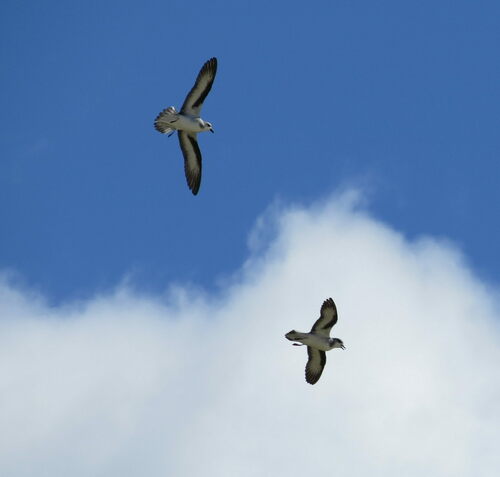 black-winged petrel
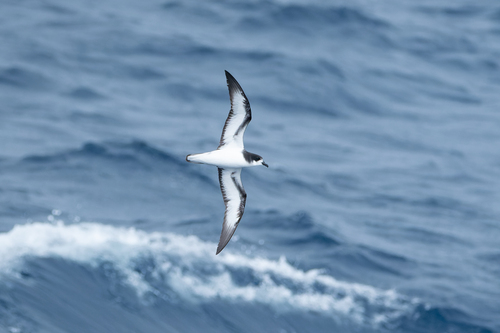 gould's petrel
Em resumo
A marca de campo mais confiável entre black-winged petrel e gould's petrel é o padrão da asa superior em voo: gould's petrel apresenta uma distinta forma escura de 'M' ou 'W' nas asas superiores, enquanto black-winged petrel não possui essa marca e, em vez disso, tem uma asa superior cinza pálido mais uniforme com bordas externas escuras. Ambos são pequenos petrels de asas longas com partes inferiores brancas, mas gould's petrel tem uma cabeça visivelmente mais escura com uma testa e rosto brancos, enquanto black-winged petrel tem uma coroa e nuca cinza pálido com bochechas brancas e um colar escuro. As diferenças estruturais são sutis, mas gould's petrel tende a ser ligeiramente maior e mais pesado. A atenção cuidadosa ao padrão das asas e às marcas da cabeça, especialmente em voo, é fundamental para separar essas duas espécies.
Dicas de identificação
- Procure pelo 'M' ou 'W' escuro nas asas superiores em voo: gould's petrel (todas as idades) apresenta um padrão escuro ousado nas asas superiores, enquanto black-winged petrel não possui isso e, em vez disso, tem uma asa superior cinza pálido mais uniforme com bordas externas escuras. Esta é a marca mais confiável em voo.
- Verifique o padrão da cabeça: gould's petrel tem uma cabeça visivelmente escura com uma testa e rosto brancos, criando um contraste acentuado. A cabeça de black-winged petrel é mais clara, com uma coroa e nuca cinza pálido, bochechas brancas e um colar escuro, resultando em uma aparência mais suave e menos contrastante.
- Avalie a asa inferior: black-winged petrel tem bordas externas pretas na asa inferior, enquanto gould's petrel (especialmente a subespécie da Nova Caledônia) pode apresentar pigmentação reduzida aqui, mas isso é sutil e variável.
- Forma e padrão da cauda: black-winged petrel tem uma cauda cortada em quadrado, listrada em preto e branco. A cauda de gould's petrel é mais curta e arredondada, e algumas subespécies mostram penas internas brancas ou principalmente brancas nas penas externas da cauda.
- Estrutura e aparência: Ambas as espécies são de asas longas e esbeltas, mas gould's petrel pode parecer ligeiramente mais robusto e tem uma cauda mais curta e arredondada. Essas diferenças são sutis e são melhor utilizadas em comparação direta.
- Tamanho: gould's petrel é marginalmente maior e mais pesado, mas isso raramente é aparente a menos que os pássaros estejam lado a lado.
- Sexo e idade: Machos de gould's petrel são ligeiramente maiores, mas as diferenças de sexo não são úteis em campo. Ambas as espécies apresentam plumagem semelhante em todas as idades, exceto pelo padrão diagnóstico da asa superior em gould's petrel.
- Armadilhas de plumagem: Ambas as espécies são brancas por baixo e escuras por cima, o que pode levar a confusões à distância. Foque no padrão da asa superior e no contraste da cabeça em vez da cor geral.
- Habitat e contexto: Se vistos se reproduzindo, note a localização: gould's petrel se reproduz principalmente ao largo da Austrália oriental e da Nova Caledônia, enquanto black-winged petrel tem uma faixa mais ampla no Pacífico. No mar, a sobreposição de faixa é possível.
- Comportamento: O comportamento de alimentação é semelhante e não é diagnóstico; ambos podem ser vistos deslizando ou batendo na superfície.
- Voz: Nenhuma diferença vocal diagnóstica é notada nas fontes disponíveis.
- Estação: Ambas são pelágicas fora da estação de reprodução; o tempo e a localização da reprodução podem ajudar se conhecidos, mas não são visíveis em campo.
- Variação de subespécies: Algumas subespécies de gould's petrel (por exemplo, a da Nova Caledônia) são mais claras por cima e têm mais branco na cauda, mas o 'M' da asa superior continua sendo a marca chave.
- Quando em dúvida: Priorize o padrão da asa superior em voo e o contraste da cabeça/rosto quando empoleirado ou na água.
- Armadilhas comuns: Não confie no tamanho geral ou na escuridão geral acima; estes são muito variáveis e se sobrepõem entre as espécies.
Tamanho
Gould's Petrel is marginally larger, measuring about 30 cm in length with a 70 cm wingspan and weighing 180–200 g, while Black-winged Petrel averages 29 cm in length, 67 cm wingspan, and 167 g in mass. These differences are slight and not always apparent in the field, so size alone is not a reliable separator. Both species are small, slender petrels with long, narrow wings, but Gould's Petrel may appear a touch bulkier, especially in direct comparison.
Plumagem
- Immature and adult flight views: Gould's Petrel of all ages shows a bold dark 'M' or 'W' pattern across the upperwings, formed by the dark brown and grey coloration typical of the Cookilaria group. This mark is visible in both juveniles and adults and is the single best field mark in flight. Black-winged Petrel lacks this 'M' pattern; instead, its upperwings are pale grey near the base with dark greyish-black along the outer edge, giving a more uniform and less patterned look.
- Head and face: Gould's Petrel has a noticeably dark head with a white forehead and face, creating a strong contrast. Black-winged Petrel has a pale grey cap and nape, white cheeks, and a dark grey collar, resulting in a less contrasting and more softly blended facial pattern.
- Underparts: Both species are white below, but Gould's Petrel's underwing may show less pigmentation in some subspecies (notably the New Caledonian form), while Black-winged Petrel has black outer edges to the underwing.
- Tail: Black-winged Petrel's tail is square-cut and barred black and white; Gould's Petrel has a short, rounded tail, and in some subspecies, the outer tail feathers have white or mostly white inner vanes.
- Sex/age variation: Males of Gould's Petrel are slightly larger, but plumage differences between sexes are minimal and not a reliable field mark.
Comportamento
Ambas as espécies são pelágicas e passam a maior parte de suas vidas no mar, vindo à terra apenas para se reproduzir. Black-winged petrel é conhecido por deslizar e bater na superfície da água ao se alimentar, frequentemente associando-se a outros Procellariiformes. O comportamento de gould's petrel é semelhante, sem diferenças comportamentais significativas notadas nas fontes que separariam de forma confiável no mar ou em terra.
Habitat
Ambas as espécies se reproduzem em ilhas oceânicas no sudoeste do Pacífico, com alguma sobreposição na faixa de reprodução (por exemplo, Ilha Lord Howe, Nova Caledônia). Black-winged petrel tem uma faixa não reprodutiva mais ampla, migrando mais ao norte para o Pacífico central (entre o Peru e o Havai), enquanto gould's petrel é mais localizado, reproduzindo-se principalmente ao largo da Austrália oriental e da Nova Caledônia. No entanto, no mar, seus habitats são semelhantes e não são um separador de campo forte.