

Black-winged Petrel vs Gould's Petrel
Pterodroma nigripennis versus Pterodroma leucoptera
Play a quiz with Black-winged Petrel and Gould's Petrel
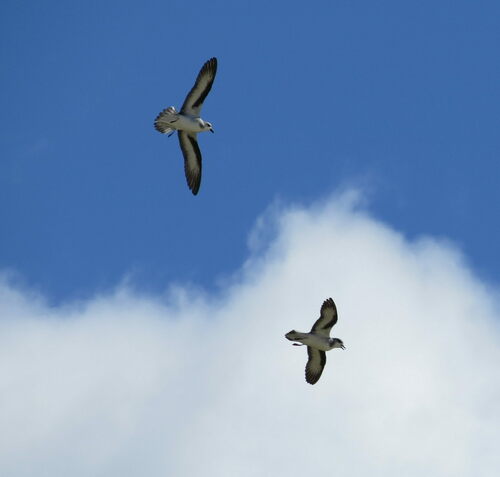 Black-winged Petrel
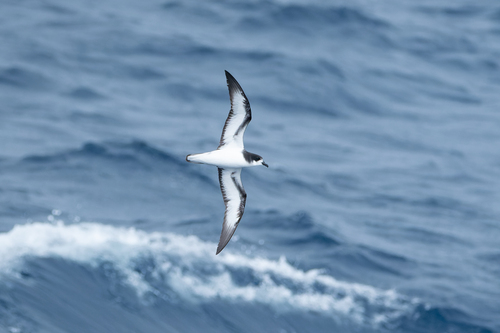 Gould's Petrel
In short
The most reliable field mark between Black-winged Petrel and Gould's Petrel is the upperwing pattern in flight: Gould's Petrel shows a distinctive dark 'M' or 'W' shape across the upperwings, while Black-winged Petrel lacks this mark and instead has a more uniform pale grey upperwing with dark outer edges. Both are small, long-winged petrels with white underparts, but Gould's Petrel has a noticeably darker head with a white forehead and face, whereas Black-winged Petrel has a pale grey cap and nape with white cheeks and a dark collar. Structural differences are subtle, but Gould's Petrel tends to be slightly larger and heavier. Careful attention to the wing pattern and head markings, especially in flight, is key to separating these two species.
Identification tips
- Look for the dark 'M' or 'W' on the upperwings in flight: Gould's Petrel (all ages) shows a bold dark pattern across the upperwings, while Black-winged Petrel lacks this and instead has a more uniform pale grey upperwing with dark outer edges. This is the most reliable mark in flight.
- Check the head pattern: Gould's Petrel has a noticeably dark head with a white forehead and face, creating a sharp contrast. Black-winged Petrel's head is paler, with a pale grey cap and nape, white cheeks, and a dark collar, resulting in a softer, less contrasting look.
- Assess the underwing: Black-winged Petrel has black outer edges to the underwing, while Gould's Petrel (especially New Caledonian subspecies) may show reduced pigmentation here, but this is subtle and variable.
- Tail shape and pattern: Black-winged Petrel has a square-cut, black-and-white barred tail. Gould's Petrel's tail is shorter and more rounded, and some subspecies show white or mainly white inner vanes on the outer tail feathers.
- Structure and jizz: Both species are long-winged and slender, but Gould's Petrel may look slightly bulkier and has a shorter, rounder tail. These differences are subtle and best used in direct comparison.
- Size: Gould's Petrel is marginally larger and heavier, but this is rarely apparent unless birds are side by side.
- Sex and age: Males of Gould's Petrel are slightly larger, but sex differences are not useful in the field. Both species show similar plumage across ages, except for the diagnostic upperwing pattern in Gould's Petrel.
- Plumage pitfalls: Both species are white below and dark above, which can lead to confusion at a distance. Focus on the upperwing pattern and head contrast rather than overall color.
- Habitat and context: If seen breeding, note the location: Gould's Petrel breeds mainly off eastern Australia and New Caledonia, while Black-winged Petrel has a wider Pacific range. At sea, range overlap is possible.
- Behavior: Feeding behavior is similar and not diagnostic; both may be seen skimming or pattering at the surface.
- Voice: No diagnostic vocal differences are noted in the available sources.
- Season: Both are pelagic outside the breeding season; breeding timing and location may help if known, but are not visible in the field.
- Subspecies variation: Some Gould's Petrel subspecies (e.g., New Caledonian) are paler above and have more white in the tail, but the upperwing 'M' remains the key mark.
- When in doubt: Prioritize the upperwing pattern in flight and the head/face contrast when perched or on the water.
- Common pitfalls: Do not rely on overall size or general darkness above; these are too variable and overlap between the species.
Size
Gould's Petrel is marginally larger, measuring about 30 cm in length with a 70 cm wingspan and weighing 180–200 g, while Black-winged Petrel averages 29 cm in length, 67 cm wingspan, and 167 g in mass. These differences are slight and not always apparent in the field, so size alone is not a reliable separator. Both species are small, slender petrels with long, narrow wings, but Gould's Petrel may appear a touch bulkier, especially in direct comparison.
Plumage
- Immature and adult flight views: Gould's Petrel of all ages shows a bold dark 'M' or 'W' pattern across the upperwings, formed by the dark brown and grey coloration typical of the Cookilaria group. This mark is visible in both juveniles and adults and is the single best field mark in flight. Black-winged Petrel lacks this 'M' pattern; instead, its upperwings are pale grey near the base with dark greyish-black along the outer edge, giving a more uniform and less patterned look.
- Head and face: Gould's Petrel has a noticeably dark head with a white forehead and face, creating a strong contrast. Black-winged Petrel has a pale grey cap and nape, white cheeks, and a dark grey collar, resulting in a less contrasting and more softly blended facial pattern.
- Underparts: Both species are white below, but Gould's Petrel's underwing may show less pigmentation in some subspecies (notably the New Caledonian form), while Black-winged Petrel has black outer edges to the underwing.
- Tail: Black-winged Petrel's tail is square-cut and barred black and white; Gould's Petrel has a short, rounded tail, and in some subspecies, the outer tail feathers have white or mostly white inner vanes.
- Sex/age variation: Males of Gould's Petrel are slightly larger, but plumage differences between sexes are minimal and not a reliable field mark.
Behaviour
Both species are pelagic and spend most of their lives at sea, only coming to land to breed. Black-winged Petrel is noted for skimming and pattering across the water's surface when feeding, often associating with other Procellariiformes. Gould's Petrel's behavior is similar, with no major behavioral differences noted in the sources that would reliably separate them at sea or on land.
Habitat
Both species breed on oceanic islands in the southwest Pacific, with some overlap in breeding range (e.g., Lord Howe Island, New Caledonia). Black-winged Petrel has a broader non-breeding range, migrating further north into the central Pacific (between Peru and Hawaii), while Gould's Petrel is more localized, breeding mainly off eastern Australia and New Caledonia. However, at sea, their habitats are similar and not a strong field separator.