

pale-bellied hermit vs stripe-throated hermit
Phaethornis anthophilus versus Phaethornis striigularis
Jogue um quiz com pale-bellied hermit e stripe-throated hermit
 pale-bellied hermit
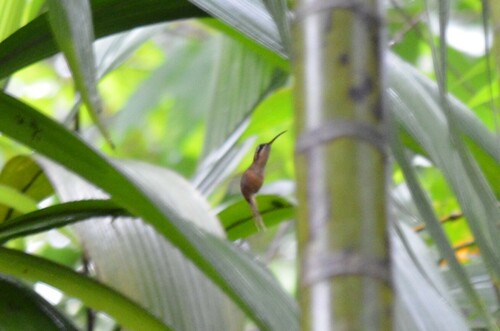 stripe-throated hermit
Em resumo
A marca de campo mais confiável entre o pale-bellied hermit e o stripe-throated hermit é o tamanho: o pale-bellied é distintamente maior e mais pesado, com um corpo visivelmente mais longo e uma aparência mais robusta. Em vistas próximas, as partes inferiores também são diagnósticas—o pale-bellied hermit apresenta partes inferiores cinza pálido, enquanto o stripe-throated hermit tem flancos e barriga cor de canela com uma garganta marrom-acinzentada, muitas vezes levemente estriada. A forma e a cor do bico fornecem mais pistas: os machos do pale-bellied hermit têm um bico quase reto, enquanto o stripe-throated hermit tem um bico longo e curvado para baixo com uma base amarelada na mandíbula inferior. Os juvenis do stripe-throated hermit são únicos por terem um dorso ruivo pálido totalmente, uma característica não observada no pale-bellied. Ambas as espécies compartilham uma máscara preta e um supercílio cor de canela, mas a impressão geral e as sutis diferenças de plumagem são fundamentais para uma separação confiante.
Dicas de identificação
- O tamanho é a primeira pista: Se o pássaro parecer grande e robusto para um hermit, prefira o pale-bellied; se pequeno e delicado, o stripe-throated é mais provável.
- Cor do dorso juvenil: Qualquer hermit com um dorso ruivo pálido totalmente é um juvenil do stripe-throated hermit—o pale-bellied nunca apresenta isso.
- Cor das partes inferiores: O pale-bellied hermit tem partes inferiores cinza pálido, enquanto o stripe-throated hermit mostra flancos e barriga cor de canela com uma garganta marrom-acinzentada.
- Estrias na garganta: Procure por pequenas estrias escuras na garganta do stripe-throated hermit (embora possam ser fracas); a garganta do pale-bellied hermit é principalmente branca e sem estrias.
- Padrão facial: Ambos têm uma máscara preta e um supercílio cor de canela, mas o malar e o supercílio do stripe-throated são brancos-canela, e a máscara pode parecer mais 'de bandido'.
- Forma do bico: Os machos do pale-bellied hermit têm um bico quase reto; o stripe-throated hermit sempre tem um bico longo e curvado para baixo. A fêmea do pale-bellied também tem um bico curvado, então isso é mais útil para machos.
- Cor do bico: O stripe-throated hermit apresenta uma base amarelada na mandíbula inferior (caso contrário, é preta); o bico do pale-bellied não é descrito como bicolor.
- Padrão da cauda: O stripe-throated hermit tem uma cauda escura com pontas brancas a ocre; o padrão da cauda do pale-bellied não é destacado como distintivo.
- Cor do rabo: O stripe-throated hermit tem um rabo ruivo pálido, que pode ser uma marca de campo útil em boa luz; o pale-bellied hermit não tem.
- Jizz em voo: O pale-bellied hermit aparece mais pesado e mais alongado em voo; o stripe-throated é mais rápido e ágil.
- Lekking e canto: Se você observar um hermit cantando uma canção aguda, estridente e monótona em um lek, é o stripe-throated hermit.
- Contexto geográfico: Na América Central ao norte do Panamá, apenas o stripe-throated é esperado; na Colômbia e no Panamá, ambos ocorrem, mas o stripe-throated é mais disseminado e comum.
- Diferenças sexuais: Ambas as espécies são sexualmente semelhantes em plumagem, mas as diferenças na forma do bico (mais reto no macho do pale-bellied) podem ajudar com indivíduos sexados.
- Variação de subespécies: Algumas subespécies do pale-bellied hermit (P. a. hyalinus) são mais verde-azuladas acima e mais pálidas abaixo, mas isso não se sobrepõe aos tons ruivos e canela do stripe-throated.
- Quando em dúvida: Foque no tamanho geral, na cor das partes inferiores e na forma/cor do bico para a separação mais confiável em campo.
Tamanho
O pale-bellied hermit é significativamente maior e mais pesado: cerca de 13 cm de comprimento e 5,9 g de massa (machos 4,5–5,5 g, fêmeas 4–5 g). O stripe-throated hermit é muito menor, com 9–10 cm e apenas 2–3 g. No campo, o pale-bellied parece mais robusto e alongado, enquanto o stripe-throated é visivelmente pequeno e delicado. Essa diferença de tamanho é frequentemente aparente mesmo sem comparação direta, especialmente se você estiver familiarizado com a faixa de tamanho típica dos hermits locais.
Plumagem
- Pássaros juvenis/imaturos: Os juvenis do stripe-throated hermit têm um dorso ruivo pálido totalmente, que é único e não é igualado pelo pale-bellied hermit em nenhuma idade. Se você ver um pequeno hermit com um dorso ruivo, é o stripe-throated.
- Adultos: O pale-bellied hermit tem partes superiores verde-escuras a oliva e partes inferiores cinza claro. O rosto apresenta uma máscara preta, supercílio cor de canela e garganta principalmente branca. Os adultos do stripe-throated hermit têm partes superiores verdes iridescentes opacas, um rabo ruivo pálido, flancos e barriga cor de canela, e uma garganta marrom-acinzentada pálida com pequenas estrias escuras, muitas vezes fracas. O padrão facial é semelhante (máscara preta, supercílio e malar brancos-canela), mas as estrias na garganta (mesmo que fracas) e as partes inferiores canela ajudam a separar o stripe-throated do pale-bellied, que é mais limpo e pálido.
- Cauda: O stripe-throated hermit tem uma cauda escura com pontas brancas a ocre (dependendo da subespécie), enquanto o padrão da cauda do pale-bellied hermit não é descrito como distintivo nas fontes.
- Bico: Os machos do pale-bellied hermit têm um bico quase reto; o stripe-throated hermit tem um bico longo e curvado para baixo com uma base amarelada na mandíbula inferior (caso contrário, é preta).
Comportamento
Ambas as espécies são típicas de hermits em comportamento, muitas vezes solitárias e se alimentando ao voar entre flores. Os machos do stripe-throated hermit formam leks e cantam para atrair fêmeas, um comportamento não especificamente observado para o pale-bellied hermit nas fontes. Em voo, o pale-bellied hermit pode parecer mais pesado e mais direto devido ao seu tamanho, enquanto o stripe-throated é provavelmente mais ágil e rápido, combinando com sua construção menor.
Habitat
Ambas as espécies ocorrem em regiões sobrepostas da Colômbia e do Panamá, mas o stripe-throated hermit se estende mais ao norte na América Central e é geralmente mais disseminado. O pale-bellied hermit é encontrado na Colômbia, Panamá e Venezuela. Ambas habitam áreas florestais úmidas, mas a abundância local e as preferências de microhabitat podem diferir—o stripe-throated é descrito como geralmente bastante comum.
Voz
Os machos do stripe-throated hermit têm uma canção aguda, estridente e monótona, que é facilmente ouvida e varia geograficamente. Nenhuma descrição vocal é fornecida para o pale-bellied hermit nas fontes, então a voz não é um separador confiável, a menos que você esteja familiarizado com a canção distinta do stripe-throated.
pale-bellied hermit · stripe-throated hermit · Minhas aves difíceis