

Tundra Bean Goose
Anser serrirostris
Ducks, Geese, and Waterfowl (Anatidae) · Anseriformes · Waterfowl
Play a quiz with Tundra Bean Goose and similar species
View all photos, video and sound
Reviewed
How to identify Tundra Bean Goose
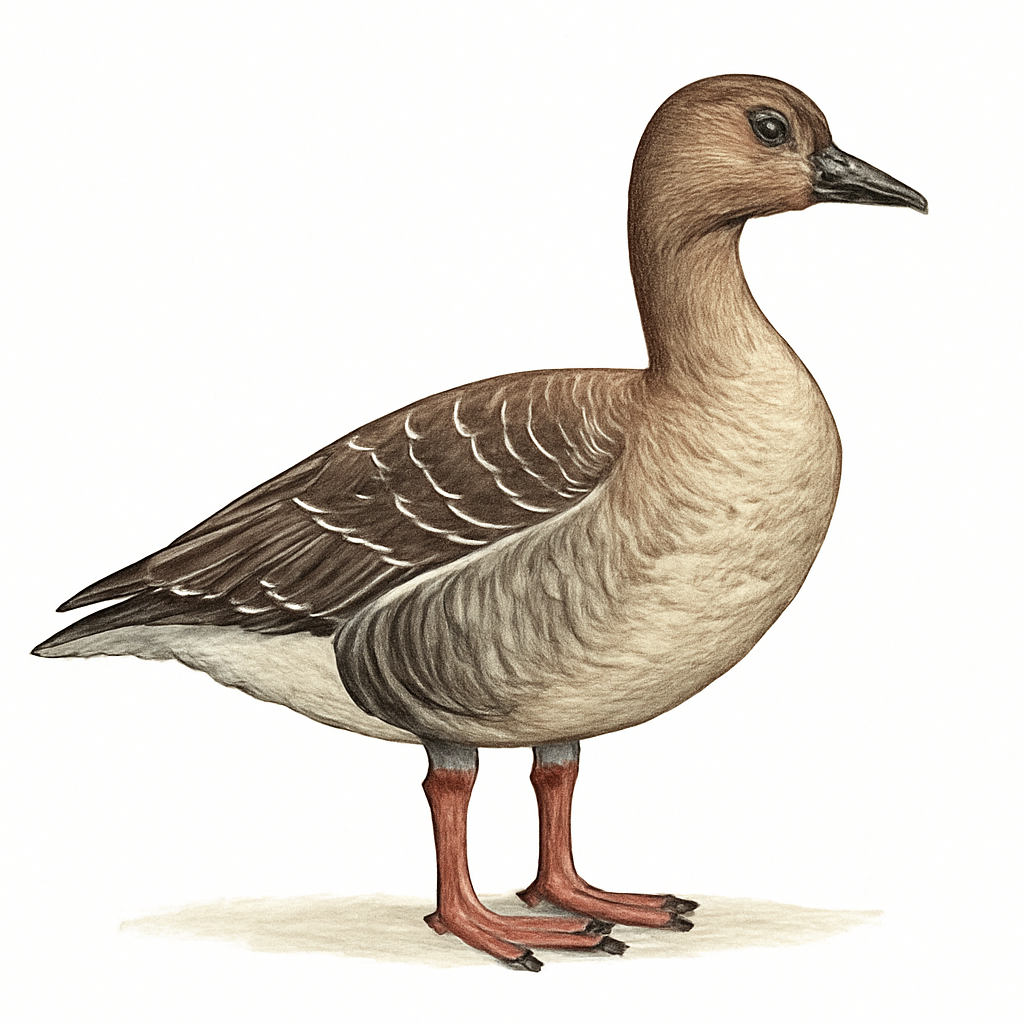
Tundra Bean Goose shows a black bill with a narrow orange band and bright orange legs, plus dark brown wing-coverts edged narrowly white.
The Tundra Bean Goose is a large, robust goose with a distinctive bill pattern: the bill is largely black at the base and tip, with a narrow orange band across the middle. The legs and feet are a bright orange, standing out against the otherwise subdued plumage. Its upper wing-coverts are dark brown, each feather edged with a narrow white fringe, giving a subtly scalloped look when seen at rest or in flight.
This species is similar in size and shape to other large grey geese, but the combination of bill coloration and orange legs is a useful field mark. There is some variation between subspecies: birds from northern Russia (rossicus) are smaller with a short, stubby bill, while East Siberian birds (serrirostris) are larger with a longer, stouter bill, but both show the same basic bill and leg coloration.
The overall plumage is brownish-grey, with no strong contrast between the head, neck, and body. The white fringes to the wing-coverts are subtle but help distinguish it from similar species. The voice and behaviour are not distinctive for field identification.
Similar species
- Taiga Bean Goose: Bill usually longer and more slender, with a larger orange area; legs also orange but bill shape and pattern differ. → How to tell them apart
- Pink-footed Goose: Bill is short with a bright pink band and pink feet, not orange; upper wing-coverts are bluish-grey, unlike the dark brown with white edges of Tundra Bean Goose. → How to tell them apart
- Greater White-fronted Goose: Shows a white blaze at the base of the bill and often black belly markings, lacking the orange banded bill and orange legs. → How to tell them apart
- Lesser White-fronted Goose: Much smaller, with a short stubby bill, prominent white forehead, and yellow eye-ring. → How to tell them apart
- Greylag Goose: Bulkier, with a uniformly orange or pink bill and pale grey upper wing-coverts, lacking the dark brown and white-edged pattern. → How to tell them apart
Often mixed up with
In quizzes, players most often confuse Tundra Bean Goose with these birds—either this species was picked by mistake, or the other way around.
| Species | Mix-ups |
|---|---|
| Taiga Bean Goose Anser fabalis | 838 |
| Pink-footed Goose Anser brachyrhynchus | 517 |
| Greater White-fronted Goose Anser albifrons | 168 |
| Lesser White-fronted Goose Anser erythropus | 94 |
| Brent Goose Branta bernicla | 94 |
Family
The Anatidae are the biological family of water birds that includes ducks, geese, and swans. The family has a cosmopolitan distribution, occurring on all the world's continents except Antarctica. These birds are adapted for swimming, floating on the water surface, and, in some cases, diving in at least shallow water.
Order
Anseriformes is an order of birds also known as waterfowl that comprises 178 living species of birds in three families: Anhimidae (three species of screamers), Anseranatidae (the magpie goose), and Anatidae, the largest family, which includes the other 174 species of waterfowl, among them the ducks, geese, and swans. Most modern species in the order are highly adapted for an aquatic existence at the water surface. With the exception of screamers, males have penises, a trait that has been lost …