

Play a quiz with Woodlark and similar species
View all photos, video and sound
Reviewed
How to identify Woodlark
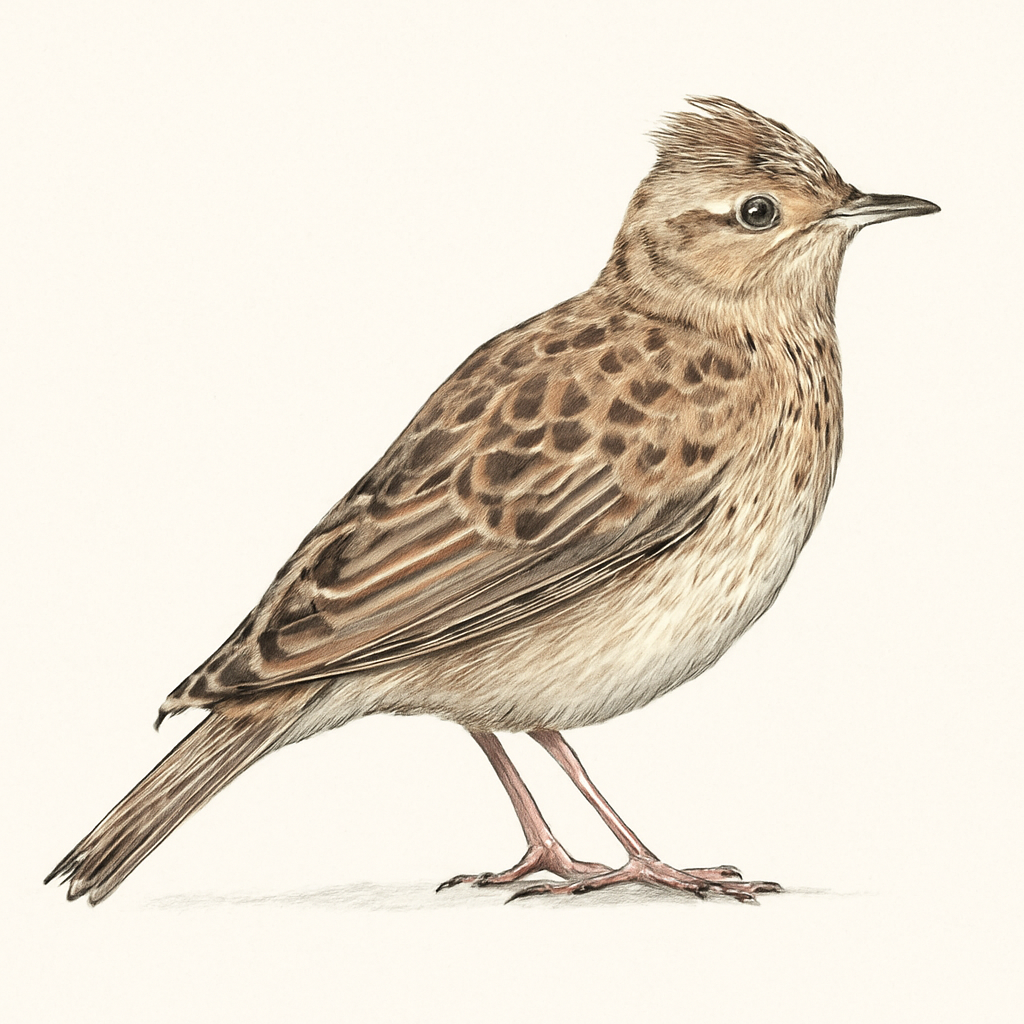
Woodlark is a compact, short-tailed lark with a striking white supercilium meeting on the nape and broad, rounded wings in flight.
The most distinctive feature of the Woodlark is its bold white supercilium (eyebrow) that curves back and meets at the nape, forming a clear pale 'V' at the back of the head. It is a small, compact lark—noticeably shorter and more rounded than the Eurasian Skylark—with a short tail and short, broad wings. The tail is tipped with white but lacks the white edges along the tail sides and rear wing edge seen in skylarks. Its upperparts are brown and streaked, while the underparts are pale.
The crest is small and usually inconspicuous, rarely raised. In flight, the combination of short tail and broad, rounded wings gives it a distinctive, fluttery appearance. The song is a sweet, melodious, repeated 'lu-lu-lu' or 'toolooeet', often delivered in a circling, fluttering song flight or from a perch.
Woodlark is typically found in open habitats such as heathland, forest clearings, and areas with scattered trees, often preferring sandy or disturbed ground.
Similar species
- Eurasian Skylark: Larger and longer-tailed; white edges on tail sides and rear wing edge (absent in Woodlark); supercilium does not meet on nape. → How to tell them apart
- Crested Lark: Larger with a much more prominent, pointed crest; lacks the white supercilium meeting on the nape. → How to tell them apart
- Greater Short-toed Lark: Smaller and more compact, but lacks the bold supercilium meeting on the nape; overall paler and less streaked above. → How to tell them apart
- Mediterranean Short-toed Lark: Smaller, paler, and lacks the distinctive white supercilium meeting on the nape. → How to tell them apart
- Thekla's Lark: More robust with a heavier bill and stronger crest; lacks the white supercilium meeting on the nape. → How to tell them apart
- Black Lark: Entirely dark plumage, never showing the pale supercilium or white tail tip of Woodlark. → How to tell them apart
Often mixed up with
In quizzes, players most often confuse Woodlark with these birds—either this species was picked by mistake, or the other way around.
| Species | Mix-ups |
|---|---|
| Eurasian Skylark Alauda arvensis | 670 |
| Crested Lark Galerida cristata | 148 |
| Greater Short-toed Lark Calandrella brachydactyla | 96 |
| Shore Lark Eremophila alpestris | 83 |
| Calandra Lark Melanocorypha calandra | 40 |
Family
Larks are passerine birds of the family Alaudidae. Larks have a cosmopolitan distribution with the largest number of species occurring in Africa. Only a single species, the horned lark, occurs in North America, and only Horsfield's bush lark occurs in Australia.
Order
A passerine () is any bird of the order Passeriformes (; from Latin passer 'sparrow' and formis '-shaped'), which includes more than half of all bird species. Sometimes known as perching birds, passerines generally have an anisodactyl arrangement of their toes (three pointing forward and one back), which facilitates perching. With more than 140 families and some 6,500 identified species, Passeriformes is the largest order of birds and one of the most diverse clades of terrestrial vertebrates, representing 60% of …