

African Grass-Owl vs American Barn Owl
Tyto capensis versus Tyto furcata
Play a quiz with African Grass-Owl and American Barn Owl
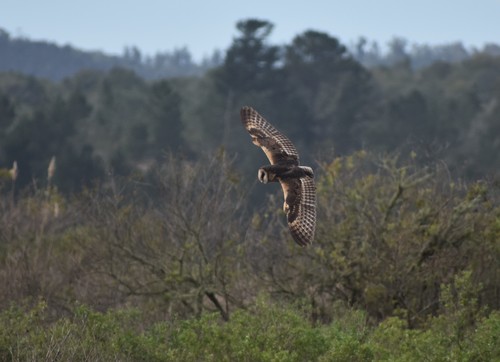 African Grass-Owl
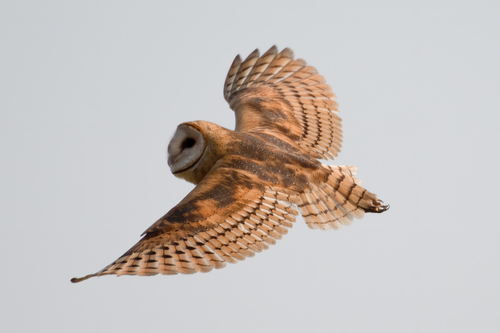 American Barn Owl
In short
The most reliable field mark to separate African Grass-Owl from American Barn Owl is the overall darkness and uniform sooty-blackish upperparts of the Grass-Owl, contrasting with the typically paler, more variegated upperparts of the Barn Owl. In flight or perched, Grass-Owl shows a strikingly dark back and wings, with scattered small white spots, while Barn Owl is generally paler brown to grey above with more extensive pale areas and finer speckling. Both have heart-shaped facial discs, but Grass-Owl’s is rimmed with a narrow, densely spotted yellowish-buff border, while Barn Owl’s is usually bright white and less distinctly rimmed. Underparts are more heavily spotted and variable in Grass-Owl, while Barn Owl’s are paler and less marked, especially in males. Structural differences are subtle, but Grass-Owl is slightly larger and heavier, especially in females.
Identification tips
- Upperparts Coloration: Grass-Owl is strikingly sooty-blackish-brown above with small white spots and greyish flecks; Barn Owl is paler brown to grey with fine black-and-white speckling, never as dark or uniform as Grass-Owl. This is the most consistent field mark at all ages.
- Facial Disc: Grass-Owl’s facial disc is whitish-cream with a narrow, densely spotted yellowish-buff rim; Barn Owl’s is usually bright white with a less distinct rim. Look for the spotted rim on Grass-Owl at close range.
- Underparts Markings: Grass-Owl always shows dark spots on the underparts, which vary from whitish to buff; Barn Owl’s underparts are usually less marked, especially in males, and can be almost unspotted in some individuals. Heavily spotted underparts favor Grass-Owl, but overlap exists with spotted female Barn Owls.
- Tail Pattern: Grass-Owl’s tail has brown central feathers and paler, almost white, outer feathers with about four dark bars; Barn Owl’s tail is squarish, light brown with darker bands, but not as contrasting.
- Leg Feathering: Grass-Owl’s whitish leg feathers extend further down the tarsi than in Barn Owl, whose tarsometatarsal feathers match the underparts and may be less extensive. This is subtle and best seen on perched birds.
- Overall Darkness/Jizz: In poor light or at a distance, Grass-Owl gives a much darker, more uniform impression, while Barn Owl appears paler and more patterned. Use this for quick separation in flight.
- Size and Bulk: Grass-Owl is slightly larger and bulkier, especially in females, but size overlap is considerable. Use only as a supporting mark.
- Flight Style: Barn Owl often flies with an undulating pattern and dangling legs; Grass-Owl’s flight is less described but may appear heavier and more direct.
- Habitat: Grass-Owl is restricted to tall, dense grasslands and marshes; Barn Owl is found in a wider range of open habitats, including farmland and near buildings. Context can help but is not definitive.
- Voice: Grass-Owl’s screech is less strident, and the male’s song is a high-pitched sibilant tremolo; Barn Owl’s screech is louder and more piercing. Use only if calls are clearly heard.
- Sexual Dimorphism: Both species show larger, heavier females and more spotted underparts in females, but this is not reliable for field separation.
- Bill and Eye Color: Grass-Owl has a whitish to pale pink bill and brownish-black eyes; Barn Owl’s bill varies from pale horn to dark buff, and iris is blackish brown. These are not strong field marks.
- Tail Shape: Both have short tails, but Barn Owl’s is described as squarish; Grass-Owl’s tail may appear shorter and more graduated due to the color contrast.
- Spotting on Upperparts: Grass-Owl’s white spots are scattered and small; Barn Owl’s speckling is finer and more evenly distributed, except on the main wing feathers.
- When in Doubt: If the bird appears unusually dark and is in tall grass, suspect Grass-Owl; if paler and in open farmland or near buildings, Barn Owl is more likely.
Size
African Grass-Owl is slightly larger and heavier on average: body length 38–42 cm, wing length 283–345 mm, and mass 355–520 g, with females significantly larger than males [wikipedia]. American Barn Owl is a medium-sized owl, with the largest females of some island races reaching over 550 g, but typical males are about 10% lighter than females [wikipedia]. In most field encounters, Grass-Owl will appear a bit bulkier, especially in the body and head. However, size overlap is considerable, and structure alone is not a safe separator unless both sexes and age are known.
Plumage
- Juvenile/immature flight (upperwing): No explicit age-specific upperwing pattern differences are described for either species in the sources, so separation relies on overall coloration and spotting at all ages.
- Adult and immature perched or in flight: African Grass-Owl is uniform sooty-blackish-brown above, with small white spots and greyish flecks, creating a much darker impression than American Barn Owl, which is pale brown to grey above with fine black-and-white speckles (except on the main wing feathers, which are light brown with darker bands). Grass-Owl’s facial disc is whitish-cream with a narrow, densely spotted yellowish-buff rim; Barn Owl’s is usually bright white with a less distinct rim. Underparts of Grass-Owl are variable, from whitish to buff, but always with dark spots; Barn Owl underparts range from white to reddish buff, with spotting variable (females more spotted, males often plainer). Grass-Owl’s tail is short with brown central feathers and paler, almost white, outer feathers showing about four dark bars; Barn Owl’s tail is short, squarish, and light brown with darker bands. Both have feathered legs, but Grass-Owl’s leg feathers are whitish and extend further down the tarsi.
Behaviour
Both species are nocturnal and hunt over open ground, but Grass-Owl is more strictly associated with tall grass habitats and may be less likely to be seen in agricultural or urban settings compared to the adaptable Barn Owl. In flight, both show long wings and a short tail, but Barn Owl’s flight is described as undulating with dangling, feathered legs, while Grass-Owl’s flight is less well described but likely appears heavier and more direct due to its bulkier build. Both perch low or on the ground, but Grass-Owl is more secretive and less likely to be seen in the open during the day.
Habitat
African Grass-Owl is closely tied to tall, dense grasslands and marshy areas, rarely venturing far from such habitats. American Barn Owl is far more adaptable, found in open countryside, farmland, grasslands, and even urban areas. If seen in extensive, undisturbed grassland, Grass-Owl is more likely; in agricultural fields, barns, or near human habitation, Barn Owl is much more probable.
Voice
Both species give screeching calls, but Grass-Owl’s is less strident than Barn Owl’s. Grass-Owl also gives a high-pitched sibilant tremolo (1–2 seconds) thought to be the male’s song. Barn Owl’s screech is louder and more piercing. However, voice is not a reliable separator unless the call is clearly heard and compared side by side.