Alpine Swift vs Common Swift
Tachymarptis melba versus Apus apus
Play a quiz with Alpine Swift and Common Swift
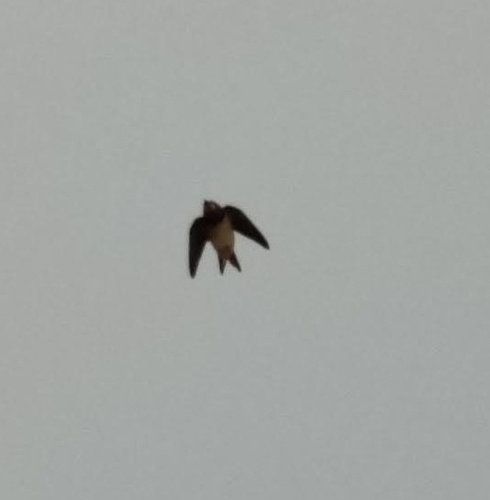 Alpine Swift
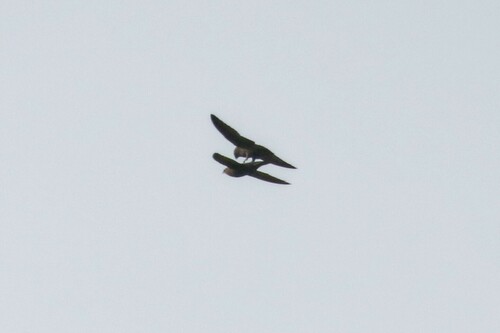 Common Swift
In short
The most reliable way to separate Alpine Swift from Common Swift is by size and underpart pattern: Alpine Swift is much larger and shows a striking white belly and throat divided by a dark breast band, while Common Swift is smaller and uniformly dark below except for a tiny pale chin patch. Both species have long, swept-back wings and a forked tail, but Alpine Swift's wings are broader and its flight is slower and more powerful. Juvenile Alpine Swifts look similar to adults but with pale feather edges, while Common Swifts remain all-dark. These differences are visible in flight and at rest, but are most obvious when the birds bank or show their underparts.
Identification tips
- Size is the first clue: Alpine Swift is nearly twice as large as Common Swift. If a swift appears unusually big and bulky compared to others, consider Alpine Swift.
- Underpart pattern: Alpine Swift shows a bold white belly and throat, divided by a dark breast band. This is visible in all ages and is diagnostic in flight or when perched. Common Swift is uniformly dark below, with only a tiny pale chin patch that is rarely visible in the field.
- Wing shape and breadth: Alpine Swift's wings are broader and less scythe-like than Common Swift's. In flight, Alpine Swift may recall a giant House Martin or Barn Swallow, but with longer wings and a more robust body.
- Tail fork: Both species have forked tails, but Alpine Swift's fork is shallower and the tail appears broader. Common Swift's tail is slimmer and the fork can look deeper, especially when spread.
- Flight style: Alpine Swift flies with slower, deeper wingbeats and glides more often, giving a powerful, steady impression. Common Swift is much faster and more erratic, with rapid, flickering wingbeats and agile turns.
- Juvenile plumage: Juvenile Alpine Swifts have pale-edged feathers on the upperparts, but still show the white belly and throat. Juvenile Common Swifts are all-dark, matching adults.
- Plumage pitfalls: In poor light, Alpine Swift's white underparts may appear duller, but the contrast with the dark breast band and flanks remains. Common Swift never shows a white belly or throat.
- Perched views: Alpine Swift is more likely to perch on cliffs or large buildings, sometimes visible at rest. Common Swift is rarely seen perched except at the nest and is more secretive.
- Habitat context: Alpine Swift is most often seen over mountains, cliffs, or large urban structures, especially in southern Europe and Asia. Common Swift is widespread in towns and lowland areas across Europe and Asia.
- Vocalizations: Listen for Alpine Swift's drawn-out twittering, which is less sharp than Common Swift's piercing screams. If you hear a screaming party, it's likely Common Swift.
- Flock composition: If you see a mixed flock, look for the larger, paler-bellied birds among the smaller, all-dark swifts.
- Seasonal context: Both species are migratory, but Alpine Swift tends to arrive earlier in spring in southern Europe and is more likely to be seen in large, loose flocks over cliffs or cities.
- Sex and age: There are no significant sex differences in field marks for either species; age differences are subtle and mainly affect feather edges in Alpine Swift juveniles.
- Distance and light: At great distance or in silhouette, size and flight style are the best clues. In good light, the white underparts of Alpine Swift are unmistakable.
- Common pitfalls: Do not confuse the white belly of Alpine Swift with the pale chin of Common Swift; the latter is tiny and rarely visible. Always check for the extent and position of white on the underparts.
Size
Alpine Swift is nearly twice the size of Common Swift. Alpine Swift measures about 20–23 cm in length with a wingspan of 54–60 cm and a body mass around 96 g [wikidata]; Common Swift is 16–17 cm long with a wingspan of 38–40 cm and is much lighter. In the field, Alpine Swift appears bulkier, with broader wings and a more robust body, while Common Swift is noticeably slimmer and more agile.
Plumage
- Juveniles and immatures: Alpine Swift juveniles resemble adults but have pale feather edges, especially on the upperparts, which can give a slightly scaled look in fresh plumage. Common Swift juveniles are all-dark like adults, lacking any pale or white underpart patches.
- Adults: Alpine Swift is dark brown above with a white throat and a large, oval white belly patch, separated by a dark breast band and surrounded by brown flanks and undertail coverts. The white on the throat and belly is highly visible in flight, especially from below. Common Swift is uniformly blackish-brown with only a tiny pale chin patch, which is not visible at a distance; otherwise, the underparts are entirely dark. Both species have long, swept-back wings and a short forked tail, but Alpine Swift's wings are broader and the tail fork is shallower.
Behaviour
Alpine Swift has a slower, more powerful flight with deep, steady wingbeats, often described as more 'muscular' or 'deliberate' compared to the rapid, agile, and highly acrobatic flight of Common Swift. Alpine Swifts may appear to glide more and can sometimes be seen circling in loose flocks, while Common Swifts are almost always in fast, erratic flight, often screaming in tight groups. Both species spend most of their lives on the wing, but Alpine Swift's flight style is noticeably less frenetic.
Habitat
Alpine Swift breeds in mountainous regions, often nesting on cliffs or tall buildings in southern Europe, Africa, and Asia. They are more likely to be found in or near upland areas or large urban structures that mimic cliffs. Common Swift is more widespread in lowland areas, frequently nesting in towns and cities throughout Europe and Asia, often under eaves or in crevices of buildings. While both can be seen over urban areas, Alpine Swift is more tied to mountainous or cliffy habitats, especially during breeding.
Voice
Alpine Swift gives a drawn-out twittering call, which is less piercing than the Common Swift's loud, high-pitched scream. Common Swift calls are sharp, screaming 'srii' notes, often given in rapid succession and in groups, with males and females producing slightly different pitches. Alpine Swift's calls are less likely to be heard as a screaming party overhead.