
Motmot

Black Guillemot vs Razorbill

Cepphus grylle versus Alca torda

Play a quiz with Black Guillemot and Razorbill
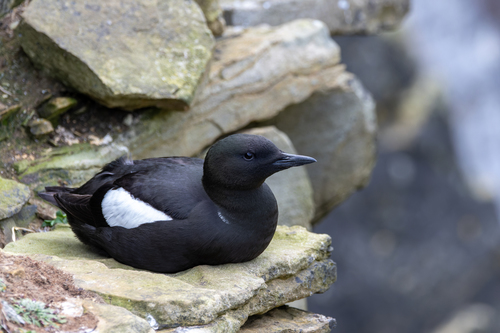
Black Guillemot (Cepphus grylle) Black Guillemot

Razorbill (Alca torda) Razorbill

Media

Loading…

In short

The most reliable field mark between Black Guillemot and Razorbill is the presence of a bold white wing patch on Black Guillemot of all ages and seasons, which stands out in flight and at rest, while Razorbill lacks any such wing patch. Juvenile and immature Black Guillemots show a distinctive spotted or mottled white wing patch, easily seen even at a distance, whereas Razorbill immatures resemble adults in lacking this feature. Structurally, Razorbill is bulkier with a much deeper, blunt-tipped bill and a longer tail, while Black Guillemot is smaller, slimmer, and has a thin, pointed bill. Seasonal plumage changes can cause confusion, but the white wing patch on Black Guillemot remains a constant separator. Both species may be seen near rocky coasts, but Razorbill is more strictly colonial and often in larger groups.

Identification tips

  1. White wing patch: Black Guillemot of all ages and seasons shows a bold white patch on the upperwing, visible both at rest and in flight; Razorbill never shows this feature. This is the single most reliable field mark.
  2. Juvenile/immature Black Guillemot: The white wing patch is often spotted or mottled with grey or brown in young birds, making them even more distinctive at a distance. Razorbill immatures lack any wing patch and resemble adults.
  3. Bill shape: Razorbill has a deep, laterally compressed, blunt-tipped bill with vertical grooves and a white line along the bill in breeding season. Black Guillemot's bill is thin, long, and pointed, always black, and lacks grooves or white lines.
  4. Tail shape: Razorbill has a noticeably long tail (center feathers longer), giving a distinctive profile, especially when perched. Black Guillemot's tail is shorter and less prominent.
  5. Plumage in summer: Black Guillemot is all black with a white wing patch, red legs and feet, and a black bill. Razorbill is black above and white below, with a black head and a thin white line from eye to bill.
  6. Plumage in winter: Black Guillemot becomes pale grey above and white below, but the white wing patch remains. Razorbill develops a white face and throat, but upperwing remains dark and lacks any white patch.
  7. Leg and foot color: Black Guillemot has bright coral-red legs and feet in summer, fading to pale red in winter. Razorbill's feet are black.
  8. Red gape: In breeding season, Black Guillemot shows a bright red mouth lining when calling, which can be visible at close range. Razorbill does not show this feature.
  9. Flight pattern: In flight, Black Guillemot shows a striking white upperwing panel; Razorbill's wings are uniformly dark. Razorbill appears bulkier and longer-tailed in flight.
  10. Size and build: Razorbill is larger, bulkier, and more thickset, with a heavier bill and longer tail. Black Guillemot is smaller, slimmer, and more delicate.
  11. Group size and behavior: Black Guillemot is usually seen singly or in pairs, rarely in large groups. Razorbill is highly colonial and often seen in large groups on cliffs or at sea.
  12. Habitat context: Black Guillemot is more likely to be seen close inshore, even outside the breeding season. Razorbill is more pelagic and strictly colonial when breeding.
  13. Perched stance: Razorbill has a horizontal stance with a long tail, while Black Guillemot is more upright and compact.
  14. Vocalization: Listen for high whistles from Black Guillemot in breeding season; Razorbill's calls are not described here.
  15. Pitfalls: In winter, both species become paler, but the white wing patch on Black Guillemot is always present and diagnostic. Do not rely solely on underpart color or overall darkness, as both species change seasonally.

Size

Razorbill is noticeably larger and heavier than Black Guillemot. Black Guillemot averages about 381 g in body mass and measures 30–32 cm in length, while Razorbill is bulkier (mean weight 505–890 g, length 37–39 cm) and appears more thickset. In the field, Razorbill's size is accentuated by its robust build and longer tail, while Black Guillemot is more delicate and compact.

Plumage

Juvenile and immature Black Guillemots are easily separated from Razorbills by their prominent white wing patch, which is often spotted or mottled with grey or brown—this mark is visible even at a distance and in flight. Adult Black Guillemots in summer are entirely black except for the large white wing patch; in winter, they become pale grey above with white underparts, but the white wing patch remains. Razorbills, regardless of age, never show a white wing patch: adults in breeding plumage are black above and white below, with a black head and a thin white line from eye to bill, and in non-breeding plumage, the face and throat become white but the upperwing remains uniformly dark. The bill of Razorbill is always deep and blunt with vertical grooves, and the white line on the bill is unique to this species. Black Guillemot's bill is slender and black. In flight, Black Guillemot shows a striking white panel on the upperwing, while Razorbill's wing is solidly dark.

Behaviour

Black Guillemots are typically seen singly or in pairs, often close to rocky shores, and may be observed carrying fish in their bills for extended periods. They are less colonial than Razorbills. Razorbills are highly colonial, nesting in dense groups on cliffs and boulders, and are more likely to be seen in large rafts on the water. Razorbills have a horizontal stance with a long tail, and in flight, their feet do not project beyond the tail. Both species dive for food, but Razorbill is capable of much deeper dives and is more likely to forage in groups at sea.

Habitat

Both species breed on rocky coasts and islands of the North Atlantic, but Black Guillemot is more often found in solitary pairs or small groups along rocky shores, including inshore waters. Razorbill is strictly colonial, nesting in large groups on cliffs and boulder fields, and is less likely to be seen alone. Black Guillemot is more likely to be resident year-round, while Razorbill is more pelagic outside the breeding season.

Voice

Black Guillemot gives a high whistle during the breeding season, with a prominent red gape visible when calling. Razorbill's vocalizations are not described in the provided notes, so are not reliably diagnostic here.

Submit a better description

Use the same sections as the comparison. Your text is published immediately.

The most reliable field mark between Black Guillemot and Razorbill is the presence of a bold white wing patch on Black Guillemot of all ages and seasons, which stands out in flight and at rest, while Razorbill lacks any such wing patch. Juvenile and immature Black Guillemots show a distinctive spotted or mottled white wing patch, easily seen even at a distance, whereas Razorbill immatures resemble adults in lacking this feature. Structurally, Razorbill is bulkier with a much deeper, blunt-tipped bill and a longer tail, while Black Guillemot is smaller, slimmer, and has a thin, pointed bill. Seasonal plumage changes can cause confusion, but the white wing patch on Black Guillemot remains a constant separator. Both species may be seen near rocky coasts, but Razorbill is more strictly colonial and often in larger groups.

  1. White wing patch: Black Guillemot of all ages and seasons shows a bold white patch on the upperwing, visible both at rest and in flight; Razorbill never shows this feature. This is the single most reliable field mark.
  2. Juvenile/immature Black Guillemot: The white wing patch is often spotted or mottled with grey or brown in young birds, making them even more distinctive at a distance. Razorbill immatures lack any wing patch and resemble adults.
  3. Bill shape: Razorbill has a deep, laterally compressed, blunt-tipped bill with vertical grooves and a white line along the bill in breeding season. Black Guillemot's bill is thin, long, and pointed, always black, and lacks grooves or white lines.
  4. Tail shape: Razorbill has a noticeably long tail (center feathers longer), giving a distinctive profile, especially when perched. Black Guillemot's tail is shorter and less prominent.
  5. Plumage in summer: Black Guillemot is all black with a white wing patch, red legs and feet, and a black bill. Razorbill is black above and white below, with a black head and a thin white line from eye to bill.
  6. Plumage in winter: Black Guillemot becomes pale grey above and white below, but the white wing patch remains. Razorbill develops a white face and throat, but upperwing remains dark and lacks any white patch.
  7. Leg and foot color: Black Guillemot has bright coral-red legs and feet in summer, fading to pale red in winter. Razorbill's feet are black.
  8. Red gape: In breeding season, Black Guillemot shows a bright red mouth lining when calling, which can be visible at close range. Razorbill does not show this feature.
  9. Flight pattern: In flight, Black Guillemot shows a striking white upperwing panel; Razorbill's wings are uniformly dark. Razorbill appears bulkier and longer-tailed in flight.
  10. Size and build: Razorbill is larger, bulkier, and more thickset, with a heavier bill and longer tail. Black Guillemot is smaller, slimmer, and more delicate.
  11. Group size and behavior: Black Guillemot is usually seen singly or in pairs, rarely in large groups. Razorbill is highly colonial and often seen in large groups on cliffs or at sea.
  12. Habitat context: Black Guillemot is more likely to be seen close inshore, even outside the breeding season. Razorbill is more pelagic and strictly colonial when breeding.
  13. Perched stance: Razorbill has a horizontal stance with a long tail, while Black Guillemot is more upright and compact.
  14. Vocalization: Listen for high whistles from Black Guillemot in breeding season; Razorbill's calls are not described here.
  15. Pitfalls: In winter, both species become paler, but the white wing patch on Black Guillemot is always present and diagnostic. Do not rely solely on underpart color or overall darkness, as both species change seasonally.

Razorbill is noticeably larger and heavier than Black Guillemot. Black Guillemot averages about 381 g in body mass and measures 30–32 cm in length, while Razorbill is bulkier (mean weight 505–890 g, length 37–39 cm) and appears more thickset. In the field, Razorbill's size is accentuated by its robust build and longer tail, while Black Guillemot is more delicate and compact.

Juvenile and immature Black Guillemots are easily separated from Razorbills by their prominent white wing patch, which is often spotted or mottled with grey or brown—this mark is visible even at a distance and in flight. Adult Black Guillemots in summer are entirely black except for the large white wing patch; in winter, they become pale grey above with white underparts, but the white wing patch remains. Razorbills, regardless of age, never show a white wing patch: adults in breeding plumage are black above and white below, with a black head and a thin white line from eye to bill, and in non-breeding plumage, the face and throat become white but the upperwing remains uniformly dark. The bill of Razorbill is always deep and blunt with vertical grooves, and the white line on the bill is unique to this species. Black Guillemot's bill is slender and black. In flight, Black Guillemot shows a striking white panel on the upperwing, while Razorbill's wing is solidly dark.

Black Guillemots are typically seen singly or in pairs, often close to rocky shores, and may be observed carrying fish in their bills for extended periods. They are less colonial than Razorbills. Razorbills are highly colonial, nesting in dense groups on cliffs and boulders, and are more likely to be seen in large rafts on the water. Razorbills have a horizontal stance with a long tail, and in flight, their feet do not project beyond the tail. Both species dive for food, but Razorbill is capable of much deeper dives and is more likely to forage in groups at sea.

Both species breed on rocky coasts and islands of the North Atlantic, but Black Guillemot is more often found in solitary pairs or small groups along rocky shores, including inshore waters. Razorbill is strictly colonial, nesting in large groups on cliffs and boulder fields, and is less likely to be seen alone. Black Guillemot is more likely to be resident year-round, while Razorbill is more pelagic outside the breeding season.

Black Guillemot gives a high whistle during the breeding season, with a prominent red gape visible when calling. Razorbill's vocalizations are not described in the provided notes, so are not reliably diagnostic here.

Discard your changes?

You have unsaved edits. If you leave now, those changes will be lost.

Black Guillemot · Razorbill · My Tricky Birds