
Motmot

Black-nest Swiftlet vs Asian Palm Swift

Aerodramus maximus versus Cypsiurus balasiensis

Play a quiz with Black-nest Swiftlet and Asian Palm Swift
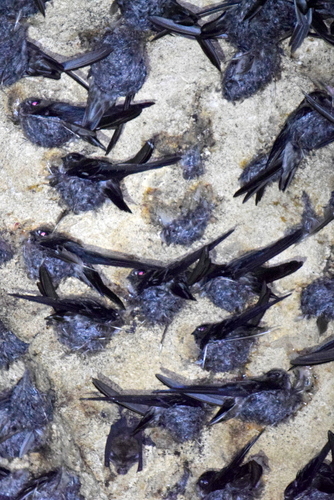
Black-nest Swiftlet (Aerodramus maximus) Black-nest Swiftlet
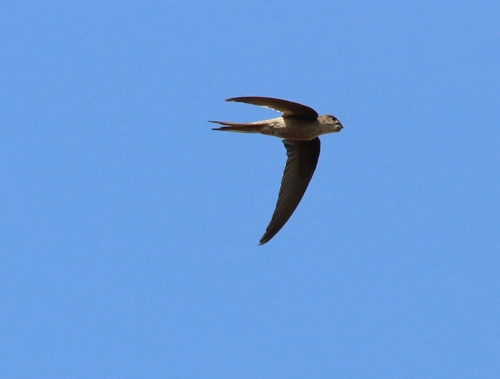
Asian Palm Swift (Cypsiurus balasiensis) Asian Palm Swift

Media

Loading…

In short

The most reliable field mark to separate Black-nest Swiftlet from Asian Palm Swift is the combination of structure and plumage: Asian Palm Swift is noticeably paler brown overall, with a very slender, long-winged, and deeply forked-tailed silhouette, while Black-nest Swiftlet is darker and more compact, with a less deeply forked tail. In flight, Asian Palm Swift shows a distinctive boomerang or crescent-shaped wing profile and a long, narrow body, whereas Black-nest Swiftlet appears chunkier and darker. If you see a swift with a very long, deeply forked tail and pale brown coloration, especially around palms or open country, it is almost certainly Asian Palm Swift. Black-nest Swiftlet is more likely in forested or montane habitats and lacks the extreme tail and wing shape of the palm swift.

Identification tips

  1. Tail shape: Asian Palm Swift has a very long, deeply forked tail, often held closed but still noticeably longer and more pointed than Black-nest Swiftlet. This is true for adults; juveniles have shorter tails but still show a fork. Black-nest Swiftlet's tail is shorter and less deeply forked.
  2. Wing shape: In flight, Asian Palm Swift shows long, swept-back wings forming a crescent or boomerang shape, giving a very distinctive jizz. Black-nest Swiftlet's wings are shorter and less dramatically curved.
  3. Overall coloration: Asian Palm Swift is mainly pale brown, while Black-nest Swiftlet is much darker overall. This contrast is visible in all ages and light conditions.
  4. Body structure: Asian Palm Swift is very slender and elongated, with a narrow body and long wings and tail. Black-nest Swiftlet appears chunkier and more compact.
  5. Habitat context: Asian Palm Swift is almost always seen around palms, open country, or cultivated areas. Black-nest Swiftlet is found in forests and montane habitats, rarely in open or palm-dominated areas.
  6. Perching behavior: Asian Palm Swift only clings to vertical surfaces (like palm leaves) and never settles on the ground. Black-nest Swiftlet may be seen entering or leaving caves or clinging to cave walls.
  7. Flight style: Asian Palm Swift often flies low over open areas and can be seen feeding near the ground. Black-nest Swiftlet is more likely to be seen higher over forests or near cave entrances.
  8. Vocalization: If you hear a loud, shrill scream from a swift, it is likely Asian Palm Swift. Lack of vocalization is not diagnostic for Black-nest Swiftlet.
  9. Nest location: Asian Palm Swift builds its nest on the underside of palm leaves, visible if you see swifts around palms. Black-nest Swiftlet nests in caves, which is not usually visible in the field but may help if you observe nesting behavior.
  10. Juvenile marks: Juvenile Asian Palm Swifts have shorter tails but are still pale brown and slender; Black-nest Swiftlet juveniles are not described in detail but are expected to be dark and compact like adults.
  11. Sex differences: Both species have similar sexes, so do not rely on sex for identification.
  12. Confusion risk: In poor light or at distance, focus on tail length and fork, wing shape, and overall darkness versus paleness. Asian Palm Swift's silhouette is unique among swifts in the region.
  13. Seasonal presence: Both species are resident in their ranges, so season is not a strong separator.
  14. Group behavior: Asian Palm Swifts often occur in flocks, especially around palms; Black-nest Swiftlet may be seen singly or in smaller groups near caves or forest edges.
  15. Feeding height: Asian Palm Swift frequently feeds low, sometimes just above ground level; Black-nest Swiftlet usually feeds higher over forest canopy.

Size

Asian Palm Swift is a small swift, with an adult body mass around 9.2g [wikidata]. Black-nest Swiftlet's mass is not provided, but its overall structure is chunkier and more compact compared to the slender, elongated Asian Palm Swift. In the field, Asian Palm Swift will appear more delicate and elongated, especially due to its long tail and wings, while Black-nest Swiftlet will look heavier and shorter-tailed.

Plumage

Juvenile Asian Palm Swifts have shorter tails than adults, but otherwise, both adults and immatures are mainly pale brown and lack strong contrast or markings. Their wings are long and swept back, giving a crescent or boomerang shape in flight. Black-nest Swiftlet, by contrast, is overall much darker, lacking the pale brown tones of Asian Palm Swift, and does not show the same wing or tail shape. No distinctive age-specific upperwing pattern is described for either species, so separation relies on overall darkness (Black-nest Swiftlet) versus paleness and tail/wing shape (Asian Palm Swift) in all plumages.

Behaviour

Asian Palm Swifts are almost always seen on the wing, rarely perching except clinging vertically to palm leaves. They feed low over open country and plantations, often near the ground and around palms. Black-nest Swiftlets are also aerial insectivores but are more associated with forested areas and caves for nesting. Asian Palm Swifts are more likely to be seen in open, cultivated, or palm-rich environments, often in flocks, while Black-nest Swiftlet is more likely in forested or montane settings.

Habitat

Asian Palm Swift is strongly associated with open country, cultivation, and especially oil palms, often nesting on the underside of palm leaves. Black-nest Swiftlet is found in subtropical or tropical moist lowland and montane forests, and is not tied to palms or open habitats. If you see a swift in a palm plantation or open area, Asian Palm Swift is much more likely; in dense forest or near caves, Black-nest Swiftlet is the better candidate.

Voice

Asian Palm Swift gives a loud, shrill scream, which can be a helpful clue in the field. There is no vocalization information provided for Black-nest Swiftlet, so voice is only useful for confirming Asian Palm Swift.

Submit a better description

Use the same sections as the comparison. Your text is published immediately.

The most reliable field mark to separate Black-nest Swiftlet from Asian Palm Swift is the combination of structure and plumage: Asian Palm Swift is noticeably paler brown overall, with a very slender, long-winged, and deeply forked-tailed silhouette, while Black-nest Swiftlet is darker and more compact, with a less deeply forked tail. In flight, Asian Palm Swift shows a distinctive boomerang or crescent-shaped wing profile and a long, narrow body, whereas Black-nest Swiftlet appears chunkier and darker. If you see a swift with a very long, deeply forked tail and pale brown coloration, especially around palms or open country, it is almost certainly Asian Palm Swift. Black-nest Swiftlet is more likely in forested or montane habitats and lacks the extreme tail and wing shape of the palm swift.

  1. Tail shape: Asian Palm Swift has a very long, deeply forked tail, often held closed but still noticeably longer and more pointed than Black-nest Swiftlet. This is true for adults; juveniles have shorter tails but still show a fork. Black-nest Swiftlet's tail is shorter and less deeply forked.
  2. Wing shape: In flight, Asian Palm Swift shows long, swept-back wings forming a crescent or boomerang shape, giving a very distinctive jizz. Black-nest Swiftlet's wings are shorter and less dramatically curved.
  3. Overall coloration: Asian Palm Swift is mainly pale brown, while Black-nest Swiftlet is much darker overall. This contrast is visible in all ages and light conditions.
  4. Body structure: Asian Palm Swift is very slender and elongated, with a narrow body and long wings and tail. Black-nest Swiftlet appears chunkier and more compact.
  5. Habitat context: Asian Palm Swift is almost always seen around palms, open country, or cultivated areas. Black-nest Swiftlet is found in forests and montane habitats, rarely in open or palm-dominated areas.
  6. Perching behavior: Asian Palm Swift only clings to vertical surfaces (like palm leaves) and never settles on the ground. Black-nest Swiftlet may be seen entering or leaving caves or clinging to cave walls.
  7. Flight style: Asian Palm Swift often flies low over open areas and can be seen feeding near the ground. Black-nest Swiftlet is more likely to be seen higher over forests or near cave entrances.
  8. Vocalization: If you hear a loud, shrill scream from a swift, it is likely Asian Palm Swift. Lack of vocalization is not diagnostic for Black-nest Swiftlet.
  9. Nest location: Asian Palm Swift builds its nest on the underside of palm leaves, visible if you see swifts around palms. Black-nest Swiftlet nests in caves, which is not usually visible in the field but may help if you observe nesting behavior.
  10. Juvenile marks: Juvenile Asian Palm Swifts have shorter tails but are still pale brown and slender; Black-nest Swiftlet juveniles are not described in detail but are expected to be dark and compact like adults.
  11. Sex differences: Both species have similar sexes, so do not rely on sex for identification.
  12. Confusion risk: In poor light or at distance, focus on tail length and fork, wing shape, and overall darkness versus paleness. Asian Palm Swift's silhouette is unique among swifts in the region.
  13. Seasonal presence: Both species are resident in their ranges, so season is not a strong separator.
  14. Group behavior: Asian Palm Swifts often occur in flocks, especially around palms; Black-nest Swiftlet may be seen singly or in smaller groups near caves or forest edges.
  15. Feeding height: Asian Palm Swift frequently feeds low, sometimes just above ground level; Black-nest Swiftlet usually feeds higher over forest canopy.

Asian Palm Swift is a small swift, with an adult body mass around 9.2g [wikidata]. Black-nest Swiftlet's mass is not provided, but its overall structure is chunkier and more compact compared to the slender, elongated Asian Palm Swift. In the field, Asian Palm Swift will appear more delicate and elongated, especially due to its long tail and wings, while Black-nest Swiftlet will look heavier and shorter-tailed.

Juvenile Asian Palm Swifts have shorter tails than adults, but otherwise, both adults and immatures are mainly pale brown and lack strong contrast or markings. Their wings are long and swept back, giving a crescent or boomerang shape in flight. Black-nest Swiftlet, by contrast, is overall much darker, lacking the pale brown tones of Asian Palm Swift, and does not show the same wing or tail shape. No distinctive age-specific upperwing pattern is described for either species, so separation relies on overall darkness (Black-nest Swiftlet) versus paleness and tail/wing shape (Asian Palm Swift) in all plumages.

Asian Palm Swifts are almost always seen on the wing, rarely perching except clinging vertically to palm leaves. They feed low over open country and plantations, often near the ground and around palms. Black-nest Swiftlets are also aerial insectivores but are more associated with forested areas and caves for nesting. Asian Palm Swifts are more likely to be seen in open, cultivated, or palm-rich environments, often in flocks, while Black-nest Swiftlet is more likely in forested or montane settings.

Asian Palm Swift is strongly associated with open country, cultivation, and especially oil palms, often nesting on the underside of palm leaves. Black-nest Swiftlet is found in subtropical or tropical moist lowland and montane forests, and is not tied to palms or open habitats. If you see a swift in a palm plantation or open area, Asian Palm Swift is much more likely; in dense forest or near caves, Black-nest Swiftlet is the better candidate.

Asian Palm Swift gives a loud, shrill scream, which can be a helpful clue in the field. There is no vocalization information provided for Black-nest Swiftlet, so voice is only useful for confirming Asian Palm Swift.

Discard your changes?

You have unsaved edits. If you leave now, those changes will be lost.

Black-nest Swiftlet · Asian Palm Swift · My Tricky Birds