
Blackpoll Warbler vs Palm Warbler
Setophaga striata versus Setophaga palmarum
Play a quiz with Blackpoll Warbler and Palm Warbler
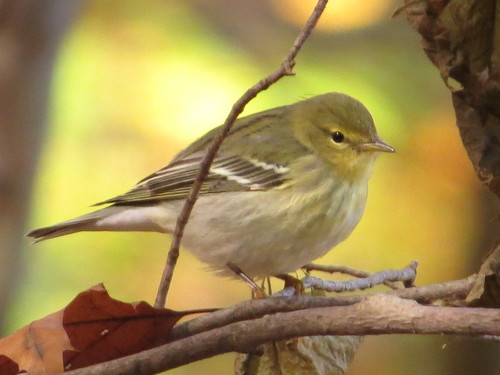 Blackpoll Warbler
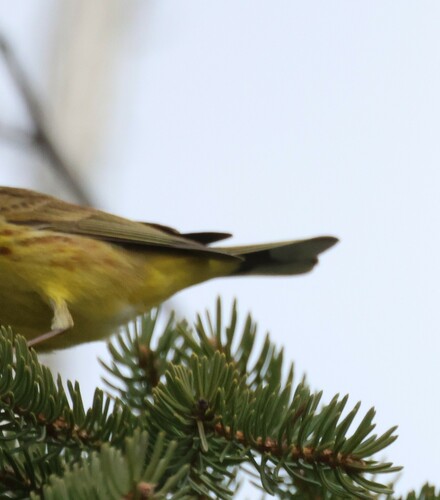 Palm Warbler
In short
The most reliable field mark to separate Blackpoll Warbler from Palm Warbler is the presence of a bold black cap and crisp white cheeks on breeding male Blackpolls, versus the constant tail-bobbing behavior and yellowish underparts of Palm Warbler. In non-breeding and immature plumages, both can show olive or yellowish tones and wing bars, making them tricky to distinguish—especially in fall. However, Palm Warbler’s persistent tail wagging and lack of strong head pattern, along with differences in leg color and underpart streaking, are key. Structure and size are very similar, so focus on behavior and head/face pattern for the most reliable separation.
Identification tips
- Tail bobbing: Palm Warbler constantly bobs its tail, even when perched or foraging on the ground; Blackpoll Warbler never does this. This is the single most reliable behavioral mark in all seasons and ages.
- Head pattern (breeding males): Blackpoll Warbler shows a bold black cap and crisp white cheeks; Palm Warbler lacks any strong head pattern, instead showing a plain face with a faint supercilium. This is diagnostic for adult males in spring/summer.
- Leg color: Blackpoll Warbler has bright orangish-pink legs, visible even in duller plumages; Palm Warbler’s legs are always dark. This mark works in all ages and seasons if legs are visible.
- Underpart color (fall/winter/immature): Palm Warbler always shows yellow undertail coverts and usually a yellow wash to the underparts, especially in the eastern subspecies; Blackpoll Warbler in non-breeding plumage may show yellowish tones but never as bright or extensive as Palm Warbler, and the undertail is not as strongly yellow.
- Underpart streaking: Blackpoll Warbler (all ages) shows fine black streaks on white underparts in breeding plumage, and streaking is usually present even in duller plumages; Palm Warbler has streaked flanks but the streaks are rufous (especially in eastern birds) and the background is yellow, not white.
- Wing bars: Both species show two white wing bars in all plumages, so this is not helpful for separation.
- Face pattern (non-breeding/immature): Blackpoll Warbler lacks the strong supercilium of Palm Warbler and may show a more contrasting face, but in dull plumages this can be subtle. Palm Warbler has a faint but usually visible pale eyebrow.
- Foraging behavior: Palm Warbler is often seen on the ground, walking and tail-bobbing; Blackpoll Warbler is more arboreal, foraging higher in trees, especially during migration.
- Habitat in winter: If seen in the southeastern US in winter, it is almost certainly Palm Warbler; Blackpoll Warbler winters in South America and is absent from North America at that time.
- Migration timing: Palm Warbler is an early spring migrant, often appearing before most other warblers; Blackpoll Warbler migrates later in spring and is one of the last warblers to arrive.
- Bill and structure: Both species have similar slender bills and overall proportions; structure is not a reliable field mark.
- Flight views (immature/fall): No distinctive upperwing or flight pattern differences are described between these species, so focus on tail bobbing and underpart color if seen in flight.
- Vocalizations: If a buzzy trill is heard, it points to Palm Warbler; Blackpoll’s song is not covered in these notes.
- Subspecies confusion: Western Palm Warblers are duller and browner, which can resemble fall Blackpolls, but still show tail bobbing and yellow undertail coverts.
- Quiz pitfalls: Most mix-ups occur with dull fall or immature birds; always look for tail bobbing, leg color, and undertail color as your first checks.
Size
Both species are similar in size, falling within the typical range for Setophaga warblers. Blackpoll Warbler averages slightly heavier (body mass ~12.3 g [wikidata]) and can reach up to 15 cm in length with a wingspan up to 25 cm [wikipedia], while Palm Warbler is a bit lighter (8.5–14.2 g) and slightly shorter (12–14 cm length, 20–21 cm wingspan) [wikipedia]. These differences are subtle and rarely diagnostic in the field, so size alone should not be relied upon to separate them.
Plumage
In breeding plumage, adult male Blackpoll Warblers are strikingly black and white, with a solid black cap, white cheeks, and two white wing bars. Females are duller but still show a pale face and wing bars, lacking the strong black cap. In fall and winter, Blackpolls become much duller, with greenish heads, streaked olive upperparts, and yellowish-tinged underparts—often resembling Palm Warbler. Juvenile and first-winter Blackpolls are even more subdued, but always retain obvious wing bars and never show the bright yellow undertail or persistent yellow wash below typical of Palm Warbler. Palm Warbler, in both subspecies, shows yellow undertail coverts year-round, with the 'eastern' form (hypochrysea) especially bright yellow below and rufous-streaked flanks, while the 'western' form (palmarum) is duller and browner. Both forms lack a strong head pattern, instead showing a faint supercilium and a plain face. Palm Warbler always bobs its tail, a unique behavioral clue. Leg color is also helpful: Blackpoll Warbler has bright orangish-pink legs, while Palm Warbler’s legs are dark.
Behaviour
Palm Warbler is unique among Setophaga warblers for its constant tail bobbing, both on the ground and in trees, which is a highly reliable behavioral cue. It also forages on the ground more frequently than Blackpoll Warbler, which tends to stay higher in the canopy during migration and breeding. Blackpoll Warbler does not show persistent tail wagging. Both species may be seen during migration, but Palm Warbler’s ground-foraging and tail-wagging are distinctive.
Habitat
During migration, both species can be found in a variety of habitats, including woodlands, edges, and shrubby areas. On breeding grounds, Blackpoll Warbler prefers northern coniferous forests, while Palm Warbler breeds in open bogs and shrubby areas, often near the ground. In winter, Palm Warbler is much more likely to be found in open, weedy fields, edges, and even urban parks in the southeastern US, while Blackpoll Warbler winters in South America and is not present in North America at that time.
Voice
Palm Warbler’s song is a monotonous buzzy trill, and its call is a sharp 'chek.' Blackpoll Warbler’s vocalizations are not described in the provided notes, so voice is only helpful for Palm Warbler, especially if the buzzy trill is heard. However, both are generally quiet during migration, and song is rarely a primary field mark outside the breeding season.