
Blue-tailed Bee-eater vs Rainbow Bee-eater
Merops philippinus versus Merops ornatus
Play a quiz with Blue-tailed Bee-eater and Rainbow Bee-eater
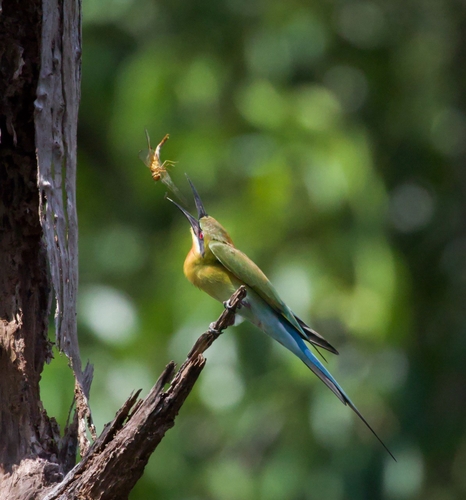 Blue-tailed Bee-eater
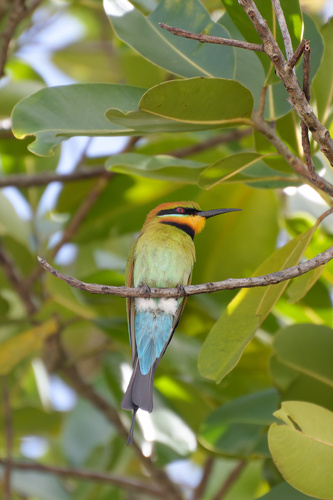 Rainbow Bee-eater
In short
The most reliable field mark to separate Blue-tailed Bee-eater from Rainbow Bee-eater is the color and extent of blue on the rump and tail: Blue-tailed shows a bright blue tail and rump, while Rainbow has a blue lower back but a darker, often blackish or violet tail. Adult Rainbow Bee-eaters also have a distinctive black throat band (gorget) and more extensive yellow-orange on the underparts, which Blue-tailed lacks. Juveniles of both species lack the long tail streamers, but Rainbow juveniles are duller with a greener crown and no throat band. Both species are slender, greenish bee-eaters with black eye stripes and elongated central tail feathers, but careful attention to tail and throat coloration, especially in perched birds, is key.
Identification tips
- Tail color (all ages): Blue-tailed Bee-eater always shows a bright blue tail and rump, while Rainbow Bee-eater has a blue lower back but a tail that is blackish or deep violet. This is most obvious in perched birds and is reliable in both adults and juveniles.
- Throat band (adults): Rainbow Bee-eater has a bold black crescent-shaped gorget across the yellow-orange throat, absent in Blue-tailed. This is a quick separator in adults.
- Underparts color (adults): Rainbow Bee-eater shows extensive pale yellow-orange from the crown through the breast and belly, while Blue-tailed has a yellow and brown throat but otherwise green underparts.
- Face pattern: Both have a black eye stripe, but Blue-tailed's blue face patch is narrower and less extensive than Rainbow's blue edging to the eye stripe.
- Juvenile plumage: Juvenile Rainbow Bee-eaters are duller, with a greener crown and no throat band or tail streamers; juvenile Blue-taileds are also drabber and lack streamers, but the blue tail is still apparent.
- Tail streamers (sex/age): Both species have elongated central tail feathers in adults, longer in males. Juveniles of both lack streamers, so don't rely on this alone for age/sex separation.
- Rump color: Blue-tailed's rump is bright blue and contrasts with the green back; Rainbow's lower back is blue but the tail is darker, so look for a sharp blue rump vs. blue undertail coverts.
- Size: Blue-tailed is marginally larger and heavier, but this is not a reliable field mark unless birds are side by side.
- Habitat context: Blue-tailed is more strictly tied to water and open river valleys, while Rainbow can be found in drier open country as well as near wetlands.
- Behavior: Both sally for insects and beat prey on perches, but Blue-tailed is more likely to be seen in large migratory flocks, especially near water.
- Nesting: Both nest colonially in sandy banks, but Rainbow is more likely to share tunnels with other bee-eaters and even other bird species.
- Voice: Blue-tailed gives a rolling, chirping 'teerp' in flight; Rainbow's call is not described here, so use with caution.
- Sex differences: In both, males have longer tail streamers; in Blue-tailed, males may have darker chestnut throats and brighter green plumage, but this is subtle and not usually visible in the field.
- Flight views: In flight, focus on tail color and length, and the presence or absence of the black throat band (only in Rainbow adults).
- Common pitfalls: Immature birds of both species lack tail streamers and can appear similar; rely on tail and rump color and the presence/absence of the throat band for the best separation.
Size
Both species are similar in overall size and structure, being slender and medium-sized bee-eaters. Blue-tailed Bee-eater averages about 29 cm in length (excluding the 7 cm tail streamers) and weighs 29–43 g [wikipedia], while Rainbow Bee-eater is slightly smaller at 23–28 cm including streamers and weighs 20–33 g [wikidata]. In the field, this size difference is subtle and not usually diagnostic unless seen side by side.
Plumage
- Juveniles: Both species lack elongated central tail feathers when immature. Juvenile Blue-tailed Bee-eaters are generally drabber green overall, while juvenile Rainbow Bee-eaters are also duller but show a greener crown and lack both the throat band and tail streamers.
- Adults: Blue-tailed Bee-eater has a predominantly green body, a narrow blue patch on the face, a black eye stripe, a yellow and brown throat, and a bright blue rump and tail. Rainbow Bee-eater adults show a green upper back and wings, bright blue lower back and under-tail coverts, a black to deep violet tail, a pale yellow-orange crown, breast, and throat, and a bold black crescent gorget across the throat. The black gorget and more extensive yellow-orange underparts are unique to Rainbow.
- Tail: Blue-tailed's tail is blue throughout, while Rainbow's is darker (blackish or violet) with blue only on the lower back and undertail coverts. Both have elongated central tail feathers in adults, longer in males.
Behaviour
Both species are aerial insectivores, sallying from open perches to catch flying insects, especially bees. Both beat prey on perches to kill and disarm them. Blue-tailed Bee-eaters are often seen in flocks, especially during migration, and may forage over water, estuaries, and even the sea (but not far from shore). Rainbow Bee-eaters also perch conspicuously and dig nest burrows, sometimes communally, and are known for their piston-like burrow ventilation behavior. Both species nest colonially in sandy banks, but Rainbow is noted for sharing tunnels with other bee-eaters and sometimes other species.
Habitat
Blue-tailed Bee-eater is mostly found in open habitats close to water, such as river valleys, lakeshores, and estuaries across South and Southeast Asia. Rainbow Bee-eater occupies a similar ecological niche in Australia and nearby regions, favoring open country, woodland edges, and sandy banks for nesting, sometimes near wetlands but also in drier areas. Both species require sandy or loamy soils for nesting burrows but are not strictly tied to water in the case of Rainbow Bee-eater.
Voice
Blue-tailed Bee-eater gives a rolling, chirping, whistling 'teerp' call, mainly in flight. Rainbow Bee-eater's vocalizations are not described in the provided notes, so voice is not a reliable separator based on current information.