

Blyth's Reed Warbler vs Common Reed Warbler
Acrocephalus dumetorum versus Acrocephalus scirpaceus
Play a quiz with Blyth's Reed Warbler and Common Reed Warbler
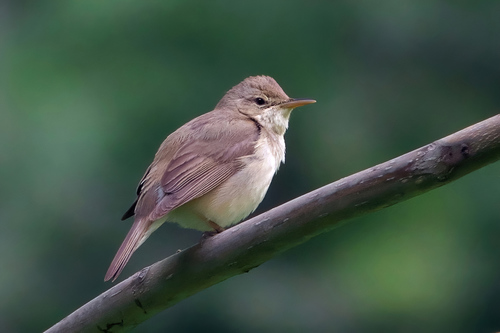 Blyth's Reed Warbler
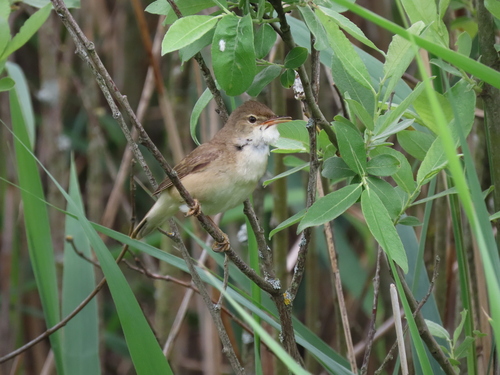 Common Reed Warbler
In short
The most reliable field mark between Blyth's Reed Warbler and Common Reed Warbler is the overall colder, plainer, and more olive-brown upperparts of Blyth's, lacking any warm or rufous tones, combined with its shorter, rounder wings and longer, thicker bill. Juvenile Common Reed Warblers are distinctly richer buff below, while Blyth's is always plainer and more off-white underneath. In direct comparison, Blyth's Reed Warbler appears slimmer, with a less flattened forehead and a less obvious supercilium. Structural and subtle plumage differences are key, as both species are unstreaked brown warblers with similar habits and habitats, making confusion common, especially in non-singing, perched birds.
Identification tips
- Underpart color in juveniles: Juvenile Common Reed Warblers are distinctly richer buff below, especially on the breast and flanks, while Blyth's Reed Warbler is always plainer and more off-white underneath. This is a key mark in late summer and autumn.
- Upperpart tone: Blyth's Reed Warbler has plain, cold olive-brown upperparts, lacking any warm or rufous tones. Common Reed Warbler can show warmer brown or even rufous hues, especially on the back and wings, but this is subtle and variable.
- Supercilium: Blyth's has a short, faint whitish supercilium that only extends from the bill base to the eye, while Common Reed Warbler's supercilium, though still weak, may be slightly longer and more obvious in some individuals. Neither species has a strong supercilium.
- Bill structure: Blyth's Reed Warbler has a noticeably longer and thicker bill, with a pale pinkish-brown base to the lower mandible. Common Reed Warbler's bill is strong and pointed but shorter and less robust in direct comparison.
- Wing shape: Blyth's has shorter, rounder wings, giving a more compact appearance when perched and in flight, while Common Reed Warbler's wings are longer and more pointed. This is subtle and best judged with experience or side-by-side views.
- Leg and foot color: Both species have pale pinkish-brown legs and feet, so this is not a separator.
- Forehead shape: Common Reed Warbler has a flatter forehead, while Blyth's is less so, but this is a minor and subjective feature.
- Song: Blyth's Reed Warbler's song is more varied, with harsh ticks, chaks, and churrs mixed with melodious whistles and mimicry. Common Reed Warbler's song is slower, more rhythmic, and less harsh, with chattering 'jit-jit-jit' notes. Use song only if heard well.
- Habitat context: If seen away from reedbeds, especially in woodland edge, gardens, or scrub, consider Blyth's Reed Warbler, though Common Reed Warbler can occur in bushes on migration. In pure reedbeds, Common Reed Warbler is much more likely.
- Range and season: In western Europe, Blyth's Reed Warbler is still rare but increasing, especially outside reedbeds. Common Reed Warbler is widespread in suitable reedbed habitat.
- Plumage uniformity: Blyth's Reed Warbler is overall plainer and less contrasting, with little difference between upperparts and underparts. Common Reed Warbler, especially juveniles, can show more contrast between brown upperparts and buff underparts.
- Behavior: Blyth's may be seen higher in trees or shrubs, while Common Reed Warbler usually stays low in reeds, but both can overlap in dense vegetation.
- Flight jizz: Blyth's shorter, rounder wings may give a more fluttery, less direct flight compared to the more purposeful flight of Common Reed Warbler, but this is subtle and not always reliable.
- Sex and age: Both species are sexually monomorphic in plumage, so sex is not a separator. Age differences are most useful in underpart color for Common Reed Warbler.
- No distinctive wing panels: Neither species shows strong wing panels, contrasting edges, or other distinctive upperwing marks at any age, so focus on overall tone and structure.
Size
Both species are very similar in size, with Blyth's Reed Warbler measuring 12–14 cm in length and Common Reed Warbler about 13 cm. Blyth's is slightly lighter on average (8–16 g vs. 12 g), but this is not a practical field mark. Wing length and span are not distinctly different in the field, though Blyth's has relatively shorter, rounder wings compared to the slightly longer-winged Common Reed Warbler. Overall, size is not a reliable separator.
Plumage
Juvenile and first-year Common Reed Warblers show noticeably richer buff underparts, especially on the breast and flanks, while Blyth's Reed Warbler of any age remains plainer and more off-white below. Both species have unstreaked brown upperparts, but Blyth's is colder olive-brown, lacking the warmer or rufous tones sometimes seen in Common Reed Warbler. The supercilium in Blyth's is short and subtle, only running from the bill base to the eye, while Common Reed Warbler can show a slightly more extensive but still weak supercilium. Both have a dusky eye-stripe. The bill of Blyth's is longer and thicker, with a pale pinkish-brown lower mandible, and the legs are similarly colored. No distinctive wing panels or contrasting edges are described for either species at any age, so upperwing pattern is not a separator here.
Behaviour
Both species are solitary and territorial during breeding, often skulking in dense vegetation. Blyth's Reed Warbler may be slightly more arboreal, using woodland edges, clearings, and even gardens, while Common Reed Warbler is more strictly associated with reedbeds. Both forage actively and can be hard to see well, but Blyth's may be seen higher in shrubs or trees. In flight, Blyth's shorter, rounder wings may give a subtly different jizz, but this is subtle and best appreciated with experience.
Habitat
Blyth's Reed Warbler breeds in damp broadleaved woodland edges, clearings, wooded gullies, parks, gardens, and sometimes coniferous forest, showing a broader habitat tolerance than Common Reed Warbler, which is strongly tied to reedbeds and waterside vegetation. In winter, Blyth's is found in trees in both wet and dry habitats in South Asia, while Common Reed Warbler winters in sub-Saharan Africa, mostly in reeds. Overlap is possible in migration, but Blyth's is more likely away from pure reedbeds.
Voice
Both species have variable songs with mimicry, but Blyth's Reed Warbler's song is more varied, mixing harsh ticks, chaks, and churrs with melodious whistles. Common Reed Warbler's song is a slower, chattering 'jit-jit-jit' with acrocephaline whistles and mimicry, but is generally less harsh and more rhythmic. Calls are not well described for separation, but song differences can be useful if heard well.
Blyth's Reed Warbler · Common Reed Warbler · My Tricky Birds