
Bridled Tern vs Grey-backed Tern
Onychoprion anaethetus versus Onychoprion lunatus
Play a quiz with Bridled Tern and Grey-backed Tern
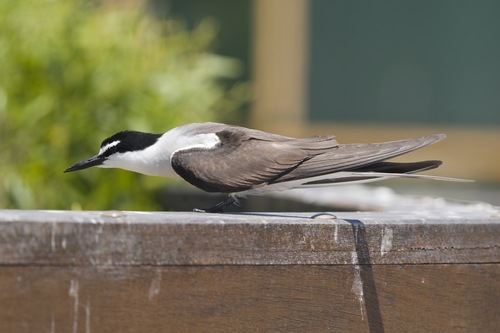 Bridled Tern
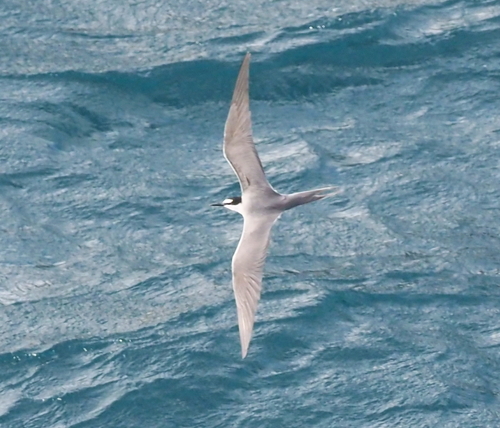 Grey-backed Tern
In short
The most reliable field mark between Bridled Tern and Grey-backed (Spectacled) Tern is the color and tone of the upperparts: Bridled Tern shows distinctly darker, slate-gray upperparts with a strong white hindneck collar, while Grey-backed Tern is noticeably paler gray above and lacks the crisp collar. Both species have white underparts and a black eye-line, but the Bridled Tern’s white forehead is narrower and its dark upperparts contrast more with the underparts. Juvenile Bridled Terns are scaly above, a feature not described for Grey-backed. In flight or perched, focus on the contrast between the back color and the sharpness of the white collar to separate these two, especially in mixed tern flocks.
Identification tips
- Upperpart Color (All Ages): Bridled Tern has distinctly darker, slate-gray upperparts compared to the paler gray of Grey-backed Tern. This is the most consistent field mark in all light conditions.
- White Hindneck Collar (Adult Bridled): Bridled Tern shows a crisp, white collar on the hindneck, especially obvious in adults. Grey-backed Tern lacks this strong collar, making the neck appear less sharply marked.
- Facial Pattern (All Ages): Both species have a black eye-line, but Bridled Tern’s white forehead is narrower and its white eyebrow is more prominent, giving a more 'masked' look. Grey-backed’s face is less sharply marked.
- Juvenile Upperparts: Juvenile Bridled Terns are scaly gray above, a feature not described for Grey-backed Tern. Look for this scaly pattern in young birds.
- Back Contrast (All Ages): In mixed flocks, Bridled Tern’s back appears much darker than Grey-backed, which can look washed out or silvery by comparison.
- Tail Shape: Both species have deeply forked tails, so this is not useful for separation.
- Bill and Legs: Both have black bills and legs; these are not helpful for separation.
- Underparts: Both have white underparts; do not use this for identification.
- Flight Style: Bridled Tern is noted to dive directly for prey, not using a stepped-hover. If observed foraging, this could help, but is subtle and not always visible.
- Perched Birds: When perched, focus on the contrast between the upperparts and the white collar for Bridled Tern. Grey-backed will look paler and less crisply marked.
- Immature Birds in Flight: If you see a scaly pattern on the back, favor Bridled Tern. If the back is smooth and pale, consider Grey-backed.
- Colony Context: Both species breed colonially, so location alone is not diagnostic, but Grey-backed is generally less common.
- Voice: No distinguishing vocalizations are described in the notes; do not rely on calls for separation.
- Season/Sex: No seasonal or sexual dimorphism is noted for either species; all field marks apply year-round and to both sexes.
- Pitfalls: In poor light, the back color difference can be subtle. Always look for the combination of darker back and crisp white collar for Bridled Tern, versus paler back and less defined neck for Grey-backed.
Size
Both species are medium-sized terns, with Bridled Tern measuring 30–32 cm in length and a wingspan of 77–81 cm [wikipedia]. No direct size data is given for Grey-backed Tern, but it is considered closely similar in size and structure. Thus, size is not a reliable field mark for separation in the field.
Plumage
Juvenile Bridled Terns are scaly gray above and pale below, a pattern not described for Grey-backed Tern, which may help with immatures. Adult Bridled Terns have dark gray upperparts, a narrow white forehead, prominent white eyebrows, and a striking white collar on the hindneck. Grey-backed Tern (Spectacled) is paler gray above, with a less contrasting back, and lacks the strong white collar. Both have white underparts and a black eye-line, but the Bridled Tern’s facial markings are bolder and more sharply defined. In all plumages, the back color is a key difference: Bridled is darker, Grey-backed is paler. The tail of both is deeply forked, and both have black bills and legs.
Behaviour
Both species are pelagic terns, feeding by plunge-diving for fish and sometimes picking from the surface. Bridled Tern is noted for diving directly rather than using a stepped-hover. No specific foraging or flight behavior differences are described for Grey-backed Tern. Both breed colonially on islands.
Habitat
Both species are tropical ocean terns, breeding on rocky or sandy islands. No habitat differences are detailed in the notes, but Grey-backed Tern is described as less common and less studied than Bridled Tern.