
Buff-headed Coucal vs Pacific Koel
Centropus milo versus Eudynamys orientalis
Play a quiz with Buff-headed Coucal and Pacific Koel
 Buff-headed Coucal
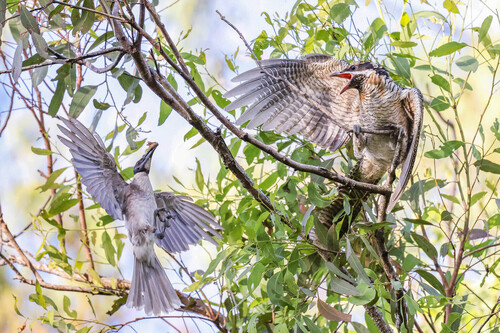 Pacific Koel
In short
The most reliable field mark between Buff-headed Coucal and Pacific Koel is the Buff-headed Coucal’s striking buff-colored head and underparts in adults, which never occurs in Pacific Koel of any age or sex. Juvenile Buff-headed Coucals are also distinctive, being heavily mottled and barred brown, while juvenile and female Pacific Koels are brown above with white spots and streaked or barred underparts, but lack the Coucal’s buff tones and strong barring. Structurally, Buff-headed Coucal is a much heavier, bulkier bird with a massive bill and short wings, contrasting with the slimmer, longer-tailed, and more streamlined Pacific Koel. If you see a large, heavy-bodied cuckoo with a buff head and underparts, it is Buff-headed Coucal; a slimmer, black or brown bird with red eyes is Pacific Koel.
Identification tips
- Buff head and underparts (adult Buff-headed Coucal): Only Buff-headed Coucal shows a buff-colored head, upper back, and underparts. Pacific Koel never shows this, regardless of age or sex.
- Glossy black wings and tail (adult Buff-headed Coucal): Contrasts with the buff body; Pacific Koel males are all black, but without the two-toned effect.
- Juvenile plumage: Juvenile Buff-headed Coucal is brown with black mottling and reddish-brown, barred wings and tail. Juvenile Pacific Koel is brown above with white spots and cream underparts with fine dark streaks—never as heavily barred or mottled as the Coucal.
- Female plumage: Female Pacific Koel is brown above with white spots and cream underparts with black streaks. Buff-headed Coucal females look like males (buff and black), never spotted or streaked below.
- Bill structure: Buff-headed Coucal has a massive, heavy bill (dark grey in adults, bicolored in juveniles). Pacific Koel’s bill is slimmer and less robust.
- Body structure: Buff-headed Coucal is bulkier, with a heavy body and short wings. Pacific Koel is more slender and elongated, with a longer tail and wings.
- Flight style: Coucal flies in short, heavy, labored bursts, often low to the ground. Koel flies more directly and swiftly, usually higher in the canopy.
- Eye color: Adult Buff-headed Coucal and Pacific Koel both have red eyes. Juvenile Coucal has brown-grey eyes; juvenile Koel has dark eyes.
- Bill color (juveniles): Juvenile Buff-headed Coucal has a bicolored bill (brown above, pale horn below); Koel juveniles have a paler, but not bicolored, bill.
- Habitat: Buff-headed Coucal is restricted to central Solomon Islands forests; Pacific Koel is widespread in Australasia and Southeast Asia, in a variety of wooded habitats.
- Vocalization: Persistent, loud, repetitive calls indicate Pacific Koel. Buff-headed Coucal is much quieter.
- Tail pattern: Koel’s tail is long and often appears graduated; Coucal’s tail is broad and less elongated.
- Behavior: Coucal is more likely to be seen clambering through dense undergrowth or low branches; Koel is more arboreal and rarely seen on the ground.
- Relative size: If the bird appears exceptionally large and heavy for a cuckoo, it is likely Buff-headed Coucal.
- Local context: If you are outside the Solomon Islands, Buff-headed Coucal is extremely unlikely.
Size
Buff-headed Coucal is significantly larger and heavier than Pacific Koel. It measures 60–69 cm in length and weighs around 769 g, making it possibly the largest cuckoo species [wikipedia]. Pacific Koel is large for a cuckoo but is slimmer and lighter, with a more elongated body and tail. The Coucal’s bulk, heavy bill, and short wings are obvious even at a distance, whereas the Koel looks sleeker and more elongated, especially in flight.
Plumage
- Juveniles: Juvenile Buff-headed Coucal is brown, mottled with black, and has reddish-brown wings and tail with black barring. The iris is brown-grey and the bill is bicolored (brown above, pale horn below). In contrast, juvenile Pacific Koel resembles the female: brown above with white spots, cream underparts with dark streaks or bars, and dark eyes. No buff tones or heavy barring as in the Coucal.
- Adult males: Buff-headed Coucal adults have a buff head, upper back, and underparts, with glossy black wings, lower back, and tail. Pacific Koel adult males are all black with blue-green gloss and red eyes—never buff or two-toned.
- Adult females: Female Pacific Koel is brown above with white spots and cream underparts with fine black stripes, lacking the Coucal’s buff coloration. Buff-headed Coucal females look like males (buff and black).
- Iris color: Adult Buff-headed Coucal has red eyes; juvenile has brown-grey. Pacific Koel adults (both sexes) have red eyes; juveniles have dark eyes.
- Bill color: Buff-headed Coucal adults have dark grey bills; juveniles have bicolored bills. Pacific Koel has a dark bill in males, paler in females and juveniles.
Behaviour
Buff-headed Coucal is a skulking, ground- or low-vegetation dweller, moving heavily and often clumsily through dense forest undergrowth. It is not a strong flier and tends to move in short, heavy flights. Pacific Koel is more arboreal and agile, often seen flying between trees or perching high in the canopy. Koels are brood parasites, rarely seen on the ground, and are more likely to be noticed by their calls or quick, direct flights.
Habitat
Buff-headed Coucal is endemic to the central Solomon Islands, found in tropical moist lowland and mountain forests, both primary and secondary growth [wikipedia]. It is strictly a forest bird. Pacific Koel is widespread in Australasia and Southeast Asia, found in a variety of wooded habitats, including forests, plantations, and even urban parks. If you are in the Solomon Islands’ central forests, Buff-headed Coucal is likely; elsewhere, especially in open or urban areas, Pacific Koel is more probable.
Voice
Pacific Koel is famous for its loud, repetitive calls, especially during the breeding season, often heard day and night. Buff-headed Coucal’s voice is not described in the provided notes, but coucals in general are less vocal and do not produce the Koel’s distinctive, far-carrying calls. If the bird is calling persistently and loudly, especially with rising or repetitive notes, it is almost certainly Pacific Koel.