
Motmot

Caribbean Martin vs Brown-chested Martin

Progne dominicensis versus Progne tapera

Play a quiz with Caribbean Martin and Brown-chested Martin

Caribbean Martin (Progne dominicensis) Caribbean Martin
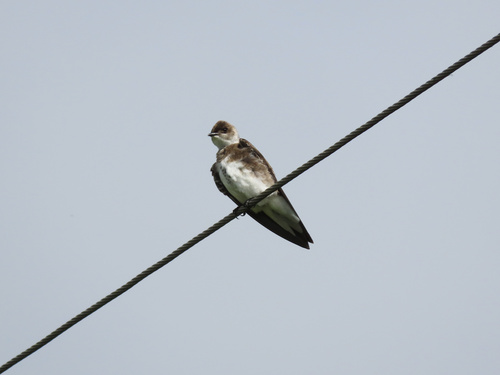
Brown-chested Martin (Progne tapera) Brown-chested Martin

Media

Loading…

In short

The most reliable field mark between Caribbean Martin and Brown-chested Martin is the underpart pattern: adult Caribbean Martins (especially males) show crisp white lower underparts with a sharp contrast to dark upperparts, while Brown-chested Martins always show a brown breast band (sometimes faint) separating the white belly from the sandy-brown upperparts. Juveniles of both species can be confusing, but the brownish wash and less forked tail of young Brown-chested Martins help. Structurally, Caribbean Martin is larger and bulkier with broader wings and a deeper fork to the tail. Both species can appear together in migration or over water, so careful attention to these details is essential.

Identification tips

  1. Breast band: Brown-chested Martin always shows a brown band across the breast (sometimes faint), separating the white belly from sandy-brown upperparts. Caribbean Martin never shows a true breast band; even dull females and juveniles have clean white lower underparts.
  2. Underpart contrast: Adult male Caribbean Martin has sharply contrasting glossy blue-black upperparts and pure white lower underparts. Brown-chested Martin is more uniformly sandy brown above and across the breast, with less contrast.
  3. Tail shape: Caribbean Martin has a more deeply forked tail, especially in adults; Brown-chested Martin's tail is only slightly forked, and juveniles have a more squared tail.
  4. Upperpart color: Caribbean Martin (male) is glossy blue-black above; Brown-chested Martin is sandy brown above, never glossy or blue-black.
  5. Juvenile marks: Juvenile Brown-chested Martin has a squared tail and grey-brown wash on the sides of the throat, plus a brownish breast band. Juvenile Caribbean Martin is duller but lacks the brown breast band and has a more forked tail.
  6. Size and structure: Caribbean Martin is larger and bulkier with broader wings and a heavier jizz; Brown-chested Martin is slimmer and more streamlined. Use this only with other marks, as there is overlap.
  7. Flight style: Both species are aerial foragers, but Caribbean Martin may appear heavier and more powerful in flight, while Brown-chested is lighter and quicker.
  8. Bill and head: Caribbean Martin has a slightly heavier bill and a more robust head profile; Brown-chested Martin's bill is finer, and the head appears less bulky.
  9. Habitat context: Caribbean Martin is more likely in the Caribbean islands, especially near towns and buildings; Brown-chested Martin is widespread on the South American mainland and less tied to man-made structures.
  10. Vocalizations: Both have gurgling calls, but Brown-chested Martin's song is longer, rolling, and more complex. Use with caution, as calls are similar and hard to separate at a distance.
  11. Sex differences: Only Caribbean Martin shows strong sexual dimorphism, with males much glossier and darker than females. Brown-chested Martin sexes are alike.
  12. Subspecies confusion: Brown-chested Martin subspecies fusca is darker overall with a more defined breast band and dusky markings on the lower breast and belly, but still always shows the brown band.
  13. Pitfalls: Immature Caribbean Martins can look dull and may be confused with Brown-chested, but always lack the brown breast band and have cleaner white underparts.
  14. Perched vs. flight views: Tail shape and underpart pattern are best seen when perched. In flight, overall size, tail fork, and underpart contrast help, but beware of lighting and molt.
  15. Overlap: Both species may occur together during migration or vagrancy, especially near water. Always use a combination of marks for confident identification.

Size

Caribbean Martin is the larger and heavier species, measuring about 18.5 cm in length and weighing around 40 g. Brown-chested Martin is slightly smaller at 16–18 cm and 30–40 g. In the field, Caribbean Martin often looks bulkier and more robust, with broader wings and a deeper forked tail, while Brown-chested Martin appears slimmer and more streamlined. However, there is overlap in size, so use size only in combination with plumage and structure.

Plumage

Juvenile and immature birds are the greatest pitfall. Juvenile Brown-chested Martins have a more squared tail and a grey-brown wash on the sides of the throat, with a brownish breast band always present, even if faint. Caribbean Martin juveniles and females are duller than adult males, with grey-brown breast and flanks but still show clean white lower underparts and lack a distinct breast band. Adult male Caribbean Martins are glossy blue-black above with sharply contrasting white lower underparts, while females and immatures are duller but still lack the brown breast band of Brown-chested. Brown-chested Martins of all ages have sandy brown upperparts, a white chin and throat, and a brown band across the breast, which is more pronounced in the darker subspecies fusca. The tail of Brown-chested is only slightly forked (more squared in juveniles), while Caribbean Martin's tail is more deeply forked.

Behaviour

Both species are aerial insectivores, hunting insects in flight, but Caribbean Martins are often more gregarious, forming larger flocks and frequently nesting in cavities in banks, buildings, or old woodpecker holes. Brown-chested Martins may forage singly or in small groups and often fly fast and low over vegetation and water, sometimes higher when feeding on swarming insects. Both can be seen over open habitats, but Caribbean Martin is more likely to be seen using man-made structures for nesting, especially in urban areas.

Habitat

Caribbean Martin breeds throughout the Caribbean (except Cuba and Isla de la Juventud), often near water, in towns, or rural areas with available nesting cavities. Brown-chested Martin is widespread in mainland Central and South America (except Chile), and is more likely to be found over open country, rivers, lakes, and sometimes in urban settings. Overlap can occur during migration or in vagrancy, especially near water or open areas where both hunt insects.

Voice

Both species have somewhat similar vocalizations described as gurgling or guttural. Caribbean Martin gives a gurgly chew-chew call. Brown-chested Martin's song is a harsh, guttural series of liquid, rolling, descending trills, and its calls include a dry, buzzy djzeut and a more musical dureet. Vocal differences are subtle and not the most reliable field mark, but Brown-chested's song is longer and more rolling.

Submit a better description

Use the same sections as the comparison. Your text is published immediately.

The most reliable field mark between Caribbean Martin and Brown-chested Martin is the underpart pattern: adult Caribbean Martins (especially males) show crisp white lower underparts with a sharp contrast to dark upperparts, while Brown-chested Martins always show a brown breast band (sometimes faint) separating the white belly from the sandy-brown upperparts. Juveniles of both species can be confusing, but the brownish wash and less forked tail of young Brown-chested Martins help. Structurally, Caribbean Martin is larger and bulkier with broader wings and a deeper fork to the tail. Both species can appear together in migration or over water, so careful attention to these details is essential.

  1. Breast band: Brown-chested Martin always shows a brown band across the breast (sometimes faint), separating the white belly from sandy-brown upperparts. Caribbean Martin never shows a true breast band; even dull females and juveniles have clean white lower underparts.
  2. Underpart contrast: Adult male Caribbean Martin has sharply contrasting glossy blue-black upperparts and pure white lower underparts. Brown-chested Martin is more uniformly sandy brown above and across the breast, with less contrast.
  3. Tail shape: Caribbean Martin has a more deeply forked tail, especially in adults; Brown-chested Martin's tail is only slightly forked, and juveniles have a more squared tail.
  4. Upperpart color: Caribbean Martin (male) is glossy blue-black above; Brown-chested Martin is sandy brown above, never glossy or blue-black.
  5. Juvenile marks: Juvenile Brown-chested Martin has a squared tail and grey-brown wash on the sides of the throat, plus a brownish breast band. Juvenile Caribbean Martin is duller but lacks the brown breast band and has a more forked tail.
  6. Size and structure: Caribbean Martin is larger and bulkier with broader wings and a heavier jizz; Brown-chested Martin is slimmer and more streamlined. Use this only with other marks, as there is overlap.
  7. Flight style: Both species are aerial foragers, but Caribbean Martin may appear heavier and more powerful in flight, while Brown-chested is lighter and quicker.
  8. Bill and head: Caribbean Martin has a slightly heavier bill and a more robust head profile; Brown-chested Martin's bill is finer, and the head appears less bulky.
  9. Habitat context: Caribbean Martin is more likely in the Caribbean islands, especially near towns and buildings; Brown-chested Martin is widespread on the South American mainland and less tied to man-made structures.
  10. Vocalizations: Both have gurgling calls, but Brown-chested Martin's song is longer, rolling, and more complex. Use with caution, as calls are similar and hard to separate at a distance.
  11. Sex differences: Only Caribbean Martin shows strong sexual dimorphism, with males much glossier and darker than females. Brown-chested Martin sexes are alike.
  12. Subspecies confusion: Brown-chested Martin subspecies fusca is darker overall with a more defined breast band and dusky markings on the lower breast and belly, but still always shows the brown band.
  13. Pitfalls: Immature Caribbean Martins can look dull and may be confused with Brown-chested, but always lack the brown breast band and have cleaner white underparts.
  14. Perched vs. flight views: Tail shape and underpart pattern are best seen when perched. In flight, overall size, tail fork, and underpart contrast help, but beware of lighting and molt.
  15. Overlap: Both species may occur together during migration or vagrancy, especially near water. Always use a combination of marks for confident identification.

Caribbean Martin is the larger and heavier species, measuring about 18.5 cm in length and weighing around 40 g. Brown-chested Martin is slightly smaller at 16–18 cm and 30–40 g. In the field, Caribbean Martin often looks bulkier and more robust, with broader wings and a deeper forked tail, while Brown-chested Martin appears slimmer and more streamlined. However, there is overlap in size, so use size only in combination with plumage and structure.

Juvenile and immature birds are the greatest pitfall. Juvenile Brown-chested Martins have a more squared tail and a grey-brown wash on the sides of the throat, with a brownish breast band always present, even if faint. Caribbean Martin juveniles and females are duller than adult males, with grey-brown breast and flanks but still show clean white lower underparts and lack a distinct breast band. Adult male Caribbean Martins are glossy blue-black above with sharply contrasting white lower underparts, while females and immatures are duller but still lack the brown breast band of Brown-chested. Brown-chested Martins of all ages have sandy brown upperparts, a white chin and throat, and a brown band across the breast, which is more pronounced in the darker subspecies fusca. The tail of Brown-chested is only slightly forked (more squared in juveniles), while Caribbean Martin's tail is more deeply forked.

Both species are aerial insectivores, hunting insects in flight, but Caribbean Martins are often more gregarious, forming larger flocks and frequently nesting in cavities in banks, buildings, or old woodpecker holes. Brown-chested Martins may forage singly or in small groups and often fly fast and low over vegetation and water, sometimes higher when feeding on swarming insects. Both can be seen over open habitats, but Caribbean Martin is more likely to be seen using man-made structures for nesting, especially in urban areas.

Caribbean Martin breeds throughout the Caribbean (except Cuba and Isla de la Juventud), often near water, in towns, or rural areas with available nesting cavities. Brown-chested Martin is widespread in mainland Central and South America (except Chile), and is more likely to be found over open country, rivers, lakes, and sometimes in urban settings. Overlap can occur during migration or in vagrancy, especially near water or open areas where both hunt insects.

Both species have somewhat similar vocalizations described as gurgling or guttural. Caribbean Martin gives a gurgly chew-chew call. Brown-chested Martin's song is a harsh, guttural series of liquid, rolling, descending trills, and its calls include a dry, buzzy djzeut and a more musical dureet. Vocal differences are subtle and not the most reliable field mark, but Brown-chested's song is longer and more rolling.

Discard your changes?

You have unsaved edits. If you leave now, those changes will be lost.

Caribbean Martin · Brown-chested Martin · My Tricky Birds