

Central American Pygmy-Owl vs Ferruginous Pygmy-Owl
Glaucidium griseiceps versus Glaucidium brasilianum
Play a quiz with Central American Pygmy-Owl and Ferruginous Pygmy-Owl
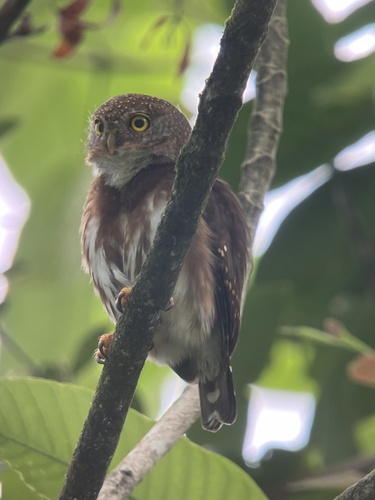 Central American Pygmy-Owl
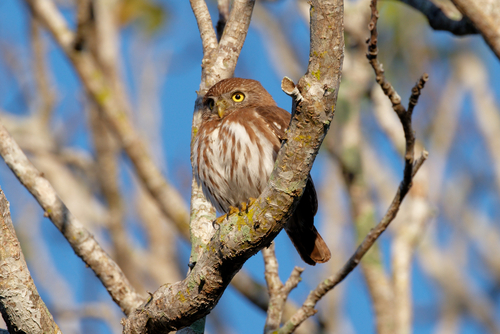 Ferruginous Pygmy-Owl
In short
The most reliable field mark between Central American Pygmy-Owl and Ferruginous Pygmy-Owl is overall coloration and head pattern, especially in adults: Central American Pygmy-Owl shows a grayish-brown crown with buff to whitish spots and a rich brown back, while Ferruginous Pygmy-Owl is highly variable but typically has a streaked crown and can be much more rufous overall. Juvenile Central American Pygmy-Owls have a plain gray crown and nape, lacking the spots and streaks of Ferruginous Pygmy-Owl. Both species have 'false eyes' on the nape, but the background color and prominence differ. Ferruginous Pygmy-Owl is generally heavier and often appears stockier with larger feet. In the field, Ferruginous Pygmy-Owl is much more likely in open or semi-open habitats, while Central American Pygmy-Owl prefers humid forests.
Identification tips
- Juvenile head pattern: If the bird has a plain gray crown and nape with no spots or streaks, and sooty 'false eyes,' it is a juvenile Central American Pygmy-Owl. Ferruginous juveniles always show some streaking or spotting on the crown.
- Crown markings (adults): Central American Pygmy-Owl has buff to whitish spots on a grayish-brown crown; Ferruginous Pygmy-Owl has elongated white or buff streaks, not spots.
- Supercilia: Ferruginous Pygmy-Owl shows prominent white supercilia above the facial disc, which Central American lacks.
- Overall coloration: Central American is consistently rich brown above, while Ferruginous can be gray-brown, rufous, or intermediate. A rufous or very pale individual is almost certainly Ferruginous.
- Tail pattern: Central American has a brown tail with pale bars; Ferruginous can have a black-and-white barred tail or a uniform rufous tail (in rufous morphs).
- Underpart streaking: Both are streaked below, but Ferruginous is often more heavily streaked and the streaks are usually white.
- Wing coverts: Ferruginous Pygmy-Owl shows obvious white spots on the wing coverts; Central American's are less conspicuous.
- 'False eyes' on nape: Both species have these, but Central American's are set in a darker background and may appear less sharply defined than Ferruginous's.
- Structure: Ferruginous is stockier with larger feet and talons, especially noticeable when perched. Central American is more slender.
- Size: Ferruginous is heavier (about 70 g vs. 50–58 g), but this is hard to judge unless both are seen side by side.
- Flight style: Ferruginous often flies with an undulating, woodpecker-like motion. Central American's flight is less frequently described as such.
- Habitat: In humid, closed forest, Central American is much more likely. In semi-open, edge, or drier habitats, Ferruginous is the default.
- Geographic context: If you are in the southwestern US, South America outside Panama/Colombia, or open country, Ferruginous is expected. In dense lowland forest from southern Mexico to Panama, Central American is likely.
- Vocalization: If you hear a song starting with a few spaced hoots, a pause, then a rapid series, suspect Central American. However, Ferruginous's song is not described here, so use with caution.
- Sex/season: Both sexes are similar, but Ferruginous females may be more rufous. No strong seasonal plumage differences are described for either species.
Size
Ferruginous Pygmy-Owl is the heavier of the two, with an average adult mass of about 69.65 g [wikidata], compared to Central American Pygmy-Owl males (50.6–58.8 g) and females (~56 g) [wikipedia]. Both species are similar in length (Central American: 13–18 cm; Ferruginous: ~15 cm), but Ferruginous Pygmy-Owl is notably stockier and has disproportionately large feet and talons. This bulkier appearance can be a subtle but useful clue, especially when perched.
Plumage
- Juvenile/immature birds: Central American Pygmy-Owl juveniles have a plain gray crown and nape, unspotted, with sooty 'false eyes' on the nape. This contrasts with Ferruginous Pygmy-Owl, which even as a juvenile shows a streaked or spotted crown and more prominent white supercilia above the facial disc. If you see a small owl with a plain gray head and no crown spots, Central American is likely.
- Adults: Central American Pygmy-Owl adults have a grayish-brown crown with buff to whitish spots, a rich brown upperpart, and a tail with pale bars. Underparts are whitish with reddish brown streaks. Ferruginous Pygmy-Owl adults are much more variable: they can be gray-brown with a black-and-white barred tail or rich rufous with a uniform rufous tail. Their crown is streaked (not spotted), and they have prominent white supercilia. Both have 'false eyes' on the nape, but Central American's are set in a darker background, while Ferruginous's are more sharply defined. Ferruginous also tends to show heavier streaking below and more obvious white spots on the wing coverts.
Behaviour
Ferruginous Pygmy-Owl is often seen hunting during daylight, sometimes with an undulating, woodpecker-like flight. It is bolder and more likely to be active in open areas. Central American Pygmy-Owl is less often seen in the open and tends to stay within or near dense forest. Both species perch openly at times, but Ferruginous is more likely to be conspicuous and to hunt in semi-open habitats.
Habitat
Central American Pygmy-Owl is restricted to humid forests from southern Mexico through Panama and into northwestern South America. It is a forest specialist and rarely found away from dense woodland. Ferruginous Pygmy-Owl, in contrast, is extremely widespread and common in a range of semi-open wooded habitats, from the southwestern US to Argentina. In Central America, Ferruginous is likely in drier, more open, or edge habitats, while Central American is the expected pygmy-owl in intact humid forest.
Voice
Central American Pygmy-Owl gives a song that starts with 2–4 evenly spaced hoots, a brief pause, then a rapid series of 6–18 similar notes ('huu-huu, huu-huu-huu...'), sometimes with trills at the start. Ferruginous Pygmy-Owl's song is not described in the provided notes, so vocalization is not a reliable separator based on this information alone.
Central American Pygmy-Owl · Ferruginous Pygmy-Owl · My Tricky Birds