

Chukar vs Demoiselle Crane
Alectoris chukar versus Grus virgo
Play a quiz with Chukar and Demoiselle Crane
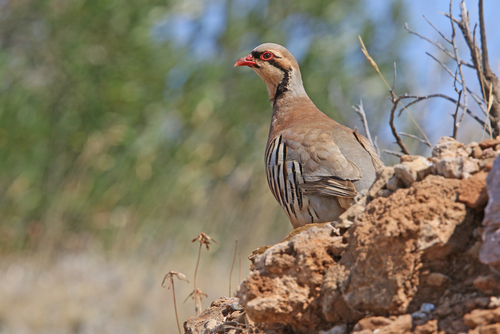 Chukar
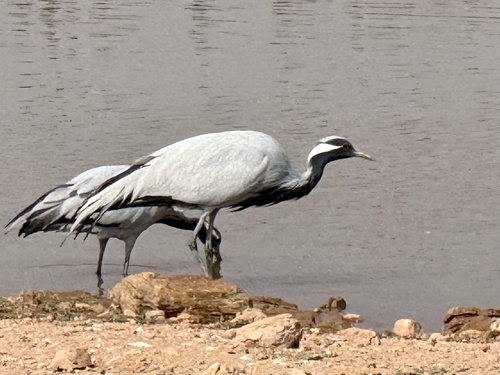 Demoiselle Crane
In short
The most reliable way to separate Chukar from Demoiselle Crane in the field is by overall structure and size: Demoiselle Crane is a tall, slender, long-necked bird with a long bill and legs, while Chukar is a rotund, short-legged partridge with a compact body and short tail. In flight or on the ground, Demoiselle Crane’s long white neck stripe and trailing black foreneck plume are unmistakable, contrasting with Chukar’s bold black-and-white face pattern and barred flanks. Even at a distance, the difference in jizz—crane’s stately, upright carriage versus the partridge’s squat, chicken-like profile—is immediate. Both species have distinctive plumage, but confusion may arise in poor light or distant views, especially if only a partial silhouette is seen.
Identification tips
- Size and Structure: Demoiselle Crane is vastly larger and taller than Chukar, with a long neck, legs, and wings. Chukar is compact, rounded, and chicken-like. This is the quickest check at any distance.
- Neck and Leg Length: Cranes show a long, slender neck and legs both when walking and in flight; Chukar has a short neck and legs, never appearing elongated.
- Face and Neck Pattern: Chukar has a bold black band running from the forehead, through the eye, and around the white throat, forming a sharp 'necklace.' Demoiselle Crane has a white stripe from the eye down the neck and a black foreneck plume—never a necklace.
- Flank and Body Color: Chukar shows rufous-barred flanks and a light brown back; Demoiselle Crane is mostly gray, with no barring on the flanks.
- Bill and Leg Color: Chukar’s bill and legs are coral red, while Demoiselle Crane’s are more muted and never red.
- Tail and Wing Shape: Chukar has a short tail and rounded wings; Demoiselle Crane’s tail is longer and wings are broad and pointed, suited for soaring flight.
- Flight Profile: In flight, Demoiselle Crane’s neck and legs are fully extended, and the wings are long and slow-beating. Chukar flies with rapid, shallow wingbeats, short distances, and never soars.
- Behavior on Ground: Chukar prefers to run when flushed and stays close to cover; Demoiselle Crane walks slowly in the open and is rarely seen running.
- Group Size and Context: Chukar is found in small coveys or pairs, especially in rocky uplands. Demoiselle Crane is often in larger flocks, especially during migration, and prefers open plains or wetlands.
- Habitat: Chukar is a bird of dry, rocky hillsides; Demoiselle Crane is found in open grasslands, steppes, and near water.
- Vocalization: Listen for Chukar’s loud, repetitive 'chuck-chuck-chukar' calls, especially at dawn and dusk. Demoiselle Crane’s calls are not described here, but cranes generally have loud, bugling voices.
- Sex Differences: Both species are similar between sexes in the field; Chukar females are slightly smaller and lack spurs, but this is rarely visible at a distance.
- Age Differences: No age-specific wing or plumage marks are described for either species in the sources, so all ages are separated by the above features.
- Potential Pitfalls: At extreme distance or in silhouette, a crane’s upright stance and long neck/legs will still contrast with the Chukar’s squat, rounded profile. Beware of partial views in dense cover for Chukar or distant cranes in flight, but structure and jizz remain reliable.
- Hybrid Confusion: Chukar may hybridize with other partridges, but never resembles a crane. Demoiselle Crane is not easily confused with any partridge.
Size
Demoiselle Crane dwarfs Chukar in every dimension. Chukar is a medium-sized partridge, about 32–35 cm long and weighing around 608 g [wikidata], with a compact, rounded body and short tail. Demoiselle Crane is much larger, 85–100 cm long, standing about 76 cm tall, with a wingspan of 155–180 cm and weighing 2–3 kg [wikipedia]. The crane’s long neck, legs, and extended wings are completely unlike the partridge’s proportions. Even at a great distance, the crane’s height and elongated silhouette stand out.
Plumage
No age-specific upperwing pattern is described for either species in the sources, so separation relies on overall plumage and face/neck markings. Adult Chukar shows a white face bordered by a sharply defined black gorget (necklace) that runs from the forehead, through the eye, and encircles the throat, with rufous-barred flanks and a light brown back. Demoiselle Crane, in all plumages, is mostly gray with a long, elegant white stripe running from the eye down the neck and a black foreneck that extends into a long, drooping plume over the chest. The Chukar’s face pattern is bold and compact, while the crane’s markings are elongated and flowing. The Chukar’s bill and legs are coral red, contrasting with the crane’s more neutral tones. No mention of juvenile-specific flight marks is given for either species.
Behaviour
Chukar is a terrestrial, ground-dwelling bird that prefers to run when disturbed, only flying short distances on rounded wings, often downhill. It is typically seen in small coveys or pairs, moving quickly and low to the ground. Demoiselle Crane is a stately, upright bird, often seen walking slowly in open fields or wetlands, and is capable of strong, sustained flight with slow, deep wingbeats. Cranes are often seen in flocks, especially during migration, and their long legs trail behind in flight. The behavioral contrast is stark: Chukar is furtive and ground-bound, while Demoiselle Crane is graceful and conspicuous.
Habitat
Chukar inhabits upland, rocky, and arid regions, often on hillsides and open slopes, sometimes descending to fields in winter. It avoids wetlands and open plains. Demoiselle Crane is found in open grasslands, steppes, and sometimes agricultural fields, often near water, and is migratory across Eurasia. The two species rarely overlap in habitat preference: Chukar is a bird of dry, rugged terrain; Demoiselle Crane prefers open, flat expanses and is often associated with water during migration and breeding.
Voice
Chukar’s call is a loud, repeated "chuck-chuck-chukar-chukar," often given in bursts and duets, especially in the mornings and evenings. Demoiselle Crane’s voice is not described in the provided notes, but cranes typically have loud, trumpeting calls that carry over long distances and are very different from the partridge’s chattering. In the field, the Chukar’s call is more abrupt and repetitive, while the crane’s is resonant and bugling.