

Common Chaffinch vs European Greenfinch
Fringilla coelebs versus Chloris chloris
Play a quiz with Common Chaffinch and European Greenfinch
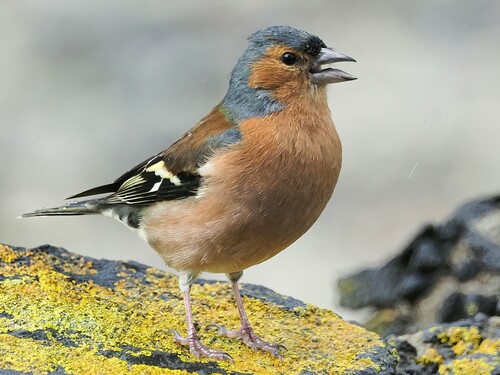 Common Chaffinch
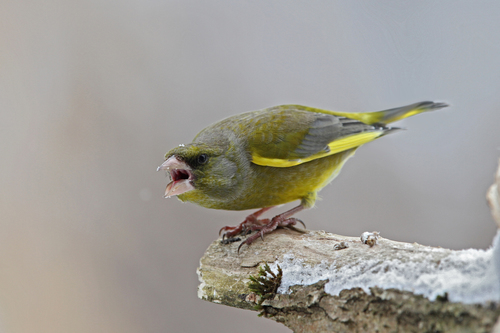 European Greenfinch
In short
The most reliable field mark between Common Chaffinch and European Greenfinch is the presence of strong white wing bars and white tail sides on the Chaffinch, visible in all ages and especially obvious in flight, versus the Greenfinch’s yellow flashes in the wings and tail. Chaffinch males are brightly colored with a blue-grey cap and rust-red underparts, while Greenfinches are mainly greenish with yellow in the wings and tail, and have a thicker, more conical bill. Females and juveniles of both species are duller, but the Chaffinch always shows the crisp white wing and tail markings, while the Greenfinch is overall more olive or brownish with yellow highlights. Structure and bill shape also help: Greenfinch is chunkier with a noticeably stout bill, while Chaffinch is slimmer and more delicate. Both species are common and can occur together, so careful attention to wing and tail pattern is essential.
Identification tips
- White wing bars (Chaffinch) vs yellow wing flashes (Greenfinch): Chaffinch of all ages and sexes shows two crisp white wing bars and white sides to the tail, especially obvious in flight or when perched with wings closed. Greenfinch never shows white in the wings or tail, only yellow.
- Bill shape: Greenfinch has a noticeably thick, conical bill, pale in color, giving a chunky-headed look. Chaffinch has a slimmer, more pointed bill, bluish-grey in spring males, paler in winter.
- Male plumage: Chaffinch males have a blue-grey cap and nape, black forehead, rust-red underparts, and olive rump. Greenfinch males are green overall with bright yellow in the wings and tail, lacking any blue or red tones.
- Female/juvenile plumage: Female and juvenile Chaffinch are grey-brown above, paler below, but always with white wing bars and tail sides. Female/juvenile Greenfinch is dull olive-brown with yellow in the wings and tail, no white.
- Flight pattern: In flight, Chaffinch shows a strong white flash in the wings and tail sides; Greenfinch shows yellow flashes, especially at the base of the primaries and in the tail, but no white.
- Overall color impression: Chaffinch is more patterned, with contrasting colors and white marks; Greenfinch is more uniform greenish or olive, with yellow highlights.
- Structure: Greenfinch appears bulkier, with a deeper chest and larger head, while Chaffinch is slimmer and more delicate.
- Leg color: Chaffinch has grey-brown legs; Greenfinch leg color is not specified but is not a primary field mark.
- Seasonal changes: Chaffinch males are brightest in spring after feather wear; in autumn and winter, the plumage is duller due to buff fringes, but white wing bars remain visible. Greenfinch yellow is brightest in males in spring/summer, duller in females and juveniles.
- Perched vs in flight: Both species can look similar when perched in poor light, but the Chaffinch’s white wing bars and tail sides are diagnostic if seen. In flight, the difference between white (Chaffinch) and yellow (Greenfinch) in the wings/tail is key.
- Habitat overlap: Both species can be found together in gardens, parks, and woodland edges, so do not rely on location alone.
- Behavior: Greenfinch may appear more sluggish or deliberate, sometimes performing slow, looping display flights. Chaffinch is more agile and active, often flicking wings or hopping.
- Voice: Greenfinch song includes wheezing trills; Chaffinch song is not described here, so do not rely on song for separation with these notes.
- Pitfalls: Female and juvenile Chaffinches are sometimes mistaken for Greenfinches due to their dull color, but always check for the white wing and tail markings. Greenfinch never shows white in the wings or tail.
- When in doubt: Focus on the presence or absence of white in the wings and tail, and the bill shape—these are the most reliable marks in all seasons and ages.
Size
Both species are similar in length (Chaffinch ~14.5 cm, Greenfinch ~15 cm) and wingspan (Chaffinch 24.5–28.5 cm, Greenfinch 24.5–27.5 cm) [wikipedia]. Chaffinch has an average body mass of 22 g [wikidata], while Greenfinch mass is not specified here but is generally similar or slightly heavier. In the field, Greenfinch may appear bulkier and more robust, especially around the chest and bill, while Chaffinch is slimmer and more agile-looking.
Plumage
- Juvenile/First-winter/Immature: Both juvenile Chaffinch and Greenfinch are duller than adults, but Chaffinch juveniles still show the distinctive white wing bars and tail sides, while Greenfinch juveniles are brownish-olive with yellowish hints but lack strong white in the wings or tail. The Greenfinch’s yellow is always present in the wing and tail, even in young birds, but less vivid than in adults.
- Adult male: Chaffinch males have a blue-grey cap, black forehead, rust-red underparts, and a light olive rump, with two bold white wing bars and white outer tail feathers. Greenfinch males are mainly green with bright yellow in the wings and tail, lacking any blue-grey or red tones, and have a thick, pale bill.
- Adult female: Female Chaffinch is dull grey-brown above and paler below, but still shows the white wing bars and tail sides. Female Greenfinch is duller and browner than the male, with less yellow but still some yellow in the wings and tail; the bill remains thick and conical.
- Flight views: Chaffinch shows a striking white flash in the wings and tail sides in all ages and sexes. Greenfinch shows yellow in the primaries and tail, but no white; the overall impression is greenish with yellow flashes, not white.
Behaviour
Both species are active and often seen feeding on the ground or in trees and shrubs. Chaffinches are agile, often hopping or flicking their wings, and may be seen in mixed flocks, especially outside the breeding season. Greenfinches are chunkier and may appear more sluggish or deliberate, often feeding in thicker vegetation or at feeders. In flight, Greenfinch males may perform a 'butterfly' display flight with slow, looping wingbeats, which is not shown by Chaffinch.
Habitat
Both species are widespread and can be found in gardens, parks, woodland edges, farmland hedges, and open country with scattered trees. Greenfinch prefers areas with thick vegetation for nesting, while Chaffinch is more adaptable and may be found in a wider range of open and semi-open habitats. Both can occur together, so habitat alone is not diagnostic.
Voice
Greenfinch song is a mix of twittering and trilling, with distinctive wheezing notes. Chaffinch song is not described in the notes, but is generally a descending series of notes ending in a flourish; however, this is not a reliable separation based on the provided information. Calls may be confused, so rely on visual marks.