
Crested Goshawk vs Shikra
Lophospiza trivirgata versus Tachyspiza badia
Play a quiz with Crested Goshawk and Shikra
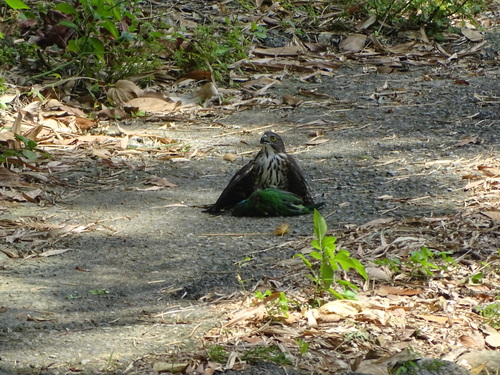 Crested Goshawk
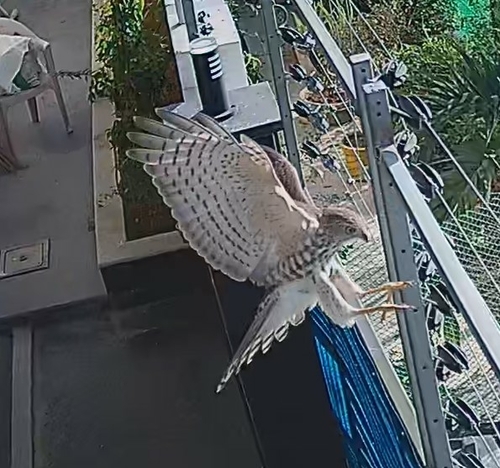 Shikra
In short
The most reliable field mark between Crested Goshawk and Shikra is the presence of a short, bushy crest on the Crested Goshawk, which is absent in Shikra. Juvenile plumage and underpart patterning can also be helpful: juvenile Crested Goshawks show buffy underparts with pale-fringed head feathers, while juvenile Shikras have more narrowly barred wings and tails with strong streaking on the upper breast. Structurally, Crested Goshawk is notably larger and bulkier, especially the female, and shows a more prominent head profile with its crest. Both species share short, broad wings and long tails, but the Goshawk's size and head shape are distinctive. Flight style is similar but Crested Goshawk tends to appear heavier and more powerful, while Shikra is more compact and agile.
Identification tips
- Crest presence: Only Crested Goshawk shows a short, bushy crest on the head, visible in profile, especially when perched or alert. Shikra always lacks a crest.
- Size and bulk: Crested Goshawk is larger and bulkier, especially the female. Shikra is distinctly smaller and more slender. Use nearby birds or context for scale.
- Juvenile underparts: Juvenile Crested Goshawk has buffy underparts with pale-fringed head feathers and streaked (not barred) breast; Shikra juvenile is whiter below with dark streaks/spots on the upper breast and narrow barring on the wings and tail.
- Adult underparts: Crested Goshawk adults have pale underparts with rufous streaks on the breast and bars on the belly; Shikra adults are whitish below with fine rufous bars, and the lower belly is less barred, with whitish thighs.
- Head pattern: Crested Goshawk male has a dark brown crown, grey sides to the head, and bold black moustachial and throat stripes; Shikra has a less contrasting head, with a narrow dark mesial throat stripe and no bold moustachial mark.
- Iris color: Adult male Shikra has a red iris; female Shikra has a yellowish-orange iris. Crested Goshawk iris color is not specified in the notes, so use with caution.
- Tail pattern (in flight): Shikra's tail has faint bands on the lateral feathers and a strong dark terminal band on the central feathers; Crested Goshawk's tail is long and may show stronger barring, but the notes do not specify a unique pattern.
- Underwing (in flight): Shikra male shows a light underwing lining and blackish wingtips when seen from below. Crested Goshawk's underwing pattern is not detailed, so this is more useful for confirming Shikra.
- Flight style: Crested Goshawk's flight is heavier and slower ('slow flap, slow flap, straight glide'), while Shikra is quicker and more agile, especially when hunting or evading.
- Habitat: Crested Goshawk prefers dense forests; Shikra is common in open country, farmland, and urban areas as well as forests. A bird in a city park or village is more likely to be Shikra.
- Behavior: Shikra is often seen singly or in pairs, and its presence alarms small birds and mammals. Crested Goshawk is more secretive and less likely to be mobbed in open areas.
- Voice: A 'pee-wee' or 'kik-ki' call points to Shikra, especially if heard in flight. Lack of vocalization is not diagnostic for Crested Goshawk.
- Sex differences: Female Crested Goshawk is much larger and browner than the male, with brown underpart streaks and bars; female Shikra is only slightly larger than the male and has heavier barring below.
- Pitfalls: Immature birds of both species can be confusing; focus on head shape (crest), size, and underpart pattern. If the crest is not visible, use a combination of size, habitat, and underpart pattern to separate them.
- Not diagnostic: Bill shape, primary projection, and tail shape are similar and not reliable for separation in the field based on the provided notes.
Size
Crested Goshawk is significantly larger, measuring 30–46 cm in length, with females much larger than males. Shikra is smaller, at 26–30 cm. This size difference is most apparent when both are seen together or with familiar species for scale. Crested Goshawk also appears bulkier and more robust, while Shikra is more slender and compact. Female Crested Goshawk is especially large compared to any Shikra, and even male Crested Goshawk is usually larger than a female Shikra. [wikipedia][avonet]
Plumage
- Juvenile/immature birds:
- Crested Goshawk juveniles have buff underparts with pale fringes to the head feathers, giving a paler, more washed-out look. Underparts are streaked rather than barred, and the background is buff, not white.
- Shikra juveniles show dark streaks and spots on the upper breast, with underparts less buff and more white-based. The wing is narrowly barred, and the tail has dark but narrow bands. In post-juvenile transition, Shikra shows strong barring on the underside contour feathers.
- Adults:
- Crested Goshawk males have a dark brown crown, grey sides to the head, and bold black moustachial and throat stripes. Underparts are pale with rufous streaks on the breast and bars on the belly. Females are browner on the head and have brown streaks and bars below.
- Shikra adults are whitish below with fine rufous bars, grey above, and the lower belly is less barred. Thighs are whitish. Males have a red iris, females a yellowish-orange iris and browner upperparts. The mesial throat stripe is dark but narrow (less bold than Crested Goshawk). In flight, Shikra males show a light underwing lining and blackish wingtips. Tail bands are faint except for a dark terminal band on the central feathers.
- Crest:
- Only Crested Goshawk shows a short, bushy crest, visible in profile, which is absent in Shikra.
[wikipedia]
Behaviour
Both species use a flap-glide flight typical of accipiters, but Crested Goshawk's flight is described as 'slow flap, slow flap, straight glide,' giving a heavier, more deliberate impression. Shikra is more agile and compact in flight, often seen singly or in pairs, and is known for its quick, agile movements when hunting or evading. During the breeding season, Shikra pairs may soar and stoop at each other, and their presence often alarms small birds and mammals. Crested Goshawk is more forest-adapted, using its bulk and power to maneuver through dense trees, while Shikra is more likely to be seen in open or urban areas as well as forests.
Habitat
Crested Goshawk is primarily a forest species, adapted for maneuvering through dense woodland with its short, broad wings and long tail. Shikra is more versatile, found in forests, farmland, and urban areas, and is more likely to be seen in open country or near human habitation. Shikra's adaptability to a wider range of habitats, including cities and villages, is a useful context clue if habitat is known.
Voice
Shikra has a distinctive 'pee-wee' call, with the first note higher and the second longer; in flight, it gives short, sharp 'kik-ki ... kik-ki' calls. Crested Goshawk's vocalizations are not detailed in the provided notes, so voice is more useful for confirming Shikra than for ruling out Crested Goshawk.