

Crested Serpent-Eagle vs Mountain Hawk-Eagle
Spilornis cheela versus Nisaetus nipalensis
Play a quiz with Crested Serpent-Eagle and Mountain Hawk-Eagle
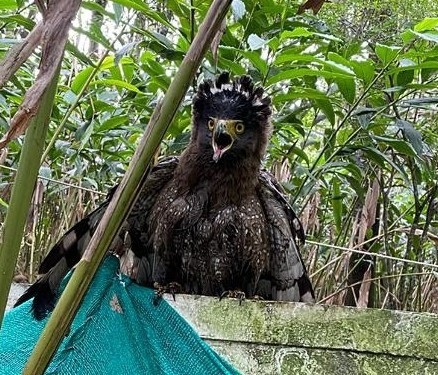 Crested Serpent-Eagle
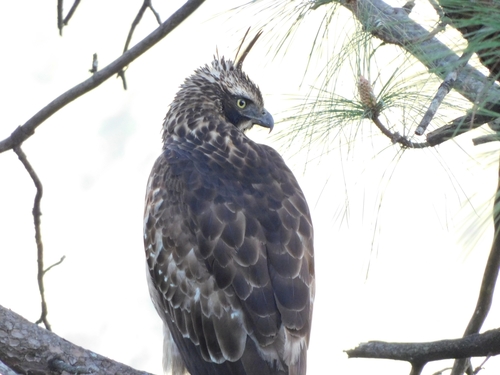 Mountain Hawk-Eagle
In short
The most reliable field mark between Crested Serpent-Eagle and Mountain Hawk-Eagle is the underwing and tail pattern in flight, especially in juveniles: juvenile Crested Serpent-Eagles show bold, broad white bars on blackish flight feathers and tail, while juvenile Mountain Hawk-Eagles have thinner, faded dusky barring and a more mottled, tawny-buff underwing. Structurally, Crested Serpent-Eagle is stockier with a shorter tail and a thick-necked look due to its prominent nuchal crest, while Mountain Hawk-Eagle is longer-winged and longer-tailed with a slimmer, more raptorial silhouette. Adults are separated by the Serpent-Eagle’s spotted underparts and paddle-shaped wings versus the Hawk-Eagle’s rufous-barred underparts and prominent rusty head. Both species can soar with wings in a shallow V, but their proportions and plumage are distinct with careful viewing.
Identification tips
- Juvenile flight pattern: Juvenile Crested Serpent-Eagle shows bold, broad white bars on blackish underwing and tail; juvenile Mountain Hawk-Eagle has thinner, faded dusky barring and a more mottled, buffy underwing. Use this in all immature birds seen in flight.
- Head and crest: Crested Serpent-Eagle has a short, black-and-white fan-shaped crest giving a thick-necked, chunky look; Mountain Hawk-Eagle’s crest is longer, mostly black with a small buffy or white tip, and the head is more slender and rusty-streaked in adults.
- Facial skin and feet: Serpent-Eagle shows bright yellow bare facial skin and feet; Hawk-Eagle’s feet are dull yellow to yellowish white, and facial skin is less prominent.
- Underparts (adults): Serpent-Eagle has white and yellowish-brown spotting on the underparts; Hawk-Eagle is barred rufous over white, with a rufous collar and bold blackish throat stripes.
- Tail pattern: Serpent-Eagle’s tail is black with broad white bars (all ages); Hawk-Eagle’s tail is grey-brown with thinner, more obscure blackish bands and a whitish tip.
- Wing shape in flight: Serpent-Eagle has broad, paddle-shaped wings held in a shallow V, appearing short and rounded; Hawk-Eagle’s wings are also rounded but longer and pinched at the rear base, with a more prominent head and longer tail.
- Perched jizz: Serpent-Eagle looks stocky, thick-necked, and short-tailed, often with the crest raised; Hawk-Eagle is more upright, long-tailed, and slender.
- Juvenile head color: Juvenile Serpent-Eagle has a lot of white on the head; juvenile Hawk-Eagle’s head is buffy to tawny with dark brown streaks.
- Underwing coverts: In flight, Serpent-Eagle’s underwing is spotted or barred; Hawk-Eagle’s is more mottled and rufous (adult) or buffy (juvenile).
- Eye color: Adult Hawk-Eagle has golden or yellow-orange eyes; Serpent-Eagle’s eye color is not specified but is less striking in the notes.
- Habitat context: Dense lowland forest or near water favors Serpent-Eagle; higher elevation, rugged forested hills favor Hawk-Eagle.
- Behavior: Serpent-Eagle is often perched and calls frequently; Hawk-Eagle is more likely to be seen actively hunting or soaring high.
- Vocalization: If you hear a repeated kluee-wip-wip, it is Serpent-Eagle.
- Sex/season: No strong sexual dimorphism or seasonal plumage differences are noted for either species; age is more important for separation.
- When in doubt: Focus on the combination of underwing/tail barring, overall structure, and habitat. If the bird is stocky with bold black-and-white barring, it is almost certainly a Crested Serpent-Eagle; if it is long-tailed, rufous-barred, and more eagle-like, it is a Mountain Hawk-Eagle.
Size
Crested Serpent-Eagle is highly variable in size across its range, but generally is a medium-large, stocky raptor (length 41–75 cm, wingspan 89–169 cm, mass 420–2300 g depending on subspecies) [wikipedia]. Mountain Hawk-Eagle is consistently large and powerful, with a long tail and long wings, usually larger and more elongated than most Crested Serpent-Eagle races (length not specified here, but consistently described as larger and longer-winged) [wikipedia]. In the field, Hawk-Eagle appears rangier and more eagle-like, while Serpent-Eagle is compact and thick-set.
Plumage
Juvenile/immature birds are most easily separated in flight:
-
Juvenile Crested Serpent-Eagle: Shows a lot of white on the head, and the underwing and tail are boldly barred black and white. The underparts are spotted with white and yellowish-brown. In flight, the broad, paddle-shaped wings and short tail with broad white bars are distinctive.
-
Juvenile Mountain Hawk-Eagle: Above, dark brown with clear cream/whitish feather edges for a scaled effect, and tawnier mid-wing patches. Below, plain buffy to tawny on the underparts and wing linings, with thin, faded dusky barring on whitish-grey flight feathers and a thinly banded tail with a whitish tip. The underwing is more mottled and lacks the bold black-and-white barring of the Serpent-Eagle. Crest is black with a small white tip.
-
Adults: Crested Serpent-Eagle is dark brown above, with a short, black-and-white fan-shaped crest, yellow bare facial skin, and spotted underparts. The tail and flight feathers are black with broad white bars. Mountain Hawk-Eagle adults are dark brown above with rusty, streaked head and a mostly black crest with buffy tip; underparts are barred rufous over white, with a rufous collar effect and bold blackish throat stripes. The tail is grey-brown with obscure blackish bands and a whitish tip.
-
In all ages: Crested Serpent-Eagle’s underwing and tail barring is broader and more contrasting; Mountain Hawk-Eagle’s is finer and less distinct, with more tawny or rufous tones on the underwing and body.
Behaviour
Crested Serpent-Eagle spends most of its day perched in dense foliage, often calling from a prominent perch and rising on thermals late in the morning. It hunts mainly by scanning from a perch or soaring over forests and adjacent grasslands, with a preference for reptiles. Mountain Hawk-Eagle is more active and agile, noted for fast, maneuverable flight with powerful, shallow wingbeats and glides. It is more likely to be seen actively hunting or soaring high over forested hills and mountains, and is described as more eagle-like in its flight style. Both can soar with wings in a shallow V, but Hawk-Eagle is more dynamic and less sedentary than the often-perched Serpent-Eagle.
Habitat
Both species are found in forested habitats across Asia, but Crested Serpent-Eagle is more closely tied to lowland and foothill forests, often near wet grasslands or thick vegetation on plains and low hills. Mountain Hawk-Eagle is more strictly a bird of upland forests and mountainous regions, often at higher elevations. If seen in dense lowland jungle or near water, Serpent-Eagle is more likely; in higher, rugged forested hills or mountains, Hawk-Eagle is favored.
Voice
Crested Serpent-Eagle gives a distinctive, repeated kluee-wip-wip call, with the first note high and rising, often heard from perches or while soaring. Mountain Hawk-Eagle’s vocalizations are not described in the provided notes, so voice is only diagnostic for Serpent-Eagle if this call is heard.
Crested Serpent-Eagle · Mountain Hawk-Eagle · My Tricky Birds