
Motmot

Crimson-winged Woodpecker vs Banded Woodpecker

Picus puniceus versus Chrysophlegma miniaceum

Play a quiz with Crimson-winged Woodpecker and Banded Woodpecker
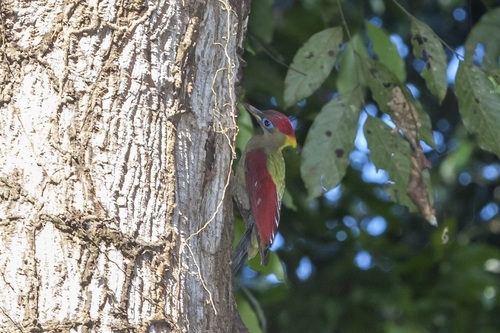
Crimson-winged Woodpecker (Picus puniceus) Crimson-winged Woodpecker
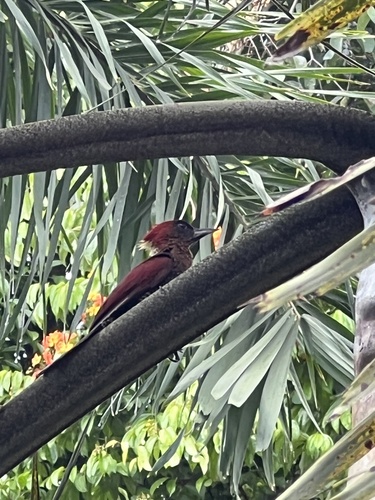
Banded Woodpecker (Chrysophlegma miniaceum) Banded Woodpecker

Media

Loading…

In short

The most reliable way to separate Crimson-winged Woodpecker from Banded Woodpecker is by overall coloration: Crimson-winged is much brighter, with vivid crimson-red wings and a generally colorful appearance, while Banded is more subdued, showing rufous-brown upperparts, a yellow rump, and extensive barring below. Both species overlap in range and habitat, so plumage is key. If you see a woodpecker with bright red wings and a striking appearance, it's Crimson-winged; if the bird is more earth-toned with heavy barring on the underparts and a yellow rump, it's Banded. Sex differences are subtle in Banded, but not a major source of confusion between these two.

Identification tips

  1. Crimson-red wings (all ages): If you see bright crimson-red on the wings, it's Crimson-winged Woodpecker. Banded Woodpecker never shows this color; its wings are rufous-brown at best.
  2. Overall brightness: Crimson-winged is a much more colorful bird overall, with a vivid and striking appearance. Banded is earth-toned and subdued.
  3. Yellow rump (Banded): Look for a yellow rump on Banded Woodpecker, contrasting with its otherwise rufous-brown upperparts. Crimson-winged lacks this feature.
  4. Heavily barred underparts (Banded): Banded Woodpecker shows strong brownish-black barring on a whitish belly and breast. Crimson-winged does not have this extensive barring.
  5. Mantle color and pattern: Banded has a dull olive mantle with buff scaling, while Crimson-winged is more uniform and colorful.
  6. Tail color: Banded has a chocolate-brown tail; Crimson-winged's tail is not specifically described but is not noted as diagnostic.
  7. Head and nape: Banded's head is rufous-brown with a shaggy yellowish nape. Crimson-winged's head is brighter and more colorful.
  8. Sex differences (Banded): Male Banded has a redder face and throat, female is browner with white flecks. This is not a major confusion point with Crimson-winged, which is always brighter overall.
  9. Bill, eye, and leg color: Both have dark bills, but Banded's chestnut eye with a bluish orbital ring and greenish legs may be visible at close range. These are not strong field marks for separation.
  10. No age-specific flight pattern: Neither species is described as having distinctive juvenile or immature wing patterns, so focus on plumage color and barring.
  11. Habitat overlap: Both species occur in the same forests, so don't rely on location or habitat for ID.
  12. Size: Both are similar in size; do not use size as a primary field mark.
  13. Behavior: Both forage for insects and larvae in trees; behavior is not a reliable separator.
  14. If in doubt, look for the combination of bright crimson wings and overall vivid coloration for Crimson-winged, versus yellow rump and strong underpart barring for Banded.

Size

Both species are similar in size, with Crimson-winged Woodpecker reaching up to 25 cm in length and Banded Woodpecker about 26 cm. Crimson-winged is slightly lighter (body mass 81g) [wikidata], but in the field, their size difference is negligible and not a reliable separation point.

Plumage

Crimson-winged Woodpecker stands out for its bright, colorful plumage, especially the vivid crimson-red wings, which are diagnostic at all ages. The rest of the plumage is also bright, making it hard to misidentify. In contrast, Banded Woodpecker is much duller overall: its upperparts are rufous-brown, the mantle is olive with buff scaling, and the rump is yellow. The underparts are heavily barred with brownish-black on a whitish background, and the tail is chocolate-brown. The head is rufous-brown with a shaggy yellowish nape. Both sexes of Banded have a dark bill, chestnut eye, and greenish legs, but males are redder on the face and throat, while females are browner and flecked with white. No age-specific wing or flight pattern marks are described for either species, so focus on overall coloration and barring.

Behaviour

No behavioral differences are highlighted in the sources that would help separate these two species in the field. Both are typical woodpeckers, foraging for insects and larvae in lowland forests.

Habitat

Both species share similar habitats, occurring in subtropical or tropical moist lowland forests across Brunei, Indonesia, Malaysia, Myanmar, Singapore, and Thailand. Banded Woodpecker is also found in mangrove forests, but this overlap is not enough to reliably separate them by habitat alone.

Submit a better description

Use the same sections as the comparison. Your text is published immediately.

The most reliable way to separate Crimson-winged Woodpecker from Banded Woodpecker is by overall coloration: Crimson-winged is much brighter, with vivid crimson-red wings and a generally colorful appearance, while Banded is more subdued, showing rufous-brown upperparts, a yellow rump, and extensive barring below. Both species overlap in range and habitat, so plumage is key. If you see a woodpecker with bright red wings and a striking appearance, it's Crimson-winged; if the bird is more earth-toned with heavy barring on the underparts and a yellow rump, it's Banded. Sex differences are subtle in Banded, but not a major source of confusion between these two.

  1. Crimson-red wings (all ages): If you see bright crimson-red on the wings, it's Crimson-winged Woodpecker. Banded Woodpecker never shows this color; its wings are rufous-brown at best.
  2. Overall brightness: Crimson-winged is a much more colorful bird overall, with a vivid and striking appearance. Banded is earth-toned and subdued.
  3. Yellow rump (Banded): Look for a yellow rump on Banded Woodpecker, contrasting with its otherwise rufous-brown upperparts. Crimson-winged lacks this feature.
  4. Heavily barred underparts (Banded): Banded Woodpecker shows strong brownish-black barring on a whitish belly and breast. Crimson-winged does not have this extensive barring.
  5. Mantle color and pattern: Banded has a dull olive mantle with buff scaling, while Crimson-winged is more uniform and colorful.
  6. Tail color: Banded has a chocolate-brown tail; Crimson-winged's tail is not specifically described but is not noted as diagnostic.
  7. Head and nape: Banded's head is rufous-brown with a shaggy yellowish nape. Crimson-winged's head is brighter and more colorful.
  8. Sex differences (Banded): Male Banded has a redder face and throat, female is browner with white flecks. This is not a major confusion point with Crimson-winged, which is always brighter overall.
  9. Bill, eye, and leg color: Both have dark bills, but Banded's chestnut eye with a bluish orbital ring and greenish legs may be visible at close range. These are not strong field marks for separation.
  10. No age-specific flight pattern: Neither species is described as having distinctive juvenile or immature wing patterns, so focus on plumage color and barring.
  11. Habitat overlap: Both species occur in the same forests, so don't rely on location or habitat for ID.
  12. Size: Both are similar in size; do not use size as a primary field mark.
  13. Behavior: Both forage for insects and larvae in trees; behavior is not a reliable separator.
  14. If in doubt, look for the combination of bright crimson wings and overall vivid coloration for Crimson-winged, versus yellow rump and strong underpart barring for Banded.

Both species are similar in size, with Crimson-winged Woodpecker reaching up to 25 cm in length and Banded Woodpecker about 26 cm. Crimson-winged is slightly lighter (body mass 81g) [wikidata], but in the field, their size difference is negligible and not a reliable separation point.

Crimson-winged Woodpecker stands out for its bright, colorful plumage, especially the vivid crimson-red wings, which are diagnostic at all ages. The rest of the plumage is also bright, making it hard to misidentify. In contrast, Banded Woodpecker is much duller overall: its upperparts are rufous-brown, the mantle is olive with buff scaling, and the rump is yellow. The underparts are heavily barred with brownish-black on a whitish background, and the tail is chocolate-brown. The head is rufous-brown with a shaggy yellowish nape. Both sexes of Banded have a dark bill, chestnut eye, and greenish legs, but males are redder on the face and throat, while females are browner and flecked with white. No age-specific wing or flight pattern marks are described for either species, so focus on overall coloration and barring.

No behavioral differences are highlighted in the sources that would help separate these two species in the field. Both are typical woodpeckers, foraging for insects and larvae in lowland forests.

Both species share similar habitats, occurring in subtropical or tropical moist lowland forests across Brunei, Indonesia, Malaysia, Myanmar, Singapore, and Thailand. Banded Woodpecker is also found in mangrove forests, but this overlap is not enough to reliably separate them by habitat alone.

Discard your changes?

You have unsaved edits. If you leave now, those changes will be lost.

Crimson-winged Woodpecker · Banded Woodpecker · My Tricky Birds