
Dideric Cuckoo vs Klaas's Cuckoo
Chrysococcyx caprius versus Chrysococcyx klaas
Play a quiz with Dideric Cuckoo and Klaas's Cuckoo
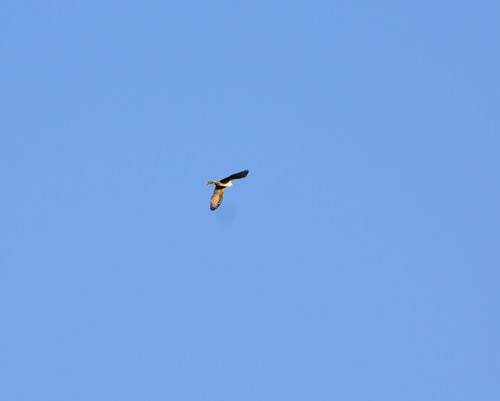 Dideric Cuckoo
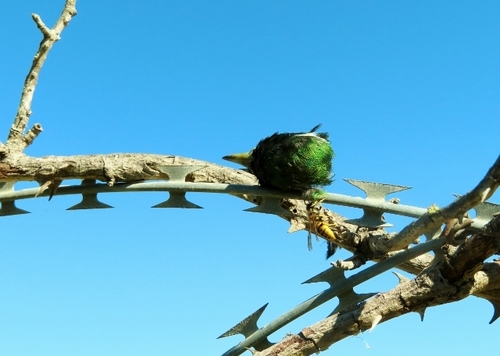 Klaas's Cuckoo
In short
Juvenile Dideric Cuckoo is best separated from Klaas's Cuckoo by its white wing-bar and streaky throat, which Klaas's never shows. In adults, Dideric males have coppery gloss and a broken white eye-stripe, while Klaas's males are a cleaner, glossy green above with plain white underparts and a small white post-ocular patch. Females of both are trickier: Dideric is more coppery and barred on the flanks, while Klaas's is bronze-brown above with faint barring below. In flight, Klaas's male is strikingly white below with dark primaries, while Dideric shows more green and copper. Dideric is slightly larger and bulkier, but this is subtle in the field.
Identification tips
- Juvenile Dideric Cuckoo shows a white wing-bar and streaky throat—these are absent in Klaas's at any age. If you see a streaky-throated, coppery juvenile with a white wing-bar, it's Dideric.
- Bill color in juveniles: Juvenile Dideric has a red bill, which is not noted for Klaas's.
- Adult male upperparts: Dideric males are glossy green with coppery sheen and a broken white eye-stripe. Klaas's males are glossy green but lack copper, have a cleaner look, and only a small white post-ocular patch.
- Underparts: Dideric males are white below, but Klaas's males are even cleaner white, with no flank barring or coppery wash.
- Female upperparts: Dideric females are more coppery above, Klaas's are bronze-brown with greenish wing coverts.
- Female underparts: Dideric females have coppery barring on the flanks and a brownish wash; Klaas's females are faintly barred white below.
- Tail pattern: Dideric has four green outer tail feathers tipped white, with the outermost pair spotted white on both vanes. Klaas's tail pattern is less marked.
- Wing pattern in flight: Klaas's male is strikingly white below with dark primaries; Dideric shows more green/copper and less contrast.
- White spots on remiges: Dideric shows 3–4 white spots on the inner vanes of the flight feathers, visible at close range or in good light.
- White eye-stripe: Dideric has a broken white eye-stripe; Klaas's has only a small white post-ocular patch.
- Flank markings: Dideric juveniles have brown blotches on the flanks; Klaas's lacks this.
- Voice: Loud, repetitive 'deed-deed-deed-deed-er-ick' is diagnostic for Dideric. Klaas's is quieter and less distinctive.
- Habitat: Dideric is more likely in open woodland and near weaver colonies; Klaas's prefers wooded areas but overlaps in many places.
- Size: Dideric is slightly larger and heavier, but this is rarely useful unless both are together.
- Sexual dimorphism: Both species show it, but Dideric's coppery tones and barring are more pronounced in females than Klaas's.
Size
Dideric Cuckoo is marginally larger and heavier (18–20 cm, 33.0 g) than Klaas's Cuckoo (16–18 cm, 27.9 g), but the difference is subtle and often hard to judge unless both are seen side by side. Both are small, slim cuckoos, but Dideric may appear a bit more robust. Size alone is rarely diagnostic in the field.
Plumage
-
Juvenile/immature: Juvenile Dideric Cuckoo stands out with a red bill, streaky throat, white wing-bar, and coppery upperparts with brownish underparts and brown blotches on the flanks. Klaas's Cuckoo juveniles are not described in detail here, but lack the white wing-bar and have a less streaked throat.
-
Adult male: Dideric is glossy green above with coppery areas, a broken white eye-stripe, short green malar stripe, and white underparts. The wings show 3–4 white spots on the inner vanes of the remiges, and the tail has white tips and spots. Klaas's male is a cleaner, glossy green above, plain white below, and has a small white post-ocular patch. In flight, Klaas's male appears largely white below with dark primaries, while Dideric shows more green and copper tones.
-
Adult female: Dideric females are more coppery above than males and show coppery barring on the flanks with a brownish wash below. Klaas's females are bronze-brown above, greenish on the wing coverts, and faintly barred white below. Both sexes of Klaas's have the small white post-ocular patch, which is less obvious in Dideric.
Behaviour
Both species are solitary and secretive, often seen alone in open woodland or forest edge. Dideric Cuckoo is noted for being particularly noisy and conspicuous when calling, while Klaas's is generally quieter and more retiring. Both are brood parasites, but Dideric is more often found near weaver colonies.
Habitat
Dideric Cuckoo favors open woodland, savanna, and riverside bushes, often in areas with weaverbirds. Klaas's Cuckoo prefers wooded regions and forest edges but overlaps with Dideric in many habitats across sub-Saharan Africa. Both can occur in similar areas, so habitat is not a strong separator except that Dideric is more likely in open or semi-open country.
Voice
Dideric Cuckoo is very vocal, with a loud, repetitive 'deed-deed-deed-deed-er-ick' call, usually four clear notes followed by a twitter. Klaas's Cuckoo's voice is not described in detail here, but is generally less persistent and less distinctive than Dideric's. If you hear the classic 'diederik' call, it's diagnostic for Dideric Cuckoo.