
Motmot

Eared Pygmy-Tyrant vs Drab-breasted Pygmy-Tyrant

Myiornis auricularis versus Hemitriccus diops

Play a quiz with Eared Pygmy-Tyrant and Drab-breasted Pygmy-Tyrant
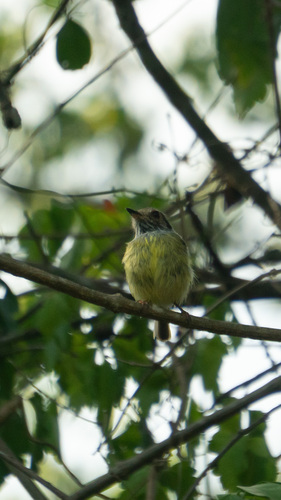
Eared Pygmy-Tyrant (Myiornis auricularis) Eared Pygmy-Tyrant
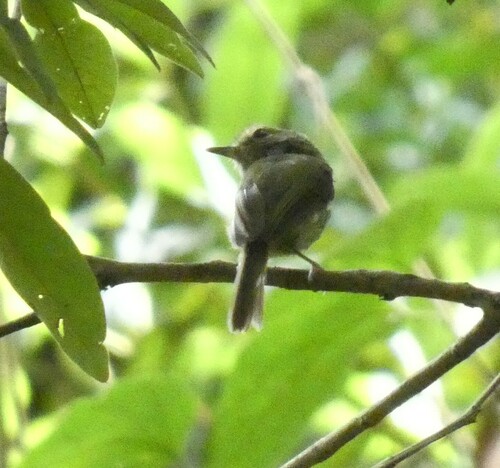
Drab-breasted Pygmy-Tyrant (Hemitriccus diops) Drab-breasted Pygmy-Tyrant

Media

Loading…

In short

The most reliable field mark to separate Eared Pygmy-Tyrant from Drab-breasted Pygmy-Tyrant is the dramatic facial pattern of the former: look for a bold buffy area around the eye, a black crescent behind whitish ear coverts, and a black patch below the eye. In contrast, Drab-breasted Pygmy-Tyrant has a much plainer olive-green face, with only a subtle white spot above the lores and a white eye-ring. Eared Pygmy-Tyrant is also noticeably smaller and more compact, while Drab-breasted is larger and heavier. Both species share similar ranges and habitats, so careful attention to facial pattern and overall size is crucial. Wing pattern is not strongly diagnostic for either species in any age, so focus on head and underpart coloration.

Identification tips

  1. Facial pattern is the best field mark: Eared Pygmy-Tyrant always shows a bold buff-cinnamon area around the eye, a distinct black crescent behind whitish ear coverts, and a black patch below the eye. Drab-breasted Pygmy-Tyrant has a plain olive-green face with only a faint white spot above the lores and a white eye-ring. This contrast is visible in all ages and sexes.
  2. Crown and nape color: Eared Pygmy-Tyrant has a bright olive crown with a brown tinge and gray nape/neck, while Drab-breasted is uniform dark olive-green above.
  3. Underparts: Eared Pygmy-Tyrant shows white throat and upper breast with thin black streaks, and bright yellow lower underparts with olive streaks. Drab-breasted has a dull gray throat and breast (sometimes with a pinkish or purplish tint), a faint white crescent between breast and belly, and a whitish belly/crissum with a yellow tinge.
  4. Wing pattern: Eared Pygmy-Tyrant has dusky wings with bright olive-yellow edges and two indistinct wingbars (often subtle), while Drab-breasted's wings are plain olive, sometimes with paler edges on innermost secondaries but no clear wingbars. This is a minor mark and not always visible.
  5. Size and structure: Eared Pygmy-Tyrant is much smaller (7–9 cm, ~5 g) and appears very compact and large-headed. Drab-breasted is larger (11 cm, 9.5–13.5 g) and more proportionate. If you see a truly tiny, big-headed bird, suspect Eared.
  6. Iris color: Eared Pygmy-Tyrant has an orange iris; Drab-breasted's is reddish-brown. This can be hard to see in the field but is consistent.
  7. Bill and legs: Eared Pygmy-Tyrant has a blackish bill and pinkish legs/feet; Drab-breasted has a gray maxilla, pinkish mandible, and light gray legs/feet. Not strongly diagnostic except at close range.
  8. Facial contrast at a distance: Even if you cannot see fine details, Eared Pygmy-Tyrant's face looks much more patterned and contrasting, while Drab-breasted's is plain.
  9. No age-specific wing or tail marks: Neither species has distinctive juvenile or immature upperwing or tail patterns that aid separation.
  10. No strong habitat separation: Both can occur in similar forest or woodland with dense understory, including bamboo. Do not rely on habitat alone.
  11. Behavior: Eared Pygmy-Tyrant may appear more active and restless, but this is subtle and not a reliable separator.
  12. Voice: No vocal differences are described in the available notes; do not rely on song or call for separation.
  13. Sexes similar: Both species have sexes alike in plumage, so all field marks apply to both males and females.
  14. Subspecies variation: Eared Pygmy-Tyrant subspecies may show paler ear coverts, but the overall facial pattern remains distinctive compared to Drab-breasted.
  15. Pitfall: Do not confuse faint wing edges or pale lores in Drab-breasted for the bold facial pattern of Eared; the latter is always much more striking and contrasting.

Size

Eared Pygmy-Tyrant is one of the smallest passerines, measuring just 7–9 cm in length and weighing about 5 g. Drab-breasted Pygmy-Tyrant is significantly larger, at about 11 cm long and 9.5–13.5 g in mass [wikipedia][wikidata]. This size difference is often visible in the field: Eared Pygmy-Tyrant appears tiny and large-headed, while Drab-breasted looks more typical for a small tyrant flycatcher. If seen together or with known reference species, the difference is striking.

Plumage

No age-specific upperwing or flight pattern is described for either species, so focus on adult and general plumage. Eared Pygmy-Tyrant of all ages and sexes shows a striking facial pattern: buff-cinnamon around the eye, whitish ear coverts edged with a black crescent, and a black patch below the eye. Its crown is bright olive with a brownish tinge, nape and neck gray, and back/rump bright olive. Wings are dusky with olive-yellow edges and two indistinct wingbars. Underparts are white on throat/upper breast with thin black streaks, and bright yellow with olive streaks below. Drab-breasted Pygmy-Tyrant is much plainer: the face is olive-green with a faint white spot above the lores and a white eye-ring, crown/back/rump are plain dark olive-green, and wings/tail are similarly plain. The throat and breast are dull gray with a pinkish or purplish tinge, separated from the whitish belly by a faint white crescent. The crissum is whitish with a yellow tinge. Iris color differs: orange in Eared, reddish-brown in Drab-breasted. Bill and leg color are not strongly diagnostic but may help at close range.

Behaviour

Both species forage in low to mid-level vegetation, making short sallies from perches to pick insects from leaves. Eared Pygmy-Tyrant is often described as more active and restless, moving quickly through dense foliage, while Drab-breasted Pygmy-Tyrant tends to be slightly less frenetic. However, behavioral differences are subtle and not reliable for separation in the field.

Habitat

Both species occur in Argentina, Brazil, and Paraguay, often in similar low to mid-level forest or woodland habitats. There is no strong habitat separation in the notes, so context is not a reliable separator. Both may be found in bamboo or dense understory, but this is not diagnostic.

Submit a better description

Use the same sections as the comparison. Your text is published immediately.

The most reliable field mark to separate Eared Pygmy-Tyrant from Drab-breasted Pygmy-Tyrant is the dramatic facial pattern of the former: look for a bold buffy area around the eye, a black crescent behind whitish ear coverts, and a black patch below the eye. In contrast, Drab-breasted Pygmy-Tyrant has a much plainer olive-green face, with only a subtle white spot above the lores and a white eye-ring. Eared Pygmy-Tyrant is also noticeably smaller and more compact, while Drab-breasted is larger and heavier. Both species share similar ranges and habitats, so careful attention to facial pattern and overall size is crucial. Wing pattern is not strongly diagnostic for either species in any age, so focus on head and underpart coloration.

  1. Facial pattern is the best field mark: Eared Pygmy-Tyrant always shows a bold buff-cinnamon area around the eye, a distinct black crescent behind whitish ear coverts, and a black patch below the eye. Drab-breasted Pygmy-Tyrant has a plain olive-green face with only a faint white spot above the lores and a white eye-ring. This contrast is visible in all ages and sexes.
  2. Crown and nape color: Eared Pygmy-Tyrant has a bright olive crown with a brown tinge and gray nape/neck, while Drab-breasted is uniform dark olive-green above.
  3. Underparts: Eared Pygmy-Tyrant shows white throat and upper breast with thin black streaks, and bright yellow lower underparts with olive streaks. Drab-breasted has a dull gray throat and breast (sometimes with a pinkish or purplish tint), a faint white crescent between breast and belly, and a whitish belly/crissum with a yellow tinge.
  4. Wing pattern: Eared Pygmy-Tyrant has dusky wings with bright olive-yellow edges and two indistinct wingbars (often subtle), while Drab-breasted's wings are plain olive, sometimes with paler edges on innermost secondaries but no clear wingbars. This is a minor mark and not always visible.
  5. Size and structure: Eared Pygmy-Tyrant is much smaller (7–9 cm, ~5 g) and appears very compact and large-headed. Drab-breasted is larger (11 cm, 9.5–13.5 g) and more proportionate. If you see a truly tiny, big-headed bird, suspect Eared.
  6. Iris color: Eared Pygmy-Tyrant has an orange iris; Drab-breasted's is reddish-brown. This can be hard to see in the field but is consistent.
  7. Bill and legs: Eared Pygmy-Tyrant has a blackish bill and pinkish legs/feet; Drab-breasted has a gray maxilla, pinkish mandible, and light gray legs/feet. Not strongly diagnostic except at close range.
  8. Facial contrast at a distance: Even if you cannot see fine details, Eared Pygmy-Tyrant's face looks much more patterned and contrasting, while Drab-breasted's is plain.
  9. No age-specific wing or tail marks: Neither species has distinctive juvenile or immature upperwing or tail patterns that aid separation.
  10. No strong habitat separation: Both can occur in similar forest or woodland with dense understory, including bamboo. Do not rely on habitat alone.
  11. Behavior: Eared Pygmy-Tyrant may appear more active and restless, but this is subtle and not a reliable separator.
  12. Voice: No vocal differences are described in the available notes; do not rely on song or call for separation.
  13. Sexes similar: Both species have sexes alike in plumage, so all field marks apply to both males and females.
  14. Subspecies variation: Eared Pygmy-Tyrant subspecies may show paler ear coverts, but the overall facial pattern remains distinctive compared to Drab-breasted.
  15. Pitfall: Do not confuse faint wing edges or pale lores in Drab-breasted for the bold facial pattern of Eared; the latter is always much more striking and contrasting.

Eared Pygmy-Tyrant is one of the smallest passerines, measuring just 7–9 cm in length and weighing about 5 g. Drab-breasted Pygmy-Tyrant is significantly larger, at about 11 cm long and 9.5–13.5 g in mass [wikipedia][wikidata]. This size difference is often visible in the field: Eared Pygmy-Tyrant appears tiny and large-headed, while Drab-breasted looks more typical for a small tyrant flycatcher. If seen together or with known reference species, the difference is striking.

No age-specific upperwing or flight pattern is described for either species, so focus on adult and general plumage. Eared Pygmy-Tyrant of all ages and sexes shows a striking facial pattern: buff-cinnamon around the eye, whitish ear coverts edged with a black crescent, and a black patch below the eye. Its crown is bright olive with a brownish tinge, nape and neck gray, and back/rump bright olive. Wings are dusky with olive-yellow edges and two indistinct wingbars. Underparts are white on throat/upper breast with thin black streaks, and bright yellow with olive streaks below. Drab-breasted Pygmy-Tyrant is much plainer: the face is olive-green with a faint white spot above the lores and a white eye-ring, crown/back/rump are plain dark olive-green, and wings/tail are similarly plain. The throat and breast are dull gray with a pinkish or purplish tinge, separated from the whitish belly by a faint white crescent. The crissum is whitish with a yellow tinge. Iris color differs: orange in Eared, reddish-brown in Drab-breasted. Bill and leg color are not strongly diagnostic but may help at close range.

Both species forage in low to mid-level vegetation, making short sallies from perches to pick insects from leaves. Eared Pygmy-Tyrant is often described as more active and restless, moving quickly through dense foliage, while Drab-breasted Pygmy-Tyrant tends to be slightly less frenetic. However, behavioral differences are subtle and not reliable for separation in the field.

Both species occur in Argentina, Brazil, and Paraguay, often in similar low to mid-level forest or woodland habitats. There is no strong habitat separation in the notes, so context is not a reliable separator. Both may be found in bamboo or dense understory, but this is not diagnostic.

Discard your changes?

You have unsaved edits. If you leave now, those changes will be lost.

Eared Pygmy-Tyrant · Drab-breasted Pygmy-Tyrant · My Tricky Birds