

Eurasian Hobby vs Peregrine Falcon
Falco subbuteo versus Falco peregrinus
Play a quiz with Eurasian Hobby and Peregrine Falcon
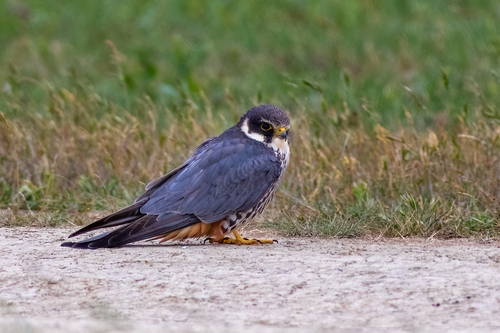 Eurasian Hobby
 Peregrine Falcon
In short
The most reliable field mark to separate Eurasian Hobby from Peregrine Falcon is overall size and structure: the Hobby is much smaller and slimmer, with long, sickle-shaped wings and a square tail, while the Peregrine is a large, robust falcon with broader, more pointed wings and a proportionally shorter tail. Adult Hobbies show distinctive rufous 'trousers' and vent, which are absent in Peregrines, while Peregrines have a bold black hood and heavily barred underparts. Juvenile Hobbies are browner and show streaked thighs, whereas young Peregrines have a more uniform brownish appearance with less contrast. Flight style also differs: Hobbies often recall swifts with their agile, buoyant flight, while Peregrines appear more powerful and direct.
Identification tips
-
Size and structure: Peregrine Falcon is much larger and bulkier than Eurasian Hobby; size difference is obvious when seen together or with familiar species for scale. Hobby is slim and delicate, with long, narrow, sickle-shaped wings and a square tail; Peregrine is robust, with broad, pointed wings and a shorter, more rounded tail.
-
Flight style: Hobby often recalls a giant swift—buoyant, agile, and flickering in flight, sometimes gliding with wings swept back. Peregrine is more direct and powerful, with strong, deep wingbeats and less buoyant flight.
-
Adult plumage: Hobby adults have slate-grey upperparts, a dark crown, two short moustache stripes, a clean white throat, and distinctive rufous 'trousers' and vent. Peregrine adults have blue-grey upperparts, a bold black hood and moustache, white throat, and heavily barred underparts with no rufous on the thighs or vent.
-
Juvenile/immature plumage: Juvenile Hobbies are browner above, with a scaled look and streaked, buffy thighs and vent. Juvenile Peregrines are more uniformly brownish, with less contrast and no rufous tones, and their underparts are streaked but less sharply than in Hobby.
-
Underpart pattern: Hobby shows black streaks on whitish underparts; Peregrine shows heavy, horizontal barring on white underparts (especially adults).
-
Facial pattern: Both have moustache marks, but Peregrine's is broader and more contrasting, forming a bold black hood; Hobby's is subtler, with two short stripes and a less extensive dark crown.
-
Thighs and vent: Hobby's rufous, unstreaked 'trousers' and vent are unique and diagnostic in adults; Peregrine's thighs and vent are barred and lack rufous.
-
Perched jizz: Hobby appears slim, long-winged, and lightly built when perched; Peregrine is heavy-chested, with a large head and thick neck.
-
Sexual dimorphism: Peregrine shows strong size dimorphism (female much larger than male); Hobby sexes are similar in size and plumage.
-
Habitat context: Hobby is more likely in open country with scattered trees, especially in lowlands; Peregrine is more likely on cliffs, tall buildings, or open landscapes, and is common in urban settings.
-
Feeding behavior: Hobby often catches and eats insects or small birds on the wing, sometimes seen eating in flight; Peregrine typically hunts birds (sometimes mammals) with a high-speed stoop, rarely seen eating in flight.
-
Group behavior: Hobbies may migrate in small groups; Peregrines are usually solitary or in pairs.
-
Voice: Not diagnostic with current notes.
-
Pitfalls: Juvenile Hobbies can be confused with small falcons due to their browner, streaked appearance; always check for rufous thighs and vent, and overall slim shape. Juvenile Peregrines can look less contrasting than adults but remain bulkier and lack rufous tones.
-
When in doubt: Focus on size, structure, and the presence or absence of rufous on the thighs and vent—these are the most reliable field marks in all ages.
Size
Eurasian Hobby is a small, slim falcon (body mass ~211 g), measuring 29–36 cm in length with a wingspan of 74–84 cm. Peregrine Falcon is much larger and bulkier (often crow-sized), with females especially being considerably bigger than males; exact mass not provided here, but it is substantially heavier and longer than Hobby. In the field, Peregrine appears robust and broad-chested, while Hobby is noticeably more delicate and slender.
Plumage
-
Juvenile/immature birds: Juvenile Hobbies are generally much browner above, with a scaled appearance and streaked, buffy thighs and undertail coverts. Their underparts are streaked, but the rufous 'trousers' are less clear and more streaked than in adults. Juvenile Peregrines, by contrast, are more uniformly brownish overall, with less contrast between upperparts and underparts, and lack the rufous vent and thighs. Their underparts are also streaked but tend to be more uniform and less sharply defined than in Hobbies.
-
Adults: Adult Hobbies are slate-grey above, with a dark crown, two short black moustache stripes, a clean white throat, and striking rufous, unstreaked thighs and vent. The rest of the underparts are whitish with black streaks. Peregrines are blue-grey above, with a bold black head and moustache, white throat, and heavily barred white underparts (not streaked). The thighs and vent are not rufous but are barred like the rest of the underparts. Sexes are similar in both species, but Peregrine females are much larger.
Behaviour
Hobbies are agile, swift-like fliers, often seen hawking insects and small birds in the air, sometimes eating on the wing. Their flight is buoyant, with quick, flickering wingbeats and gliding reminiscent of swifts. Peregrines are powerful, direct fliers, often hunting from a high perch or soaring before stooping at high speed to strike prey in mid-air. Peregrines are less likely to be seen catching insects and more often target birds and occasionally mammals, striking with force and precision.
Habitat
Eurasian Hobby prefers open country such as farmland, marshes, taiga, savannah, and lowlands with scattered woods. They are most often seen in open landscapes, especially where there are abundant insects and small birds. Peregrine Falcons require open space for hunting and are found over open water, marshes, valleys, fields, tundra, and increasingly in urban areas where they hunt pigeons and other city birds. Both species can be seen in similar open habitats, but Peregrines are more likely to be found in cities and on cliffs.