

Eurasian Wigeon vs Northern Pintail
Mareca penelope versus Anas acuta
Play a quiz with Eurasian Wigeon and Northern Pintail
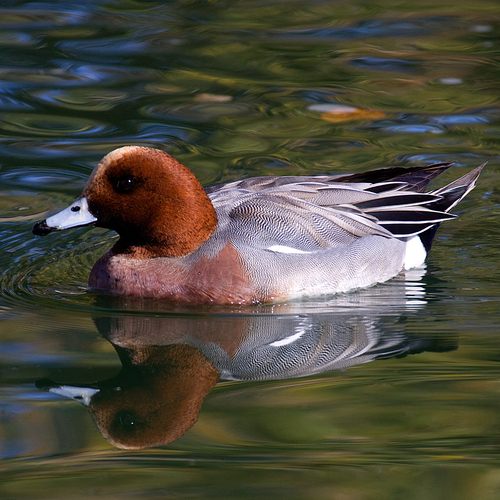 Eurasian Wigeon
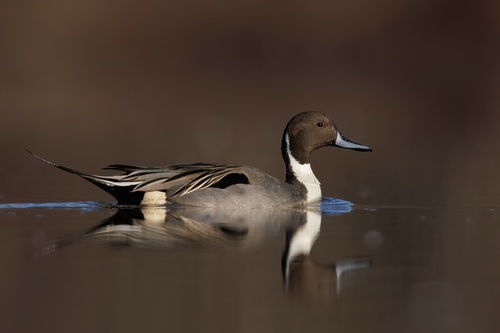 Northern Pintail
In short
The most reliable field mark between Eurasian Wigeon and Northern Pintail is the male Pintail's long, sharply pointed central tail feathers, which are never present in Wigeon of any age or sex. In flight, both species show distinctive upperwing patterns, but the Wigeon’s bold white upperwing patch (on both sexes and ages) stands out, while Pintails have a more subtle speculum pattern with a white trailing edge. Female and eclipse-plumaged birds are often confused, but Wigeon are compact with rounded heads and short necks, while Pintails are more slender, long-necked, and have a graceful, elongated shape. Careful attention to structure and wing pattern, especially in flight or among flocks, will separate even drab individuals.
Identification tips
- Tail shape is critical: Male Pintails (all plumages) have extremely long, pointed central tail feathers, giving a sharp, pin-like tail. No Wigeon ever shows this feature. Female Pintails have a longer, more pointed tail than Wigeon, but not as extreme as males.
- Upperwing pattern in flight: All Wigeon (male, female, juvenile) show a bold white patch on the upperwing, visible both at rest and in flight. Pintails lack this; instead, look for a dark speculum with a white trailing edge (most prominent in females and juveniles) and pale rufous at the front in males.
- Head and neck structure: Pintails are slender with a long neck and small head, giving a graceful, stretched appearance. Wigeon are compact, with a short neck and rounded head, often looking 'blocky' compared to Pintail.
- Bill color and shape: Both have blue-grey bills, but Pintail's is longer and more slender, matching its overall shape. Wigeon's bill is shorter and stubbier.
- Breeding male plumage: Male Wigeon have a chestnut head with a creamy crown, pink breast, and grey flanks. Male Pintails have a chocolate-brown head, white neck stripe, and long grey scapulars. These are unmistakable when seen well.
- Female and eclipse confusion: Female Wigeon are light brown, sometimes with a rufous or grayish head, but always compact. Female Pintails are more mottled and have a more uniform grey-brown head and a longer, slimmer neck. Eclipse males of both species resemble females, but Pintail males retain the long tail and upperwing pattern.
- Juvenile upperwing: Juvenile Pintails have a dull brown speculum with a narrow white trailing edge; juvenile Wigeon still show the white upperwing patch.
- Posture and jizz: Pintails swim with neck extended and tail often raised, looking elegant and elongated. Wigeon are more horizontal and compact in the water.
- Size in mixed flocks: Pintails are noticeably larger and longer-necked than Wigeon. Use this when both species are together.
- Voice: Wigeon males give a clear, two-note whistle, higher-pitched than the softer, flute-like whistle of Pintail drakes. Females are less distinctive but Wigeon are generally more vocal.
- Habitat overlap: Both species occur together, so do not rely on habitat alone. However, Wigeon may be more often seen grazing on land, while Pintails are more aquatic.
- Pitfalls: In poor light or at distance, female and eclipse-plumaged birds can be very similar. Focus on structure (neck and tail length), upperwing pattern in flight, and flock context for best separation.
- When marks fail: If only the head and neck are visible, Pintail's longer neck and more slender head may be apparent. If only the back is seen, look for the white wing patch (Wigeon) or long scapulars and pointed tail (Pintail).
Size
Northern Pintail is notably larger and more elongated than Eurasian Wigeon. Pintails average around 945.5 g in body mass [wikidata], with males reaching up to 76 cm in length and a wingspan up to 95 cm [wikipedia]. Wigeon are smaller and more compact, with a length of 42–52 cm and a wingspan of 71–80 cm [wikipedia]. In the field, Pintails look longer-necked and sleeker, while Wigeon appear short-necked and round-headed. This size and shape difference is especially apparent when both species are together or in mixed flocks.
Plumage
Juvenile and female Pintails are mottled brown with a uniform grey-brown head and a long, slender neck. Their upperwing in flight shows a dull brown speculum with a narrow white trailing edge, which is most prominent at the rear. Juvenile Pintails are less neatly scalloped and have a duller speculum than adults. In contrast, all ages and sexes of Eurasian Wigeon show a bold white patch on the upperwing, visible both at rest and in flight. Breeding male Wigeon have a chestnut head with a creamy crown, pink breast, and grey flanks, while male Pintails have a chocolate-brown head, white neck stripe, and long grey scapulars. Female Wigeon are light brown, sometimes with a rufous or grayish head, but always lack the Pintail’s elongated shape and pointed tail. In eclipse (non-breeding) plumage, male Pintails resemble females but keep the long tail and upperwing pattern, while male Wigeon become more like females but retain the white wing patch.
Behaviour
Pintails are more graceful and elongated in posture, often swimming with their necks extended and tails held up, accentuating their streamlined shape. Their flight is fast, with wings swept slightly back. Wigeon are more compact and sit lower in the water, with a more horizontal posture and shorter neck. In mixed flocks, Pintails tend to stand out by their upright, elegant stance and longer neck movements, while Wigeon appear more rounded and less elongated.
Habitat
Both species can be found in similar wetland habitats during migration and winter, including lakes, marshes, and flooded fields. However, Pintails are more likely to be seen in open, shallow water and sometimes walk well on land, while Wigeon often graze on grasslands near water and are more likely to be seen in compact flocks. Habitat overlap is common, so context alone is not a reliable separator.
Voice
Wigeon are known for their distinctive whistling calls, especially the male's clear, two-note whistle. Pintail drakes give a flute-like whistle, while females produce a rough quack. The Wigeon's whistle is higher-pitched and more piercing, while Pintail vocalizations are softer and less distinctive in mixed flocks. However, calls are not always heard in the field, especially outside the breeding season.