

Eurasian Woodcock vs Common Snipe
Scolopax rusticola versus Gallinago gallinago
Play a quiz with Eurasian Woodcock and Common Snipe
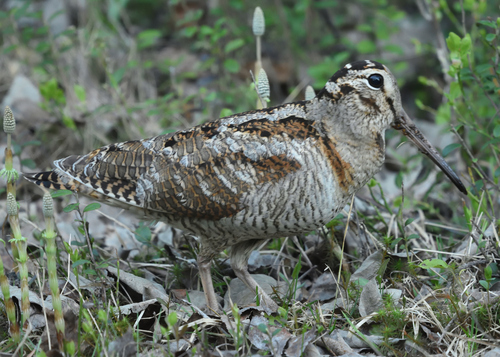 Eurasian Woodcock
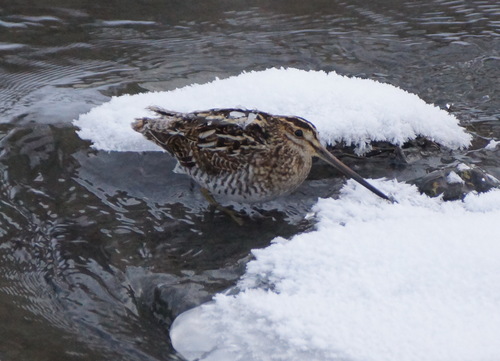 Common Snipe
In short
The most reliable field mark to separate Eurasian Woodcock from Common Snipe is the head pattern: Woodcock shows bold black bars across the crown, while Snipe has pale and dark stripes running lengthwise. In flight, Woodcock appears larger and rounder-winged, with broad, rounded wings and a slower, more direct flight; Snipe is smaller, with pointed wings and a rapid, zig-zagging flush. Woodcock's cryptic, reddish-brown upperparts and buff underparts contrast with Snipe's brown, heavily striped upperparts and straw-yellow dorsal stripes. Bill length and structure also differ, but can overlap. Both are well-camouflaged, but their preferred habitats and behavior when flushed are distinct.
Identification tips
- Head pattern: Woodcock has bold black bars running across the crown (side-to-side); Snipe has pale and dark stripes running lengthwise from bill to nape. This is the single most reliable mark at all ages and in all conditions.
- Wing shape in flight: Woodcock's wings are broad and rounded, giving a bat-like or chunky appearance; Snipe's wings are sharply pointed, creating a sleeker, more aerodynamic look. This difference is obvious when birds flush.
- Flight style: Woodcock flushes with a slow, direct, whirring flight, often low and straight; Snipe explodes upward with a rapid, zig-zagging, erratic flight, often accompanied by a sharp 'scape' call.
- Bill length and structure: Both have long, straight bills, but Woodcock's is thicker and slightly longer (6–8 cm) compared to Snipe's more slender 5.5–7 cm bill. This is subtle and not always reliable in the field.
- Upperparts pattern: Woodcock is intricately patterned with reddish-brown, black, and buff, blending perfectly with leaf litter; Snipe is brown with straw-yellow stripes along the back and a dark eye-stripe bordered by pale lines.
- Underparts: Woodcock's underparts are buff and less heavily marked; Snipe's are paler with more streaking, especially on the breast.
- Eye placement: Woodcock's eyes are set very high and far back on the head, giving a 'wide-eyed' look and 360-degree vision; Snipe's eyes are more typical in placement.
- Tail shape: Not strongly diagnostic, but Snipe's tail is shorter and more squared; Woodcock's is slightly longer and more rounded.
- Leg color: Woodcock's legs vary from grey to pinkish; Snipe's are short and greenish-grey. Not a primary field mark but can help at close range.
- Size and bulk: Woodcock is much larger and bulkier, but size is hard to judge unless both species are seen together.
- Habitat: Woodcock is almost always in woodland or dense cover; Snipe is in open, wet habitats. If you flush a bird from woods, it's almost certainly Woodcock.
- Behavior when flushed: Woodcock relies on camouflage and flushes only when nearly stepped on; Snipe is more likely to flush at a greater distance and in a more panicked manner.
- Vocalizations: Snipe's 'scape' call and drumming display are unique; Woodcock's roding call is heard only at dusk in spring, in woodland.
- Seasonal context: Both species can be present in migration, but Woodcock is more likely in wooded areas, especially in winter; Snipe is present in marshes year-round in many areas.
- Sex and age: Sexes are not separable in the field for either species, and juveniles do not show strong differences from adults in the field marks above. Focus on head pattern and flight style for all ages.
Size
Eurasian Woodcock is noticeably larger and bulkier than Common Snipe. Woodcock measures 33–38 cm in length with a 55–65 cm wingspan, while Snipe is 25–27 cm long with a 44–47 cm wingspan. Snipe's average mass is about 119.5 g [wikidata], while Woodcock is heavier (though no precise mass is given here, it is consistently described as larger and heavier in the field). In the hand or at close range, Woodcock's much more robust body and longer overall length are apparent, but in the field, shape and flight style are more reliable than size alone.
Plumage
The most diagnostic plumage mark for all ages is the head pattern: Woodcock has bold black bars running across the crown (side-to-side), while Snipe has pale and dark stripes running lengthwise (front-to-back) from bill to nape. On the upperparts, Woodcock is intricately patterned with reddish-brown, black, and buff, giving a leaf-litter effect, while Snipe shows brown upperparts with straw-yellow lengthwise stripes and a dark eye-stripe bordered by pale lines. Underparts of Woodcock are buff and less heavily marked than Snipe, which has paler underparts with some streaking. In flight, Woodcock's wings are broad and rounded, with no strong contrast or panels; Snipe's wings are pointed and show a more uniform brown, but with a slight paler trailing edge (not as bold as in Wilson's Snipe). Juvenile and immature plumages are not described as strongly distinctive in flight, so the head pattern and overall shape remain the best clues across ages.
Behaviour
Woodcock is typically found in woodland or dense cover and relies on its camouflage to remain hidden, often flushing only at very close range with a slow, direct, whirring flight. Snipe prefers open marshes, wet meadows, and bogs, and when flushed, explodes into a rapid, zig-zagging flight, often uttering a sharp 'scape' call. Woodcock's flight is more lumbering and direct, while Snipe's is erratic and fast. Both probe for food with long bills, but Woodcock is more likely to be seen at dusk or dawn, sometimes performing its 'roding' display flight.
Habitat
Woodcock is a bird of woodland and dense cover, often in temperate or subarctic forests, and is rarely found in open marshes. Snipe is strongly associated with open, wet habitats: marshes, bogs, wet meadows, and tundra. If you flush a bird from dense woodland, Woodcock is far more likely; from open, wet ground, Snipe is the default. Habitat context is a strong supporting clue.
Voice
Woodcock's display flight ('roding') features a repeated 'orr, orr, orr, pist' call, usually at dusk in spring and early summer. Snipe's main vocalization is the 'winnowing' or 'drumming' sound produced by vibrating tail feathers during display flights, described as a bleating or goat-like sound, and a sharp 'scape' call when flushed. If you hear a bleating or drumming in open country, it's Snipe; Woodcock's calls are less likely to be heard except during roding in woodland.