
Motmot

European Honey-buzzard vs Short-toed Eagle

Pernis apivorus versus Circaetus gallicus

Play a quiz with European Honey-buzzard and Short-toed Eagle
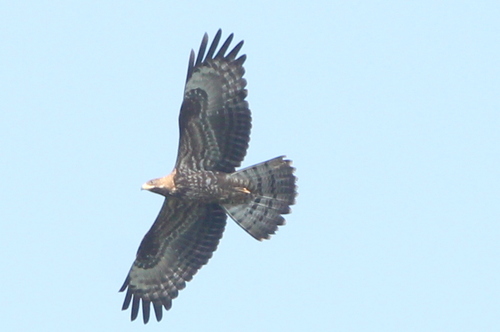
European Honey-buzzard (Pernis apivorus) European Honey-buzzard
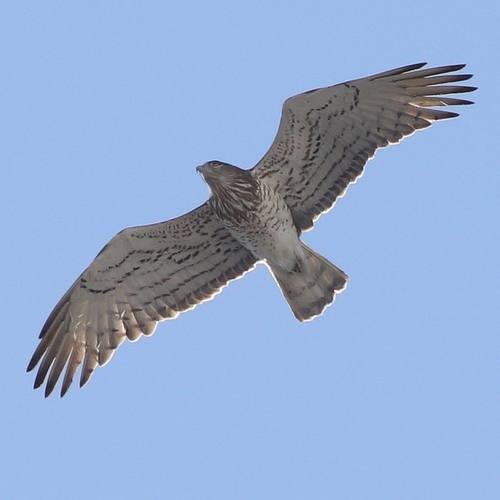
Short-toed Eagle (Circaetus gallicus) Short-toed Eagle

Media

Loading…

In short

The most reliable field mark to separate European Honey-buzzard from Short-toed Eagle in flight is the combination of head and wing shape: Honey-buzzard shows a small, pigeon-like head and long neck, with flat, straight wings and a long, narrow tail with only two or three dark bars. Short-toed Eagle is much bulkier, with a rounded, owl-like head, broad wings, and a shorter, broader tail with three or four bars. Juvenile Honey-buzzards can mimic the plumage of Common Buzzard, but never look as white below as Short-toed Eagle. In perched birds, note the Honey-buzzard's slim build and small head versus the eagle's powerful, upright stance and fierce yellow eyes. Both species soar on flat wings, but the eagle is much larger and whiter below, especially on the underwings and body.

Identification tips

  1. Head and neck shape in flight: Honey-buzzard has a small, pigeon-like head and long neck projecting forward; Short-toed Eagle's head is large, rounded, and owl-like, with a short neck. This is visible at all ages and distances.
  2. Tail pattern: Honey-buzzard shows a long, narrow tail with two narrow dark bars and a broad subterminal bar (all ages); Short-toed Eagle has a shorter, broader tail with three or four bars (adults and immatures).
  3. Underwing and underbody color: Short-toed Eagle is strikingly white below, with lightly barred underwings and underparts; Honey-buzzard is never so white, showing variable but generally darker and more patterned underparts.
  4. Wing shape and posture: Honey-buzzard's wings are long, narrow, and held flat or slightly down at the tips; Short-toed Eagle's wings are broader and more paddle-shaped, also held flat but with a deeper chest and more powerful impression.
  5. Size and bulk: Short-toed Eagle is much larger and heavier, with a wingspan up to 195 cm and weight up to 2.3 kg; Honey-buzzard is slimmer, lighter, and more graceful in flight.
  6. Eye color: At close range, Short-toed Eagle shows bright yellow eyes; Honey-buzzard's eyes are less conspicuous and not as bright.
  7. Perched jizz: Honey-buzzard perches with a slim, elongated silhouette and small head; Short-toed Eagle is upright, deep-chested, and powerful, with a large, rounded head.
  8. Sex differences: Male Honey-buzzard has a blue-grey head, female brown; Short-toed Eagle does not show strong sexual dimorphism in the field.
  9. Juvenile confusion: Juvenile Honey-buzzard can mimic Common Buzzard but not Short-toed Eagle; Short-toed Eagle juveniles are still white below and never show the mimicry pattern.
  10. Flight behavior: Short-toed Eagle often hovers like a kestrel when hunting; Honey-buzzard rarely hovers, preferring to soar or glide.
  11. Habitat context: Honey-buzzard is more likely over forests and woodland; Short-toed Eagle is seen over open country, plains, and semi-desert.
  12. Vocalization: Only Honey-buzzard gives a clear 'peee-lu' call; Short-toed Eagle is usually silent.
  13. Tail length: Honey-buzzard's tail is proportionally longer and narrower than the eagle's, especially noticeable in flight.
  14. Display behavior: Honey-buzzard males may wing-clap in display; Short-toed Eagle does not.
  15. Pitfalls: Do not confuse juvenile Honey-buzzard with Short-toed Eagle based on pale underparts—eagle is always whiter and bulkier, with a different head and tail shape.

Size

Short-toed Eagle is substantially larger and heavier than European Honey-buzzard. The eagle measures 59–70 cm in length with a wingspan of 162–195 cm and weighs 1.2–2.3 kg (average 1.7 kg) [wikipedia, avonet]. In contrast, Honey-buzzard is 52–60 cm long, wingspan 130–150 cm, and weighs 440–1050 g [wikipedia, avonet]. In the field, Short-toed Eagle appears much bulkier and more powerful, with a deeper chest and heavier build, while Honey-buzzard is noticeably slimmer and lighter, with a more graceful, buoyant flight.

Plumage

Juvenile and immature Honey-buzzards can look confusingly similar to Common Buzzard, but not to Short-toed Eagle. Honey-buzzard of all ages shows a long tail with only two narrow dark bars plus a broad subterminal bar, and a small, projecting head. Males have a blue-grey head, females brown. The underparts are variable but never as white as Short-toed Eagle. In flight, Honey-buzzard's wings are long and narrow, with a straight trailing edge and sometimes a slight downward kink at the carpal. Short-toed Eagle adults are strikingly white below, with lightly barred underwings and underparts, a pale brown throat and upper breast, and a short, broad tail with three or four bars. The eagle's upperparts are greyish-brown, and the head is rounded and pale. The eagle's yellow eyes are conspicuous at close range. In summary: Honey-buzzard never shows the all-white underparts and underwings of Short-toed Eagle, and the eagle never has the long, narrow tail and small head of Honey-buzzard.

Behaviour

Both species soar on flat wings, but their flight style and posture differ. Honey-buzzard soars with wings held flat and tips sometimes slightly down, with a long neck and head projecting forward, giving a distinctive jizz reminiscent of a giant sparrowhawk. The chest can appear angular in direct flight. Short-toed Eagle also soars on flat wings but appears heavier and broader, often hovering like a kestrel when hunting. The eagle spends more time on the wing and is more likely to be seen quartering open country or hovering over slopes. Perched, Honey-buzzard is slim and inconspicuous, while the eagle is upright and powerful.

Habitat

European Honey-buzzard breeds in woodland, often in mature conifer forests, and is secretive except during display flights in spring. It is scarce and local in the UK, mainly in southeastern England, mid Wales, and central Scotland. Short-toed Eagle prefers open habitats: cultivated plains, arid scrub, foothills, and semi-desert, always with some trees for nesting but usually hunting over open ground. The eagle is rare in most of Europe except Spain, and is a vagrant in the UK. In the field, Honey-buzzard is more likely over forests, Short-toed Eagle over open country.

Voice

Honey-buzzard gives a clear, two-syllable 'peee-lu' call, especially in display. Short-toed Eagle is generally very silent, but can give musical whistling notes on occasion, especially near the nest. In most field situations, vocalizations are not a reliable separator.

Submit a better description

Use the same sections as the comparison. Your text is published immediately.

The most reliable field mark to separate European Honey-buzzard from Short-toed Eagle in flight is the combination of head and wing shape: Honey-buzzard shows a small, pigeon-like head and long neck, with flat, straight wings and a long, narrow tail with only two or three dark bars. Short-toed Eagle is much bulkier, with a rounded, owl-like head, broad wings, and a shorter, broader tail with three or four bars. Juvenile Honey-buzzards can mimic the plumage of Common Buzzard, but never look as white below as Short-toed Eagle. In perched birds, note the Honey-buzzard's slim build and small head versus the eagle's powerful, upright stance and fierce yellow eyes. Both species soar on flat wings, but the eagle is much larger and whiter below, especially on the underwings and body.

  1. Head and neck shape in flight: Honey-buzzard has a small, pigeon-like head and long neck projecting forward; Short-toed Eagle's head is large, rounded, and owl-like, with a short neck. This is visible at all ages and distances.
  2. Tail pattern: Honey-buzzard shows a long, narrow tail with two narrow dark bars and a broad subterminal bar (all ages); Short-toed Eagle has a shorter, broader tail with three or four bars (adults and immatures).
  3. Underwing and underbody color: Short-toed Eagle is strikingly white below, with lightly barred underwings and underparts; Honey-buzzard is never so white, showing variable but generally darker and more patterned underparts.
  4. Wing shape and posture: Honey-buzzard's wings are long, narrow, and held flat or slightly down at the tips; Short-toed Eagle's wings are broader and more paddle-shaped, also held flat but with a deeper chest and more powerful impression.
  5. Size and bulk: Short-toed Eagle is much larger and heavier, with a wingspan up to 195 cm and weight up to 2.3 kg; Honey-buzzard is slimmer, lighter, and more graceful in flight.
  6. Eye color: At close range, Short-toed Eagle shows bright yellow eyes; Honey-buzzard's eyes are less conspicuous and not as bright.
  7. Perched jizz: Honey-buzzard perches with a slim, elongated silhouette and small head; Short-toed Eagle is upright, deep-chested, and powerful, with a large, rounded head.
  8. Sex differences: Male Honey-buzzard has a blue-grey head, female brown; Short-toed Eagle does not show strong sexual dimorphism in the field.
  9. Juvenile confusion: Juvenile Honey-buzzard can mimic Common Buzzard but not Short-toed Eagle; Short-toed Eagle juveniles are still white below and never show the mimicry pattern.
  10. Flight behavior: Short-toed Eagle often hovers like a kestrel when hunting; Honey-buzzard rarely hovers, preferring to soar or glide.
  11. Habitat context: Honey-buzzard is more likely over forests and woodland; Short-toed Eagle is seen over open country, plains, and semi-desert.
  12. Vocalization: Only Honey-buzzard gives a clear 'peee-lu' call; Short-toed Eagle is usually silent.
  13. Tail length: Honey-buzzard's tail is proportionally longer and narrower than the eagle's, especially noticeable in flight.
  14. Display behavior: Honey-buzzard males may wing-clap in display; Short-toed Eagle does not.
  15. Pitfalls: Do not confuse juvenile Honey-buzzard with Short-toed Eagle based on pale underparts—eagle is always whiter and bulkier, with a different head and tail shape.

Short-toed Eagle is substantially larger and heavier than European Honey-buzzard. The eagle measures 59–70 cm in length with a wingspan of 162–195 cm and weighs 1.2–2.3 kg (average 1.7 kg) [wikipedia, avonet]. In contrast, Honey-buzzard is 52–60 cm long, wingspan 130–150 cm, and weighs 440–1050 g [wikipedia, avonet]. In the field, Short-toed Eagle appears much bulkier and more powerful, with a deeper chest and heavier build, while Honey-buzzard is noticeably slimmer and lighter, with a more graceful, buoyant flight.

Juvenile and immature Honey-buzzards can look confusingly similar to Common Buzzard, but not to Short-toed Eagle. Honey-buzzard of all ages shows a long tail with only two narrow dark bars plus a broad subterminal bar, and a small, projecting head. Males have a blue-grey head, females brown. The underparts are variable but never as white as Short-toed Eagle. In flight, Honey-buzzard's wings are long and narrow, with a straight trailing edge and sometimes a slight downward kink at the carpal. Short-toed Eagle adults are strikingly white below, with lightly barred underwings and underparts, a pale brown throat and upper breast, and a short, broad tail with three or four bars. The eagle's upperparts are greyish-brown, and the head is rounded and pale. The eagle's yellow eyes are conspicuous at close range. In summary: Honey-buzzard never shows the all-white underparts and underwings of Short-toed Eagle, and the eagle never has the long, narrow tail and small head of Honey-buzzard.

Both species soar on flat wings, but their flight style and posture differ. Honey-buzzard soars with wings held flat and tips sometimes slightly down, with a long neck and head projecting forward, giving a distinctive jizz reminiscent of a giant sparrowhawk. The chest can appear angular in direct flight. Short-toed Eagle also soars on flat wings but appears heavier and broader, often hovering like a kestrel when hunting. The eagle spends more time on the wing and is more likely to be seen quartering open country or hovering over slopes. Perched, Honey-buzzard is slim and inconspicuous, while the eagle is upright and powerful.

European Honey-buzzard breeds in woodland, often in mature conifer forests, and is secretive except during display flights in spring. It is scarce and local in the UK, mainly in southeastern England, mid Wales, and central Scotland. Short-toed Eagle prefers open habitats: cultivated plains, arid scrub, foothills, and semi-desert, always with some trees for nesting but usually hunting over open ground. The eagle is rare in most of Europe except Spain, and is a vagrant in the UK. In the field, Honey-buzzard is more likely over forests, Short-toed Eagle over open country.

Honey-buzzard gives a clear, two-syllable 'peee-lu' call, especially in display. Short-toed Eagle is generally very silent, but can give musical whistling notes on occasion, especially near the nest. In most field situations, vocalizations are not a reliable separator.

Discard your changes?

You have unsaved edits. If you leave now, those changes will be lost.

European Honey-buzzard · Short-toed Eagle · My Tricky Birds