
Motmot

Gilded Barbet vs Paradise Tanager

Capito auratus versus Tangara chilensis

Play a quiz with Gilded Barbet and Paradise Tanager
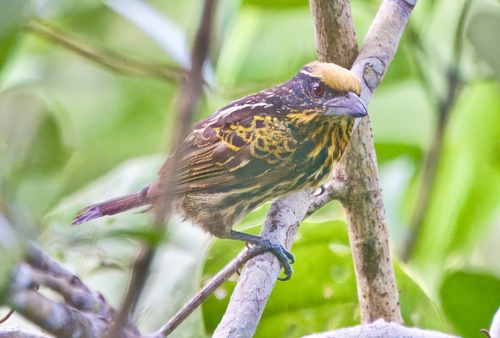
Gilded Barbet (Capito auratus) Gilded Barbet
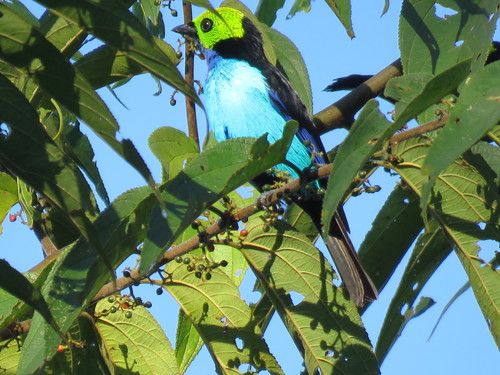
Paradise Tanager (Tangara chilensis) Paradise Tanager

Media

Loading…

In short

The most reliable field mark to separate Gilded Barbet from Paradise Tanager is the head and underparts color: Gilded Barbet has a yellow to orange crown and throat (with some red in the throat depending on subspecies), a thickset black body with yellow streaks, and a pale yellow belly with black flank streaks, while Paradise Tanager is instantly recognized by its bright light green head and sky-blue underparts. The Barbet is larger and bulkier, with a heavy, stubby bill, compared to the smaller, more delicate tanager with a slender black bill. Both species have black upperparts, but the Barbet’s yellow wing markings and facial pattern are unique. Females and immatures of Gilded Barbet can show more streaking and yellow on the wings, but never the green-blue combination of the tanager. In flight or perched, the color blocks and bill shape are the quickest clues.

Identification tips

  1. Head color: Paradise Tanager always has a bright light green head, while Gilded Barbet has a yellow to orange (sometimes reddish) crown and throat. This is the fastest field mark at any age.
  2. Underparts color: Paradise Tanager’s underparts are sky blue, never yellow. Gilded Barbet has a pale yellow belly with black streaking on the flanks (and chest in females), never blue.
  3. Bill shape and color: Gilded Barbet has a thick, stubby, grey bill with a broad black tip; Paradise Tanager’s bill is slender, pointed, and entirely black. Bill shape is especially obvious when perched or feeding.
  4. Size and structure: Gilded Barbet is larger, bulkier, and more thickset, with a big head and heavy bill. Paradise Tanager is smaller, lighter, and more delicate overall.
  5. Wing markings: Gilded Barbet shows yellow spots or bars on the greater wing coverts, yellow edging to remiges, and yellow tips to tertials. Paradise Tanager’s wings are black, lacking any yellow markings.
  6. Facial pattern: Gilded Barbet has a black mask with narrow yellow eyebrows extending as parallel lines over the mantle; Paradise Tanager lacks any eyebrow or mask, just a clean green head.
  7. Flank and chest streaking: Female and some male Gilded Barbets show black streaking on the flanks (and chest in females), which is never present in Paradise Tanager.
  8. Rump color: Paradise Tanager has a yellow and red or all red rump (depending on subspecies), which is a bright patch visible in flight or when perched. Gilded Barbet’s rump is black, blending with the upperparts.
  9. Eye color: Gilded Barbet has dark maroon irides; Paradise Tanager’s eye color is not distinctive in the field.
  10. Leg color: Both have greyish legs, not a useful separator.
  11. Sex/age variation: Female Gilded Barbets have more yellow and orange on the wings and more streaking, but still never show the tanager’s green-blue combination. Immature tanagers and barbets are not described in detail, but no evidence suggests they overlap in key color blocks.
  12. Behavior: Gilded Barbet is more deliberate and upright; Paradise Tanager is agile and often in mixed flocks.
  13. Habitat: Both can occur together, but Barbet may be more tied to riverine or foothill forests.
  14. Voice: Not described in the notes; do not rely on vocalization for separation here.
  15. Pitfalls: In poor light, the Barbet’s yellow may appear pale, but the tanager’s blue and green will not be matched by any Barbet. Bill shape and size are always reliable, even at a distance.

Size

Gilded Barbet is noticeably larger and bulkier, reaching about 20 cm (8 in) in length, compared to the Paradise Tanager’s 13.5–15 cm (5.3–6 in). The Barbet is also heavier and more thickset, with a large head and robust, stubby bill, while the Paradise Tanager is lighter (21 g), more slender, and has a proportionally smaller, pointed black bill. This size and structure difference is apparent even at a distance or in mixed flocks.

Plumage

No age-specific wing or flight pattern is described for either species, so focus is on overall plumage. Adult Gilded Barbet is mostly black above with a yellow to orange crown and throat (throat can be red or orange by subspecies), yellow streaks on the wings, and a pale yellow belly with black streaking on the flanks. Females are similar but have more yellow and orange on the wing coverts, yellowish streaking on the face and back, and more extensive black streaking on the chest and flanks; some western females have a black-streaked throat. Paradise Tanager of all ages and sexes is unmistakably multicolored: light green head, sky-blue underparts, black upperparts, and a rump that is yellow and red or all red depending on subspecies. The tanager’s bill is always black, while the Barbet’s is grey with a broad black tip. The Barbet’s maroon eyes and the tanager’s brilliant color blocks are also useful. In summary, the Barbet never shows the green-blue combination of the tanager, and the tanager never has the yellow/orange crown or yellow wing markings of the Barbet.

Behaviour

Both species are primarily frugivorous and occur in the canopy or subcanopy of humid forests. Gilded Barbet, being bulkier, often perches more upright and moves deliberately, sometimes pausing for long periods. Paradise Tanager is more active, agile, and often seen in mixed-species flocks, moving quickly through foliage and foraging acrobatically. The Barbet’s heavy build and slower movements contrast with the tanager’s light, energetic behavior.

Habitat

Both species share similar Amazonian lowland and foothill forest habitats across much of northern and western Amazonia (Bolivia, Brazil, Colombia, Ecuador, Peru, Venezuela). Gilded Barbet is more closely tied to riverine forests and the lower foothills of the Andes, while Paradise Tanager is widespread in humid tropical and subtropical forests. Both can be found in the same general regions, so habitat alone is not diagnostic, but the Barbet may be more likely in slightly higher or riverine forests.

Submit a better description

Use the same sections as the comparison. Your text is published immediately.

The most reliable field mark to separate Gilded Barbet from Paradise Tanager is the head and underparts color: Gilded Barbet has a yellow to orange crown and throat (with some red in the throat depending on subspecies), a thickset black body with yellow streaks, and a pale yellow belly with black flank streaks, while Paradise Tanager is instantly recognized by its bright light green head and sky-blue underparts. The Barbet is larger and bulkier, with a heavy, stubby bill, compared to the smaller, more delicate tanager with a slender black bill. Both species have black upperparts, but the Barbet’s yellow wing markings and facial pattern are unique. Females and immatures of Gilded Barbet can show more streaking and yellow on the wings, but never the green-blue combination of the tanager. In flight or perched, the color blocks and bill shape are the quickest clues.

  1. Head color: Paradise Tanager always has a bright light green head, while Gilded Barbet has a yellow to orange (sometimes reddish) crown and throat. This is the fastest field mark at any age.
  2. Underparts color: Paradise Tanager’s underparts are sky blue, never yellow. Gilded Barbet has a pale yellow belly with black streaking on the flanks (and chest in females), never blue.
  3. Bill shape and color: Gilded Barbet has a thick, stubby, grey bill with a broad black tip; Paradise Tanager’s bill is slender, pointed, and entirely black. Bill shape is especially obvious when perched or feeding.
  4. Size and structure: Gilded Barbet is larger, bulkier, and more thickset, with a big head and heavy bill. Paradise Tanager is smaller, lighter, and more delicate overall.
  5. Wing markings: Gilded Barbet shows yellow spots or bars on the greater wing coverts, yellow edging to remiges, and yellow tips to tertials. Paradise Tanager’s wings are black, lacking any yellow markings.
  6. Facial pattern: Gilded Barbet has a black mask with narrow yellow eyebrows extending as parallel lines over the mantle; Paradise Tanager lacks any eyebrow or mask, just a clean green head.
  7. Flank and chest streaking: Female and some male Gilded Barbets show black streaking on the flanks (and chest in females), which is never present in Paradise Tanager.
  8. Rump color: Paradise Tanager has a yellow and red or all red rump (depending on subspecies), which is a bright patch visible in flight or when perched. Gilded Barbet’s rump is black, blending with the upperparts.
  9. Eye color: Gilded Barbet has dark maroon irides; Paradise Tanager’s eye color is not distinctive in the field.
  10. Leg color: Both have greyish legs, not a useful separator.
  11. Sex/age variation: Female Gilded Barbets have more yellow and orange on the wings and more streaking, but still never show the tanager’s green-blue combination. Immature tanagers and barbets are not described in detail, but no evidence suggests they overlap in key color blocks.
  12. Behavior: Gilded Barbet is more deliberate and upright; Paradise Tanager is agile and often in mixed flocks.
  13. Habitat: Both can occur together, but Barbet may be more tied to riverine or foothill forests.
  14. Voice: Not described in the notes; do not rely on vocalization for separation here.
  15. Pitfalls: In poor light, the Barbet’s yellow may appear pale, but the tanager’s blue and green will not be matched by any Barbet. Bill shape and size are always reliable, even at a distance.

Gilded Barbet is noticeably larger and bulkier, reaching about 20 cm (8 in) in length, compared to the Paradise Tanager’s 13.5–15 cm (5.3–6 in). The Barbet is also heavier and more thickset, with a large head and robust, stubby bill, while the Paradise Tanager is lighter (21 g), more slender, and has a proportionally smaller, pointed black bill. This size and structure difference is apparent even at a distance or in mixed flocks.

No age-specific wing or flight pattern is described for either species, so focus is on overall plumage. Adult Gilded Barbet is mostly black above with a yellow to orange crown and throat (throat can be red or orange by subspecies), yellow streaks on the wings, and a pale yellow belly with black streaking on the flanks. Females are similar but have more yellow and orange on the wing coverts, yellowish streaking on the face and back, and more extensive black streaking on the chest and flanks; some western females have a black-streaked throat. Paradise Tanager of all ages and sexes is unmistakably multicolored: light green head, sky-blue underparts, black upperparts, and a rump that is yellow and red or all red depending on subspecies. The tanager’s bill is always black, while the Barbet’s is grey with a broad black tip. The Barbet’s maroon eyes and the tanager’s brilliant color blocks are also useful. In summary, the Barbet never shows the green-blue combination of the tanager, and the tanager never has the yellow/orange crown or yellow wing markings of the Barbet.

Both species are primarily frugivorous and occur in the canopy or subcanopy of humid forests. Gilded Barbet, being bulkier, often perches more upright and moves deliberately, sometimes pausing for long periods. Paradise Tanager is more active, agile, and often seen in mixed-species flocks, moving quickly through foliage and foraging acrobatically. The Barbet’s heavy build and slower movements contrast with the tanager’s light, energetic behavior.

Both species share similar Amazonian lowland and foothill forest habitats across much of northern and western Amazonia (Bolivia, Brazil, Colombia, Ecuador, Peru, Venezuela). Gilded Barbet is more closely tied to riverine forests and the lower foothills of the Andes, while Paradise Tanager is widespread in humid tropical and subtropical forests. Both can be found in the same general regions, so habitat alone is not diagnostic, but the Barbet may be more likely in slightly higher or riverine forests.

Discard your changes?

You have unsaved edits. If you leave now, those changes will be lost.

Gilded Barbet · Paradise Tanager · My Tricky Birds