
Great Spotted Woodpecker vs Alpine Chough
Dendrocopos major versus Pyrrhocorax graculus
Play a quiz with Great Spotted Woodpecker and Alpine Chough
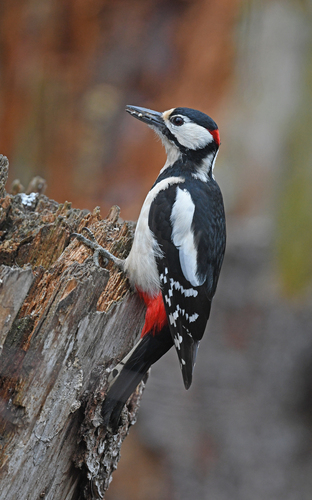 Great Spotted Woodpecker
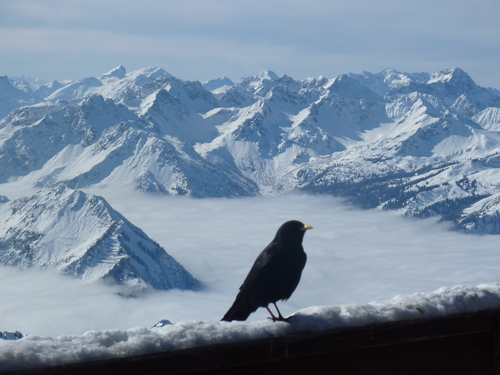 Alpine Chough
In short
The most reliable field mark to separate Great Spotted Woodpecker from Alpine Chough is overall coloration and structure: Great Spotted Woodpecker is a compact, black-and-white bird with a bold white shoulder patch and red on the belly (plus red on the head in males and juveniles), while Alpine Chough is a glossy black, crow-like bird with a yellow bill and red legs. In flight or at rest, the woodpecker shows strong black-and-white contrast and a short, chisel bill, whereas the chough is uniformly black with a slender, downcurved yellow bill and longer wings and tail. Juvenile woodpeckers can be confused with other woodpeckers but not with choughs, and vice versa. Habitat is also a strong clue: woodpeckers in woodland, choughs in high mountain open areas.
Identification tips
- Overall color: Great Spotted Woodpecker is black and white with a red vent area; Alpine Chough is entirely glossy black with no white or red plumage.
- Bill color and shape: Woodpecker has a straight, chisel-like slate-black bill; chough has a slender, downcurved yellow bill (adults) or dull yellow (juveniles).
- Leg color: Woodpecker's legs are greenish-grey; chough's legs are bright red (adults) or brownish (juveniles).
- White shoulder patch: Only Great Spotted Woodpecker has a large white patch on the shoulder, visible at rest and in flight.
- Red on head: Male woodpeckers have a red nape; juveniles have a red crown. Choughs never show red on the head.
- Red on belly: Only woodpecker has a red (adult) or pinkish (juvenile) lower belly and undertail. Chough is all black below.
- Wing pattern in flight: Woodpecker shows black-and-white barred wings and tail; chough is uniformly black with no barring or white.
- Tail shape: Woodpecker has a short, stiff tail used for bracing on trees; chough has a longer, more flexible tail, often fanned in flight.
- Flight style: Woodpecker flies in bounding, undulating arcs; chough soars, glides, and performs acrobatic maneuvers with loose, deep wingbeats.
- Habitat: Woodpecker in woods, chough in high mountain open areas. If you see a 'woodpecker' on a cliff above the treeline, reconsider.
- Perching behavior: Woodpecker climbs trunks and branches; chough perches on rocks, cliffs, or the ground, never climbing trees.
- Voice: Woodpecker gives sharp 'kick' calls and drums; chough gives rippling, whistled calls, never drums.
- Sex differences: Only woodpecker shows sexual dimorphism (red nape in males); chough sexes are identical.
- Juvenile confusion: Juvenile woodpecker's red crown and duller plumage are unique; juvenile chough is just a duller black bird with a dull yellow bill.
- Size: Chough is nearly twice as long and much heavier than woodpecker; in direct comparison, chough is crow-sized, woodpecker is much smaller.
Size
Great Spotted Woodpecker is a medium-sized woodpecker, about 20–24 cm long and weighing around 89 g [wikidata]. Alpine Chough is much larger, at 37–39 cm in length with a 75–85 cm wingspan, and is nearly twice as long as the woodpecker. The chough is also much heavier (adult mass not given in AVONET, but Wikipedia gives 188–252 g), with a proportionally longer tail and wings. In the field, the chough appears crow-sized and rangy, while the woodpecker is compact and shorter-tailed.
Plumage
- Juvenile/immature birds: Juvenile Great Spotted Woodpecker has a red crown (less extensive in females), duller and browner upperparts, and less defined markings than adults. The lower belly is pinkish rather than red. Juvenile Alpine Chough is simply a duller version of the adult: still all black but with a dull yellow bill and brownish legs. There are no bold white patches or red on the underparts in choughs of any age.
- Adults: Great Spotted Woodpecker is black above with large white shoulder patches, white face and underparts (except for a scarlet lower belly and undertail), and black-and-white barred wings and tail. Males have a red nape, females lack this. Alpine Chough is glossy black all over, with no white or red in the plumage, a short yellow bill, and red legs. Sexes are identical in choughs.
- In flight: Great Spotted Woodpecker shows strong black-and-white contrast on the upperwing and a white shoulder patch; Alpine Chough is all black with no white at all.
Behaviour
Great Spotted Woodpecker is often seen climbing tree trunks and branches, hitching upwards in short hops, and drumming or pecking at wood. It rarely spends time on the ground and flies in a bounding, undulating manner typical of woodpeckers. Alpine Chough is highly aerial, often seen soaring, gliding, or performing acrobatic flight maneuvers in updrafts near cliffs. On the ground, it walks or hops in open areas, often in flocks. It does not climb trees or drum.
Habitat
Great Spotted Woodpecker is a woodland bird, found in forests, parks, and gardens across the Palearctic, including lowland and montane woods. It is rarely found in open or treeless areas. Alpine Chough is strictly a high mountain species, breeding and foraging above the treeline on cliffs, rocky slopes, and alpine meadows from Spain to Nepal. It is not found in forests or lowland habitats. If you see a black bird with a yellow bill in high mountains, it is almost certainly an Alpine Chough; if in woodland, a woodpecker.
Voice
Great Spotted Woodpecker gives sharp 'kick' or 'chik' calls and drums on wood; its calls are short, hard, and not crow-like. Alpine Chough has a rippling 'preep' and whistled 'sweeeooo', higher-pitched and more musical than typical crows, plus a rolling churr alarm call. Its calls are never drumming or woodpecker-like. Voice is a strong clue if heard.