

Great Spotted Woodpecker vs Lesser Spotted Woodpecker
Dendrocopos major versus Dryobates minor
Play a quiz with Great Spotted Woodpecker and Lesser Spotted Woodpecker
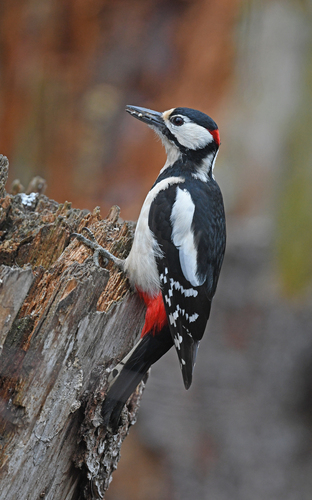 Great Spotted Woodpecker
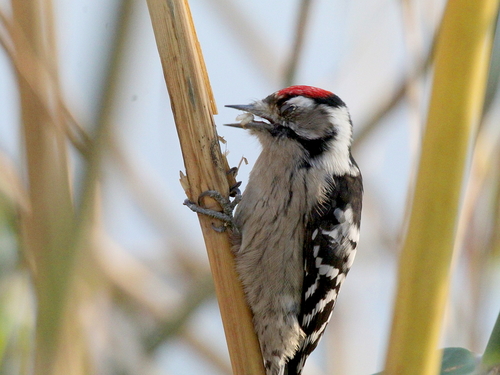 Lesser Spotted Woodpecker
In short
The most reliable way to separate Great Spotted Woodpecker from Lesser Spotted Woodpecker is by size and structure: Great Spotted is much larger and bulkier, with a heavier bill and a striking red patch on the lower belly, while Lesser Spotted is tiny, more sparrow-sized, and lacks this red belly mark. In flight or perched, Lesser Spotted shows strong black-and-white barring across the back and wings, and adult males have a full crimson crown (not just a nape patch). Juveniles of both can show red on the head, but the overall size difference and the presence or absence of the red belly patch are consistent at all ages. Both are black-and-white woodpeckers, but careful attention to these structural and plumage details will prevent confusion, especially with immature birds.
Identification tips
- Size is the first check: Great Spotted is nearly twice the length and several times the mass of Lesser Spotted. If the bird seems sparrow-sized, it's Lesser Spotted; if it's thrush- or small crow-sized, it's Great Spotted.
- Bill structure: Great Spotted has a thick, powerful bill; Lesser Spotted's bill is short and fine, almost dainty.
- Red on the belly: Only Great Spotted Woodpecker (all ages) shows a red patch on the lower belly and undertail. Lesser Spotted never has red on the belly.
- Crown color in adults: Adult male Lesser Spotted has a full crimson crown; adult male Great Spotted has only a red nape patch. Adult female Lesser Spotted has a white crown; adult female Great Spotted has no red on the head at all.
- Juvenile head pattern: Juvenile Great Spotted shows a red crown (more in males), but is much larger and glossier than juvenile Lesser Spotted. Juvenile Lesser Spotted of both sexes can show some crimson on the crown, but are always tiny and have strong wing barring.
- Back and wing pattern: Lesser Spotted shows broad, bold black-and-white barring across the lower back and wings, visible in flight and when perched. Great Spotted has a large white shoulder patch and less extensive barring, with the back mostly black.
- Shoulder patch: Great Spotted has a large, clean white shoulder patch; Lesser Spotted has a more barred and streaked appearance with no solid white shoulder.
- Flank pattern: Lesser Spotted has white underparts with dark streaks on the flanks; Great Spotted is clean white below except for the red undertail.
- Tail pattern: Both have some barring in the tail, but Lesser Spotted's outer tail feathers are more strongly barred.
- Habitat and foraging height: If the bird is high in the canopy, especially in mature deciduous woodland, suspect Lesser Spotted. Great Spotted is more often seen lower down or in a wider range of wooded habitats.
- Drumming and call: Lesser Spotted's drumming is shorter, softer, and more rattling; Great Spotted's is louder and more forceful. Lesser Spotted's call is a repeated 'keek', but beware overlap in calls.
- Nest hole size and placement: Lesser Spotted makes smaller nest holes (2.5–5 cm diameter) high up; Great Spotted's are larger and often lower.
- Behavior at feeders: Great Spotted will visit feeders and is bolder; Lesser Spotted rarely comes to feeders and is much shyer.
- Glossiness and color tone: Great Spotted adults are glossier with blue-black upperparts; Lesser Spotted is duller black and white.
- Seasonal changes: Lesser Spotted shows no marked seasonal plumage change; Great Spotted adults moult after breeding but retain the key field marks year-round.
Size
Great Spotted Woodpecker is substantially larger: 20–24 cm in length, with a wingspan of 34–39 cm and a body mass around 89 g. Lesser Spotted Woodpecker is the smallest European woodpecker, only 14–16.5 cm long, with a wingspan of 24–29 cm and a body mass averaging just under 20 g. In the field, Great Spotted appears robust and crow-like for a woodpecker, while Lesser Spotted is delicate, closer in size to a House Sparrow. Bill size is also a giveaway: Great Spotted has a thick, strong bill, while Lesser Spotted's is fine and short.
Plumage
-
Juveniles: Both species' juveniles can show red on the head, but Lesser Spotted juvenile males and females both have some crimson on the crown, while Great Spotted juveniles have a red crown (more extensive in males). Lesser Spotted juveniles are much smaller and lack the red belly patch of Great Spotted. The wing and back pattern is a key difference: Lesser Spotted of all ages shows broad, conspicuous black-and-white barring on the wings and lower back, while Great Spotted has a large white shoulder patch and less extensive barring, with the tail and flight feathers barred but the back mostly glossy black.
-
Adults: Great Spotted Woodpecker adults have glossy blue-black upperparts, a large white shoulder patch, and a red patch on the lower belly and undertail. Males have a crimson nape, females lack red on the head. Lesser Spotted adult males have a full crimson crown (not just a nape patch), females have a white crown, and both sexes have a barred lower back and wings, with no red on the belly. Underparts are white with streaks on the flanks in Lesser Spotted, plain white in Great Spotted except for the red undertail.
Behaviour
Both species share a similar bounding, undulating flight and can be seen drumming or foraging on tree trunks and branches. However, Lesser Spotted Woodpecker is much more likely to be found high in the canopy, often at the very tops of tall trees, and is generally more elusive and inconspicuous. Great Spotted is bolder, often seen lower on trunks or even at feeders, and is more likely to be noticed by its larger size and more forceful movements. Both species excavate holes and leave wood chips at the base, but Lesser Spotted's holes are much smaller and higher up.
Habitat
Both species occur in woodland and parks, but Lesser Spotted Woodpecker is more specialized foraging in the upper canopy and favors older, mature deciduous woods with plenty of dead branches. Great Spotted is more generalist, found in a wider range of wooded habitats including coniferous forests, parks, and gardens. The presence of dead wood is important for both, but Lesser Spotted is more sensitive to the removal of dead trees.
Voice
Both species have sharp calls and drumming, but Lesser Spotted's call is a repeated 'keek', surprisingly loud for its size, and its drumming is a rapid, vibrating rattle that is shorter and softer than Great Spotted's. With experience, the difference in drumming can be learned, but in the field, vocalizations are less reliable than visual marks unless the bird is unseen.
Great Spotted Woodpecker · Lesser Spotted Woodpecker · My Tricky Birds