
Motmot

Great White Egret vs Medium Egret

Ardea alba versus Ardea intermedia

Play a quiz with Great White Egret and Medium Egret

Great White Egret (Ardea alba) Great White Egret
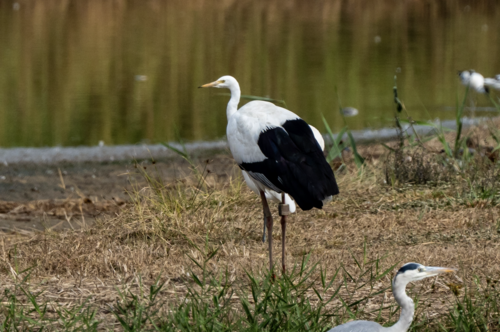
Medium Egret (Ardea intermedia) Medium Egret

Media

Loading…

In short

The most reliable field mark to separate Great White Egret from Medium Egret is the length of the gape line: on Great White Egret, the gape extends well behind the eye, while on Medium Egret it ends below or just behind the eye. Size is also a strong clue—Great White Egret is much larger and bulkier, with a longer neck and bill. Both species are all-white at all ages, but structural differences and subtle bill and leg color changes in breeding season help. In flight, both retract their necks, but Great White Egret’s proportions are noticeably more heron-like and elongated. Use a combination of bill shape, head profile, and especially the gape line for the most consistent separation.

Identification tips

  1. Gape line: On Great White Egret, the gape (the bare skin at the base of the bill) extends well behind the eye; on Medium Egret, it ends below or just behind the eye. This is the single most reliable mark at all ages and seasons—use close views or photos to check.
  2. Size and bulk: Great White Egret is much larger and heavier, with a longer neck and bill. If you see both together, the difference is striking. Alone, compare to nearby birds or habitat features for scale.
  3. Bill shape and length: Great White Egret has a longer, more slender bill that nearly aligns with the flat top of the head. Medium Egret’s bill is shorter, thicker, and the head has a slightly domed profile. This is subtle but useful with experience.
  4. Neck length and posture: Great White Egret’s neck is longer, often forms a noticeable kink in the middle, and is longer than the body. Medium Egret’s neck is a little less than body length and appears straighter when extended.
  5. Breeding season bill color: Great White Egret’s bill may darken (sometimes dusky) and lower legs may become paler. Medium Egret’s bill can become reddish or black (especially Asian birds), and upper legs may show dull yellow or pink. These marks are variable and region-dependent, but worth checking in breeding birds.
  6. Plume placement: In breeding plumage, Great White Egret shows long ornamental plumes on the back; Medium Egret has loose filamentous plumes on breast and back. This is subtle and best seen at close range.
  7. Leg color: Both have dark legs outside breeding, but in some Medium Egret subspecies, the upper legs may show color in breeding season (yellow or pink). Great White Egret’s legs are typically black, but can become lighter in breeding.
  8. Head profile: Great White Egret’s bill and head are more aligned and flat-topped; Medium Egret’s head is slightly domed, and the bill appears thicker at the base.
  9. Flight silhouette: Both fly with necks retracted, but Great White Egret appears longer-winged and more elongated overall. No distinctive juvenile or immature flight pattern differences are described.
  10. Behavioral stance: Great White Egret may adopt a sideways-leaning, 'one-eyed' hunting posture; Medium Egret tends to stalk upright with neck extended forward.
  11. Habitat context: If in the Americas, a large all-white egret is almost certainly Great White Egret. In Asia, check carefully, as both species may occur together.
  12. Association with other egrets: Medium Egret is more likely to be seen with Little or Cattle Egrets, and is closer to them in size. Great White Egret stands out as much larger in mixed flocks.
  13. Juvenile/immature plumage: No distinctive age-specific upperwing or flight marks are described for either species; juveniles look like nonbreeding adults.
  14. Vocalizations: Not useful for separation; both are generally quiet, and Great White Egret’s croaks are not diagnostic.
  15. Sex differences: Both species are sexually monomorphic—males and females look alike at all ages.

Size

Great White Egret is significantly larger: 80–104 cm long, wingspan 131–170 cm, and averages about 1,000 g in mass. Medium Egret is noticeably smaller: 56–72 cm long, wingspan 105–115 cm, and about 400 g. In the field, this size gap is usually obvious if both are seen together, but can be tricky if only one bird is present. Great White Egret is closer in size to Grey or Great Blue Heron, while Medium Egret is much closer to Little Egret or Cattle Egret.

Plumage

Both species are all-white at all ages, with no age-specific upperwing or flight pattern differences noted—juveniles and adults look similar, lacking dark tips or panels. Breeding adults of both species develop ornamental plumes, but placement differs: Great White Egret shows long plumes on the back, while Medium Egret has loose filamentous plumes on breast and back. Bill and leg color shift in breeding season: Great White Egret’s bill may darken and lower legs lighten, while Medium Egret’s bill can become reddish or black (especially in Asian birds), and upper legs may show dull yellow or pink. Outside breeding, both have yellow bills and dark legs, but Medium Egret’s bill is shorter and thicker. No distinctive juvenile wing pattern is described for either species.

Behaviour

Great White Egret often hunts patiently, sometimes adopting a sideways-leaning 'one-eyed' stance, and walks with neck extended and wings close. Medium Egret stalks prey methodically, usually upright with neck extended forward. Both species retract their necks in flight (unlike storks or ibises). Medium Egret is more likely to be seen foraging in shallow water or flooded fields, sometimes with other herons. Both nest colonially, but Great White Egret is more widespread and may be seen in a broader range of wetland habitats.

Habitat

Great White Egret is cosmopolitan, found in a wide range of wetlands across the Americas, Africa, Europe, and Asia, including lakes, rivers, marshes, and estuaries. Medium Egret is more localized, resident in southern and eastern Asia, and prefers shallow coastal or freshwater wetlands, including flooded fields. Where their ranges overlap (especially in Asia), both can be found in similar habitats, but Great White Egret is more likely in larger, open wetlands.

Voice

Neither species is very vocal. Great White Egret gives a low, hoarse croak when disturbed, and at colonies emits a loud croaking 'cuk cuk cuk' and higher-pitched squawks. No distinctive vocalizations are described for Medium Egret in the sources, and it is generally quiet. Voice is not a reliable field mark between these two.

Submit a better description

Use the same sections as the comparison. Your text is published immediately.

The most reliable field mark to separate Great White Egret from Medium Egret is the length of the gape line: on Great White Egret, the gape extends well behind the eye, while on Medium Egret it ends below or just behind the eye. Size is also a strong clue—Great White Egret is much larger and bulkier, with a longer neck and bill. Both species are all-white at all ages, but structural differences and subtle bill and leg color changes in breeding season help. In flight, both retract their necks, but Great White Egret’s proportions are noticeably more heron-like and elongated. Use a combination of bill shape, head profile, and especially the gape line for the most consistent separation.

  1. Gape line: On Great White Egret, the gape (the bare skin at the base of the bill) extends well behind the eye; on Medium Egret, it ends below or just behind the eye. This is the single most reliable mark at all ages and seasons—use close views or photos to check.
  2. Size and bulk: Great White Egret is much larger and heavier, with a longer neck and bill. If you see both together, the difference is striking. Alone, compare to nearby birds or habitat features for scale.
  3. Bill shape and length: Great White Egret has a longer, more slender bill that nearly aligns with the flat top of the head. Medium Egret’s bill is shorter, thicker, and the head has a slightly domed profile. This is subtle but useful with experience.
  4. Neck length and posture: Great White Egret’s neck is longer, often forms a noticeable kink in the middle, and is longer than the body. Medium Egret’s neck is a little less than body length and appears straighter when extended.
  5. Breeding season bill color: Great White Egret’s bill may darken (sometimes dusky) and lower legs may become paler. Medium Egret’s bill can become reddish or black (especially Asian birds), and upper legs may show dull yellow or pink. These marks are variable and region-dependent, but worth checking in breeding birds.
  6. Plume placement: In breeding plumage, Great White Egret shows long ornamental plumes on the back; Medium Egret has loose filamentous plumes on breast and back. This is subtle and best seen at close range.
  7. Leg color: Both have dark legs outside breeding, but in some Medium Egret subspecies, the upper legs may show color in breeding season (yellow or pink). Great White Egret’s legs are typically black, but can become lighter in breeding.
  8. Head profile: Great White Egret’s bill and head are more aligned and flat-topped; Medium Egret’s head is slightly domed, and the bill appears thicker at the base.
  9. Flight silhouette: Both fly with necks retracted, but Great White Egret appears longer-winged and more elongated overall. No distinctive juvenile or immature flight pattern differences are described.
  10. Behavioral stance: Great White Egret may adopt a sideways-leaning, 'one-eyed' hunting posture; Medium Egret tends to stalk upright with neck extended forward.
  11. Habitat context: If in the Americas, a large all-white egret is almost certainly Great White Egret. In Asia, check carefully, as both species may occur together.
  12. Association with other egrets: Medium Egret is more likely to be seen with Little or Cattle Egrets, and is closer to them in size. Great White Egret stands out as much larger in mixed flocks.
  13. Juvenile/immature plumage: No distinctive age-specific upperwing or flight marks are described for either species; juveniles look like nonbreeding adults.
  14. Vocalizations: Not useful for separation; both are generally quiet, and Great White Egret’s croaks are not diagnostic.
  15. Sex differences: Both species are sexually monomorphic—males and females look alike at all ages.

Great White Egret is significantly larger: 80–104 cm long, wingspan 131–170 cm, and averages about 1,000 g in mass. Medium Egret is noticeably smaller: 56–72 cm long, wingspan 105–115 cm, and about 400 g. In the field, this size gap is usually obvious if both are seen together, but can be tricky if only one bird is present. Great White Egret is closer in size to Grey or Great Blue Heron, while Medium Egret is much closer to Little Egret or Cattle Egret.

Both species are all-white at all ages, with no age-specific upperwing or flight pattern differences noted—juveniles and adults look similar, lacking dark tips or panels. Breeding adults of both species develop ornamental plumes, but placement differs: Great White Egret shows long plumes on the back, while Medium Egret has loose filamentous plumes on breast and back. Bill and leg color shift in breeding season: Great White Egret’s bill may darken and lower legs lighten, while Medium Egret’s bill can become reddish or black (especially in Asian birds), and upper legs may show dull yellow or pink. Outside breeding, both have yellow bills and dark legs, but Medium Egret’s bill is shorter and thicker. No distinctive juvenile wing pattern is described for either species.

Great White Egret often hunts patiently, sometimes adopting a sideways-leaning 'one-eyed' stance, and walks with neck extended and wings close. Medium Egret stalks prey methodically, usually upright with neck extended forward. Both species retract their necks in flight (unlike storks or ibises). Medium Egret is more likely to be seen foraging in shallow water or flooded fields, sometimes with other herons. Both nest colonially, but Great White Egret is more widespread and may be seen in a broader range of wetland habitats.

Great White Egret is cosmopolitan, found in a wide range of wetlands across the Americas, Africa, Europe, and Asia, including lakes, rivers, marshes, and estuaries. Medium Egret is more localized, resident in southern and eastern Asia, and prefers shallow coastal or freshwater wetlands, including flooded fields. Where their ranges overlap (especially in Asia), both can be found in similar habitats, but Great White Egret is more likely in larger, open wetlands.

Neither species is very vocal. Great White Egret gives a low, hoarse croak when disturbed, and at colonies emits a loud croaking 'cuk cuk cuk' and higher-pitched squawks. No distinctive vocalizations are described for Medium Egret in the sources, and it is generally quiet. Voice is not a reliable field mark between these two.

Discard your changes?

You have unsaved edits. If you leave now, those changes will be lost.

Great White Egret · Medium Egret · My Tricky Birds