
Motmot

Green-throated Carib vs Grey Trembler

Eulampis holosericeus versus Cinclocerthia gutturalis

Play a quiz with Green-throated Carib and Grey Trembler
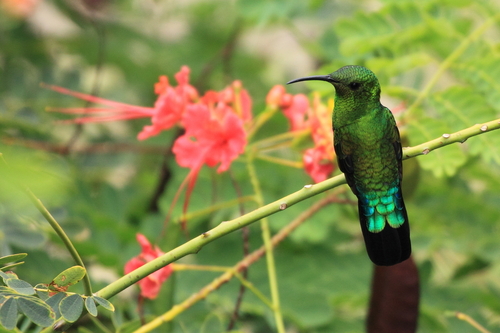
Green-throated Carib (Eulampis holosericeus) Green-throated Carib
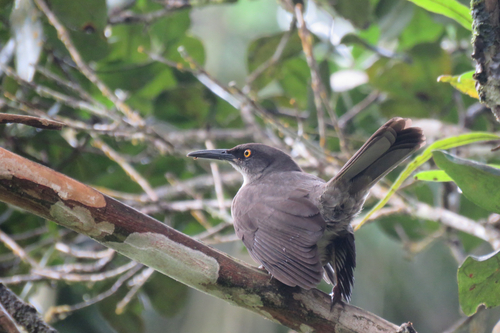
Grey Trembler (Cinclocerthia gutturalis) Grey Trembler

Media

Loading…

In short

The most reliable field mark between these two is overall size and structure: the Grey Trembler is a large, robust songbird with a long tail and a slightly downcurved bill, while the Green-throated Carib is a much smaller, compact hummingbird with a slender, decurved bill and iridescent plumage. In any view, the Carib’s bright green gorget and shimmering back contrast sharply with the Trembler’s uniform gray-brown tones and buffy underparts. Juvenile Tremblers may show a mottled chest, but even these cannot be confused for the metallic hues of the Carib. Bill shape, tail length, and feeding behavior are also strong clues, especially if seen foraging or in flight.

Identification tips

  1. Size is the fastest check: If the bird is tiny and hummingbird-like, it is a Green-throated Carib; if it is robin-sized or larger, it is a Grey Trembler. This holds for all ages and sexes.
  2. Bill shape and length: Carib has a slender, decurved bill (longer and more curved in females), suited for nectar feeding; Trembler has a longer, slightly downcurved bill, but it is thicker and more robust, not needle-like.
  3. Tail length and shape: Trembler has a long, straight tail, often carried low; Carib’s tail is shorter and dark blue (often looks black), never as long as the body.
  4. Plumage color: Carib is bright metallic green above and on the throat, with a black belly and green vent; Trembler is always gray-brown above, buffy below, and never iridescent.
  5. Juvenile plumage: Young Tremblers are browner with a mottled chest, but still lack any green or blue; Carib juveniles are similar to adults in their metallic hues.
  6. Underparts: Carib has a black belly and green vent; Trembler shows buffy white on the throat and belly, with gray-brown or olive-tinged flanks.
  7. Face pattern: Trembler’s face is somewhat darker than the rest of the upperparts, but not sharply marked; Carib’s face is not contrasting, dominated by the green gorget.
  8. Flight style: Carib hovers and darts rapidly, rarely perching for long; Trembler flies in short bursts and spends much time walking or hopping.
  9. Feeding behavior: Carib feeds at flowers, often hovering; Trembler probes tangles and epiphytes, never hovers.
  10. Wing movement: Trembler sometimes droops and rapidly vibrates its wings (the 'trembling' display); Carib’s wings are only rapidly moved in flight or to make whirring sounds during disputes.
  11. Voice: Carib gives sharp, simple calls; Trembler, as a mimid, may have more complex vocalizations (not detailed here).
  12. Habitat context: Carib is common in gardens and near human habitation; Trembler is more forest-dependent and restricted to Martinique and Saint Lucia.
  13. Sex differences: Female Carib is duller green and has a longer, more curved bill; female Trembler is only slightly longer-billed than male, with no major plumage difference.
  14. Subspecies variation: Carib subspecies E. h. chlorolaemus has darker underparts, but still shows metallic green; Trembler subspecies differ subtly in breast and flank color, never approaching Carib’s iridescence.
  15. Range check: If not on Martinique or Saint Lucia, Trembler is highly unlikely; Carib is widespread in the Lesser Antilles and Puerto Rico.

Size

Size is a decisive difference: the Green-throated Carib is a small hummingbird, weighing about 6.2 g and measuring 10.5–12 cm in length. In contrast, the Grey Trembler is a much larger bird, weighing 65–76 g and reaching 23–26 cm in length—over twice as long and more than ten times heavier. The Trembler’s bulk, long tail, and substantial bill are immediately apparent next to the tiny, delicate Carib.

Plumage

Plumage is diagnostic at all ages. Adult Green-throated Caribs of both sexes have a bright green back and gorget, with a black belly and a dark blue (appearing black) tail. Females are slightly duller and have a longer, more curved bill. Juvenile and adult Grey Tremblers lack any iridescence: they are warm gray-brown above, with a darker face and wings, and buffy white throat and belly. Juvenile Tremblers are browner overall with a mottled chest, but still show no metallic colors. The Carib’s green vent and shimmering upperparts are never matched by the Trembler’s subdued, earth-toned plumage. No age or season of Trembler shows the Carib’s metallic green or blue, and no Carib ever appears gray-brown or mottled.

Behaviour

Behavior is quite distinct. Green-throated Caribs are fast, agile fliers, often hovering at flowers or darting between perches, typical of hummingbirds. They may defend feeding territories, especially males. Grey Tremblers, on the other hand, forage by moving through tangles and probing epiphytes from the ground to the canopy, often using a distinctive wing-trembling display—drooping and rapidly vibrating their wings. Tremblers are much more likely to be seen walking or hopping in dense vegetation, never hovering like a hummingbird.

Habitat

Both species can occur in the Lesser Antilles, but their local ranges and habitat preferences differ. Green-throated Carib is found in Puerto Rico and most of the Lesser Antilles, often in gardens, second growth, and around homes, adapting well to human-altered habitats. Grey Trembler is restricted to Martinique and Saint Lucia, typically in forested areas, and forages from the ground to the canopy. If seen in a garden or open area, Carib is far more likely; in dense forest, especially on Martinique or Saint Lucia, Trembler is possible.

Voice

Green-throated Carib gives sharp 'chup!' or 'chuwp!' calls, and may produce rattles and wing whirs during disputes. Grey Trembler’s voice is not described in detail here, but as a mimid, it likely has more complex, varied calls and songs. In the field, a simple, sharp call points to Carib, while more elaborate vocalizations suggest Trembler.

Submit a better description

Use the same sections as the comparison. Your text is published immediately.

The most reliable field mark between these two is overall size and structure: the Grey Trembler is a large, robust songbird with a long tail and a slightly downcurved bill, while the Green-throated Carib is a much smaller, compact hummingbird with a slender, decurved bill and iridescent plumage. In any view, the Carib’s bright green gorget and shimmering back contrast sharply with the Trembler’s uniform gray-brown tones and buffy underparts. Juvenile Tremblers may show a mottled chest, but even these cannot be confused for the metallic hues of the Carib. Bill shape, tail length, and feeding behavior are also strong clues, especially if seen foraging or in flight.

  1. Size is the fastest check: If the bird is tiny and hummingbird-like, it is a Green-throated Carib; if it is robin-sized or larger, it is a Grey Trembler. This holds for all ages and sexes.
  2. Bill shape and length: Carib has a slender, decurved bill (longer and more curved in females), suited for nectar feeding; Trembler has a longer, slightly downcurved bill, but it is thicker and more robust, not needle-like.
  3. Tail length and shape: Trembler has a long, straight tail, often carried low; Carib’s tail is shorter and dark blue (often looks black), never as long as the body.
  4. Plumage color: Carib is bright metallic green above and on the throat, with a black belly and green vent; Trembler is always gray-brown above, buffy below, and never iridescent.
  5. Juvenile plumage: Young Tremblers are browner with a mottled chest, but still lack any green or blue; Carib juveniles are similar to adults in their metallic hues.
  6. Underparts: Carib has a black belly and green vent; Trembler shows buffy white on the throat and belly, with gray-brown or olive-tinged flanks.
  7. Face pattern: Trembler’s face is somewhat darker than the rest of the upperparts, but not sharply marked; Carib’s face is not contrasting, dominated by the green gorget.
  8. Flight style: Carib hovers and darts rapidly, rarely perching for long; Trembler flies in short bursts and spends much time walking or hopping.
  9. Feeding behavior: Carib feeds at flowers, often hovering; Trembler probes tangles and epiphytes, never hovers.
  10. Wing movement: Trembler sometimes droops and rapidly vibrates its wings (the 'trembling' display); Carib’s wings are only rapidly moved in flight or to make whirring sounds during disputes.
  11. Voice: Carib gives sharp, simple calls; Trembler, as a mimid, may have more complex vocalizations (not detailed here).
  12. Habitat context: Carib is common in gardens and near human habitation; Trembler is more forest-dependent and restricted to Martinique and Saint Lucia.
  13. Sex differences: Female Carib is duller green and has a longer, more curved bill; female Trembler is only slightly longer-billed than male, with no major plumage difference.
  14. Subspecies variation: Carib subspecies E. h. chlorolaemus has darker underparts, but still shows metallic green; Trembler subspecies differ subtly in breast and flank color, never approaching Carib’s iridescence.
  15. Range check: If not on Martinique or Saint Lucia, Trembler is highly unlikely; Carib is widespread in the Lesser Antilles and Puerto Rico.

Size is a decisive difference: the Green-throated Carib is a small hummingbird, weighing about 6.2 g and measuring 10.5–12 cm in length. In contrast, the Grey Trembler is a much larger bird, weighing 65–76 g and reaching 23–26 cm in length—over twice as long and more than ten times heavier. The Trembler’s bulk, long tail, and substantial bill are immediately apparent next to the tiny, delicate Carib.

Plumage is diagnostic at all ages. Adult Green-throated Caribs of both sexes have a bright green back and gorget, with a black belly and a dark blue (appearing black) tail. Females are slightly duller and have a longer, more curved bill. Juvenile and adult Grey Tremblers lack any iridescence: they are warm gray-brown above, with a darker face and wings, and buffy white throat and belly. Juvenile Tremblers are browner overall with a mottled chest, but still show no metallic colors. The Carib’s green vent and shimmering upperparts are never matched by the Trembler’s subdued, earth-toned plumage. No age or season of Trembler shows the Carib’s metallic green or blue, and no Carib ever appears gray-brown or mottled.

Behavior is quite distinct. Green-throated Caribs are fast, agile fliers, often hovering at flowers or darting between perches, typical of hummingbirds. They may defend feeding territories, especially males. Grey Tremblers, on the other hand, forage by moving through tangles and probing epiphytes from the ground to the canopy, often using a distinctive wing-trembling display—drooping and rapidly vibrating their wings. Tremblers are much more likely to be seen walking or hopping in dense vegetation, never hovering like a hummingbird.

Both species can occur in the Lesser Antilles, but their local ranges and habitat preferences differ. Green-throated Carib is found in Puerto Rico and most of the Lesser Antilles, often in gardens, second growth, and around homes, adapting well to human-altered habitats. Grey Trembler is restricted to Martinique and Saint Lucia, typically in forested areas, and forages from the ground to the canopy. If seen in a garden or open area, Carib is far more likely; in dense forest, especially on Martinique or Saint Lucia, Trembler is possible.

Green-throated Carib gives sharp 'chup!' or 'chuwp!' calls, and may produce rattles and wing whirs during disputes. Grey Trembler’s voice is not described in detail here, but as a mimid, it likely has more complex, varied calls and songs. In the field, a simple, sharp call points to Carib, while more elaborate vocalizations suggest Trembler.

Discard your changes?

You have unsaved edits. If you leave now, those changes will be lost.

Green-throated Carib · Grey Trembler · My Tricky Birds