

Grey-and-buff Woodpecker vs Grey-capped Pygmy Woodpecker
Hemicircus concretus versus Yungipicus canicapillus
Play a quiz with Grey-and-buff Woodpecker and Grey-capped Pygmy Woodpecker
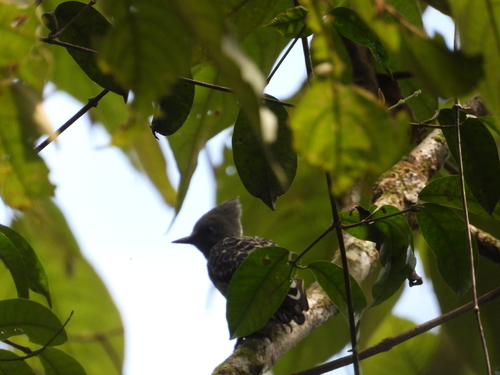 Grey-and-buff Woodpecker
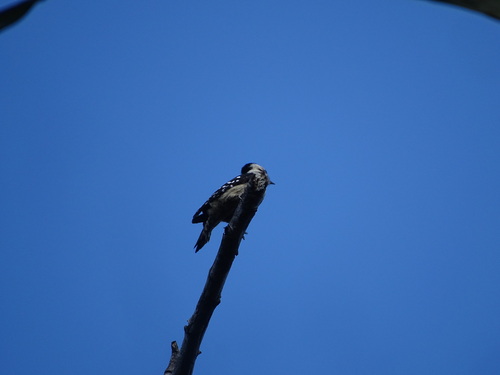 Grey-capped Pygmy Woodpecker
In short
The most reliable field mark to separate Grey-and-buff Woodpecker from Grey-capped Pygmy Woodpecker is overall pattern: Grey-and-buff is a compact, plump bird with a large, cone-shaped crest and a mostly grey head (males have a red forehead), while Grey-capped Pygmy is a small, dark woodpecker with a clearly barred black-and-white back, strong facial stripes, and a dark grey crown (with a red nape in males). Grey-and-buff shows a scalloped effect on the upperparts and wings, with a fine white wavy line on the head, while Grey-capped Pygmy has prominent streaking below and bold face patterning. Both species are small, but Grey-and-buff is bulkier and has a proportionally larger head and shorter tail. These differences are visible both perched and in flight, but facial and upperpart patterns are key at all ages.
Identification tips
- Head and Crest Shape: Grey-and-buff Woodpecker has a large, cone-shaped crest and a proportionally large head, giving it a distinctive profile. Grey-capped Pygmy Woodpecker has a flatter crown and a smaller, less prominent crest.
- Facial Pattern: Grey-and-buff shows a mostly grey head with a fine white wavy line from cheek to mantle, and a muted face. Grey-capped Pygmy has a bold black eyestripe, thin dark malar stripe, broad white supercilium and cheeks, and a dark grey crown (red nape in males). The face of Grey-capped Pygmy is much more contrasting and patterned.
- Sex Differences: In Grey-and-buff, only males have a red forehead; females have an all-grey head and crest. In Grey-capped Pygmy, males have a red nape, which is absent in females.
- Upperparts and Wing Pattern: Grey-and-buff has blackish upperparts and wings with white or buff scalloping, creating a scaled or scalloped effect. Grey-capped Pygmy is strongly barred black-and-white above, with a more crisp and regular pattern.
- Underparts: Grey-and-buff is mostly plain grey below. Grey-capped Pygmy has dark buff underparts with prominent dark streaking, making the belly look much more patterned.
- Tail: Grey-and-buff has a short, rounded, dark tail. Grey-capped Pygmy's central tail feathers are usually unbarred, but the tail is longer and less rounded than in Grey-and-buff.
- Bill Shape: Grey-and-buff has a long, slender, grey bill with a black tip. Grey-capped Pygmy's bill is not described in detail, but is generally shorter and finer in proportion to head size.
- Body Structure: Grey-and-buff is plump and compact, with a short tail and large head. Grey-capped Pygmy is more slender and elongated, with a longer tail and smaller head.
- Iris Color: Grey-and-buff has chestnut irides. Grey-capped Pygmy's eyes are dark, but not specifically described as chestnut.
- Rump: Grey-and-buff may show a stained white rump due to gland secretions, a feature not present in Grey-capped Pygmy.
- Habitat Context: If seen in lowland rainforest or forest edge in Peninsular Malaysia, Sumatra, or Borneo, consider Grey-and-buff. If in a wider range of forest types, including higher elevation or mangroves, especially outside the Sundaic region, Grey-capped Pygmy is more likely.
- Behavior: Both species forage by gleaning, but Grey-and-buff may appear heavier and more deliberate in movement.
- Group Size: Grey-and-buff is often solitary or in pairs, sometimes in mixed flocks. Grey-capped Pygmy may be encountered in small groups or mixed flocks as well.
- Plumage Pitfalls: Immature or worn birds may lose some contrast, but overall body shape, crest, and face pattern remain reliable.
- Seasonal Variation: No strong seasonal plumage changes are described for either species, so these marks are reliable year-round.
Size
Grey-and-buff Woodpecker is slightly larger and noticeably bulkier than Grey-capped Pygmy Woodpecker. It reaches about 13.5 cm in length and weighs around 29 g [wikidata], with a plump body, large head, and short, rounded tail. Grey-capped Pygmy Woodpecker is smaller and more slender overall, with a proportionally longer tail and finer build. In the field, Grey-and-buff often appears more compact and heavyset, while Grey-capped Pygmy looks daintier and more elongated.
Plumage
No detailed age-specific wing or flight pattern differences are described for either species, so focus on adult and general plumage. Grey-and-buff Woodpecker has a mostly grey head with a fine white wavy line from cheek to mantle, a large crest (red on forehead in males, all grey in females), blackish upperparts and wings with white or buff scalloping, and grey underparts. The tail and underwing are dark, and the rump can be stained from gland secretions. In contrast, Grey-capped Pygmy Woodpecker has a dark grey crown (red nape in males), bold black eyestripes, thin dark malar stripes, broad white supercilia and cheeks, and a strongly barred black-and-white back. Its underparts are dark buff with prominent dark streaking, and the central tail feathers are usually unbarred. The face pattern is much stronger and more contrasting in Grey-capped Pygmy, while Grey-and-buff is more muted and scalloped. These differences apply to both sexes and all ages as described.
Behaviour
Grey-and-buff Woodpecker is usually seen singly or in pairs, sometimes joining mixed-species flocks in the canopy. It forages mainly by gleaning insects and fruit from foliage and branches, rather than drilling. It roosts communally in shallow holes excavated in dead wood. Grey-capped Pygmy Woodpecker's behavior is not detailed in the notes, but it is generally similar in foraging style and habitat use. Both species are active and agile, but Grey-and-buff's plumper shape and larger head may make its movements appear more deliberate compared to the more nimble Grey-capped Pygmy.
Habitat
Both species occur in Southeast Asian forests, but Grey-and-buff Woodpecker is more restricted to lowland and mid-elevation evergreen rainforests, forest edges, plantations, bamboo thickets, and even wooded urban areas. It is now extinct in Singapore. Grey-capped Pygmy Woodpecker has a much wider range, from the Himalayas and Manchuria to Southeast Asia, and uses subtropical or tropical moist lowland and montane forests, as well as mangroves. Overlap is possible in Southeast Asia, but Grey-capped Pygmy is more likely at higher elevations and in a broader range of forest types.
Grey-and-buff Woodpecker · Grey-capped Pygmy Woodpecker · My Tricky Birds