
Motmot

Grey-headed Kingfisher vs Blue-breasted Kingfisher

Halcyon leucocephala versus Halcyon malimbica

Play a quiz with Grey-headed Kingfisher and Blue-breasted Kingfisher
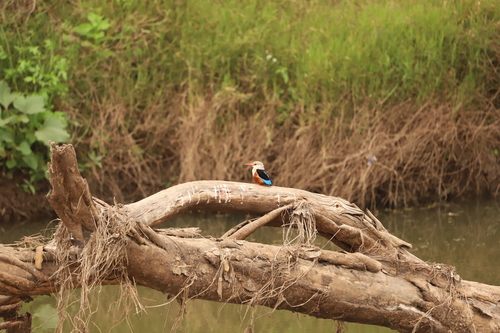
Grey-headed Kingfisher (Halcyon leucocephala) Grey-headed Kingfisher
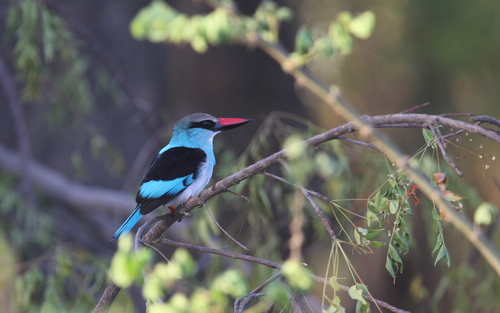
Blue-breasted Kingfisher (Halcyon malimbica) Blue-breasted Kingfisher

Media

Loading…

In short

The most reliable field mark to separate Grey-headed Kingfisher from Blue-breasted Kingfisher is the color and pattern of the head and underparts: Grey-headed Kingfisher has a pale grey head and rich chestnut underparts, while Blue-breasted Kingfisher shows a bright blue head and a white belly with a distinct blue breast band. Bill color is also diagnostic: Grey-headed has an all-red bill, while Blue-breasted has a red upper mandible and black lower mandible. In flight or perched, Blue-breasted appears bulkier and longer than the more slender Grey-headed. Both species have blue in the wings and tail, but the extent and shade differ. These distinctions hold for adults; juveniles are duller but follow the same pattern.

Identification tips

  1. Head color: Grey-headed Kingfisher always has a pale grey head (adults and immatures), while Blue-breasted Kingfisher has a bright blue head. This is the most immediate field mark at any age.
  2. Underpart color: Grey-headed Kingfisher shows rich chestnut underparts (belly and breast), contrasting with the Blue-breasted's white belly and blue breast band. Juveniles follow the same pattern, though colors are duller.
  3. Breast band: Only Blue-breasted Kingfisher has a distinct blue breast band separating the white belly from the blue upperparts. Grey-headed never shows this band.
  4. Bill color: Grey-headed has an all-red bill, while Blue-breasted has a red upper mandible and a black lower mandible. This is visible even at distance in good light.
  5. Size and structure: Blue-breasted is larger (25 cm vs. 21 cm), bulkier, and appears more robust when perched. Grey-headed is slimmer and more delicate.
  6. Wing and tail color: Both species have blue wings and tail, but Blue-breasted's blue is more extensive and brighter, including the head and back. Grey-headed's blue is limited to the rump, wings, and tail, with a black mantle and back.
  7. Shoulder color: Blue-breasted has black shoulders, while Grey-headed's mantle and back are black but the shoulder is not as distinctly marked.
  8. Habitat context: If the bird is in deep forest, riverine woodland, or dense shade, Blue-breasted is more likely. In open woodland, scrub, or drier areas, especially away from water, Grey-headed is expected.
  9. Behavior: Grey-headed often perches exposed and motionless, sometimes bobbing its head before diving. Blue-breasted is more likely to be seen quietly in deep shade, wary and territorial.
  10. Vocalizations: Listen for the sharp 'tchk, tchk, tchk' of Grey-headed versus the whistled 'pu-pu-pu-pu-ku-ku-ku-ku' of Blue-breasted. Calls are distinctive when heard well.
  11. Flight style: Blue-breasted's flight is rapid and direct; Grey-headed's is less described but not noted as especially fast or direct.
  12. Juvenile confusion: Juveniles of both species are duller but retain the key head and underpart color patterns. No unique juvenile wing patterns are described for either species, so rely on head and belly color.
  13. Seasonal movement: Grey-headed is migratory in some areas and may be seen away from breeding sites, while Blue-breasted is mostly resident but may shift locally in the dry season.
  14. Sex differences: Both species are sexually monomorphic in plumage, so sex is not a useful field mark.
  15. Bill shape: Both have large, robust kingfisher bills, but the color difference is the key mark.

Size

Blue-breasted Kingfisher is noticeably larger, averaging 25 cm in length, compared to the Grey-headed Kingfisher's 21 cm. This size difference is apparent in the field, with Blue-breasted appearing bulkier and more robust, especially when perched. Both species have similar proportions typical of Halcyon kingfishers, but the Blue-breasted's heavier build and longer body are clear when seen side-by-side or with experience.

Plumage

For all ages, Grey-headed Kingfisher shows a pale grey head, black mantle and back, bright blue rump, wings and tail, and chestnut underparts. The bill is entirely red. Blue-breasted Kingfisher has a bright blue head, back, wing panel, and tail, with a white belly and a blue breast band; the shoulders are black. Its bill is two-toned: red above, black below. Juveniles of both species are duller, but the head and underpart color pattern remains: Grey-headed juveniles retain the grey head and chestnut belly, while Blue-breasted juveniles are blue-headed with a white belly and blue breast band. No distinctive age-specific upperwing pattern is described for either species, but the overall blue vs. grey/chestnut contrast is strong even in immature birds.

Behaviour

Grey-headed Kingfisher often perches motionless in open woodland or scrub, watching the ground for prey, and is less tied to water than most kingfishers. It may bob its head before diving. Blue-breasted Kingfisher prefers deep shade in well-wooded habitats, perching quietly and being more wary and territorial. Its flight is described as rapid and direct. Both species hunt from perches, but Blue-breasted is more likely to be found in dense forest or along watercourses, while Grey-headed is more at home in drier, open areas.

Habitat

Grey-headed Kingfisher is widespread across tropical and semi-tropical Africa and southern Arabia, favoring woodland, scrub, and cultivated areas, often away from water. Blue-breasted Kingfisher is restricted to Equatorial Africa, preferring well-wooded habitats and retreating to wetter areas in the dry season. It is more closely associated with dense forest and riverine woodland than the Grey-headed, which can be found in more open and arid settings.

Voice

Grey-headed Kingfisher gives a succession of ascending and descending notes, becoming strident, and a sharp 'tchk, tchk, tchk' warning call. Blue-breasted Kingfisher's call is a whistled 'pu-pu-pu-pu-ku-ku-ku-ku.' The calls are quite different in tone and rhythm, with Grey-headed's being sharper and more mechanical, and Blue-breasted's more musical and whistled.

Submit a better description

Use the same sections as the comparison. Your text is published immediately.

The most reliable field mark to separate Grey-headed Kingfisher from Blue-breasted Kingfisher is the color and pattern of the head and underparts: Grey-headed Kingfisher has a pale grey head and rich chestnut underparts, while Blue-breasted Kingfisher shows a bright blue head and a white belly with a distinct blue breast band. Bill color is also diagnostic: Grey-headed has an all-red bill, while Blue-breasted has a red upper mandible and black lower mandible. In flight or perched, Blue-breasted appears bulkier and longer than the more slender Grey-headed. Both species have blue in the wings and tail, but the extent and shade differ. These distinctions hold for adults; juveniles are duller but follow the same pattern.

  1. Head color: Grey-headed Kingfisher always has a pale grey head (adults and immatures), while Blue-breasted Kingfisher has a bright blue head. This is the most immediate field mark at any age.
  2. Underpart color: Grey-headed Kingfisher shows rich chestnut underparts (belly and breast), contrasting with the Blue-breasted's white belly and blue breast band. Juveniles follow the same pattern, though colors are duller.
  3. Breast band: Only Blue-breasted Kingfisher has a distinct blue breast band separating the white belly from the blue upperparts. Grey-headed never shows this band.
  4. Bill color: Grey-headed has an all-red bill, while Blue-breasted has a red upper mandible and a black lower mandible. This is visible even at distance in good light.
  5. Size and structure: Blue-breasted is larger (25 cm vs. 21 cm), bulkier, and appears more robust when perched. Grey-headed is slimmer and more delicate.
  6. Wing and tail color: Both species have blue wings and tail, but Blue-breasted's blue is more extensive and brighter, including the head and back. Grey-headed's blue is limited to the rump, wings, and tail, with a black mantle and back.
  7. Shoulder color: Blue-breasted has black shoulders, while Grey-headed's mantle and back are black but the shoulder is not as distinctly marked.
  8. Habitat context: If the bird is in deep forest, riverine woodland, or dense shade, Blue-breasted is more likely. In open woodland, scrub, or drier areas, especially away from water, Grey-headed is expected.
  9. Behavior: Grey-headed often perches exposed and motionless, sometimes bobbing its head before diving. Blue-breasted is more likely to be seen quietly in deep shade, wary and territorial.
  10. Vocalizations: Listen for the sharp 'tchk, tchk, tchk' of Grey-headed versus the whistled 'pu-pu-pu-pu-ku-ku-ku-ku' of Blue-breasted. Calls are distinctive when heard well.
  11. Flight style: Blue-breasted's flight is rapid and direct; Grey-headed's is less described but not noted as especially fast or direct.
  12. Juvenile confusion: Juveniles of both species are duller but retain the key head and underpart color patterns. No unique juvenile wing patterns are described for either species, so rely on head and belly color.
  13. Seasonal movement: Grey-headed is migratory in some areas and may be seen away from breeding sites, while Blue-breasted is mostly resident but may shift locally in the dry season.
  14. Sex differences: Both species are sexually monomorphic in plumage, so sex is not a useful field mark.
  15. Bill shape: Both have large, robust kingfisher bills, but the color difference is the key mark.

Blue-breasted Kingfisher is noticeably larger, averaging 25 cm in length, compared to the Grey-headed Kingfisher's 21 cm. This size difference is apparent in the field, with Blue-breasted appearing bulkier and more robust, especially when perched. Both species have similar proportions typical of Halcyon kingfishers, but the Blue-breasted's heavier build and longer body are clear when seen side-by-side or with experience.

For all ages, Grey-headed Kingfisher shows a pale grey head, black mantle and back, bright blue rump, wings and tail, and chestnut underparts. The bill is entirely red. Blue-breasted Kingfisher has a bright blue head, back, wing panel, and tail, with a white belly and a blue breast band; the shoulders are black. Its bill is two-toned: red above, black below. Juveniles of both species are duller, but the head and underpart color pattern remains: Grey-headed juveniles retain the grey head and chestnut belly, while Blue-breasted juveniles are blue-headed with a white belly and blue breast band. No distinctive age-specific upperwing pattern is described for either species, but the overall blue vs. grey/chestnut contrast is strong even in immature birds.

Grey-headed Kingfisher often perches motionless in open woodland or scrub, watching the ground for prey, and is less tied to water than most kingfishers. It may bob its head before diving. Blue-breasted Kingfisher prefers deep shade in well-wooded habitats, perching quietly and being more wary and territorial. Its flight is described as rapid and direct. Both species hunt from perches, but Blue-breasted is more likely to be found in dense forest or along watercourses, while Grey-headed is more at home in drier, open areas.

Grey-headed Kingfisher is widespread across tropical and semi-tropical Africa and southern Arabia, favoring woodland, scrub, and cultivated areas, often away from water. Blue-breasted Kingfisher is restricted to Equatorial Africa, preferring well-wooded habitats and retreating to wetter areas in the dry season. It is more closely associated with dense forest and riverine woodland than the Grey-headed, which can be found in more open and arid settings.

Grey-headed Kingfisher gives a succession of ascending and descending notes, becoming strident, and a sharp 'tchk, tchk, tchk' warning call. Blue-breasted Kingfisher's call is a whistled 'pu-pu-pu-pu-ku-ku-ku-ku.' The calls are quite different in tone and rhythm, with Grey-headed's being sharper and more mechanical, and Blue-breasted's more musical and whistled.

Discard your changes?

You have unsaved edits. If you leave now, those changes will be lost.

Grey-headed Kingfisher · Blue-breasted Kingfisher · My Tricky Birds