
Himalayan Flameback vs Black-rumped Flameback
Dinopium shorii versus Dinopium benghalense
Play a quiz with Himalayan Flameback and Black-rumped Flameback
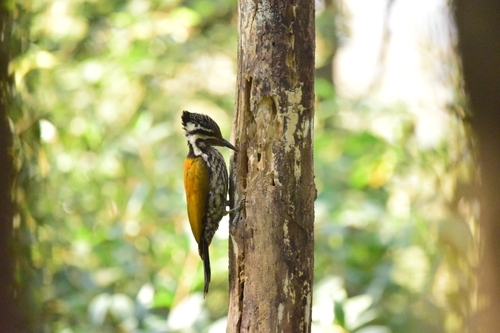 Himalayan Flameback
 Black-rumped Flameback
In short
The most reliable way to separate Himalayan Flameback from Black-rumped Flameback is by focusing on the throat and rump: Himalayan Flameback shows a brownish-centered throat (sometimes extending onto the breast) with irregular black spotting, while Black-rumped Flameback always has a sharply black throat finely marked with white and a distinctive black rump. Himalayan Flameback also has a black hind neck and an indistinct, often brownish moustachial stripe, whereas Black-rumped lacks a dark moustachial stripe entirely. Both species are similar in overall golden-backed appearance, but careful attention to these head and rump details, along with habitat context, will resolve most confusion. Juvenile and female plumages can be especially tricky, so look for the throat and rump pattern first before relying on crest color or size.
Identification tips
- Throat pattern: Himalayan Flameback shows a brownish-centered throat (sometimes reddish in males), often extending onto the breast and bordered by irregular black spotting. Black-rumped Flameback always has a sharply black throat finely marked with white. This is the most consistent field mark for all ages and sexes.
- Rump color: Black-rumped Flameback has a black rump (never red or golden), which is unique among golden-backed woodpeckers in the region. Himalayan Flameback does not have a black rump; its back and rump blend with the golden or coppery tones of the wings.
- Moustachial stripe: Himalayan Flameback has an indistinct, often brownish moustachial stripe (sometimes reddish in males), while Black-rumped Flameback lacks any dark moustachial stripe. This is particularly useful in close views of the head.
- Crest color (sex-specific): Male Himalayan Flameback has a yellowish-red to red forehead and crest, while the female's crest is entirely black streaked with white. In Black-rumped Flameback, males have a red crown and crest, but females have a black forecrown with white spots and red only on the rear crest. Young birds of Black-rumped resemble the female but are duller. Crest color can be helpful but is variable and overlaps in some views.
- Hind neck: Himalayan Flameback has a black hind neck, which is less prominent or absent in Black-rumped Flameback.
- Eye color: Himalayan Flameback may show reddish or brown eyes, but this is subtle and not always visible in the field.
- Breast pattern: Himalayan Flameback's breast is irregularly streaked with black or can be completely white. Black-rumped Flameback has white underparts with dark chevron markings, a more regular and patterned look.
- Wing color: Himalayan Flameback's wings are coppery brown to red, while Black-rumped Flameback has golden yellow wing coverts. In flight, this may be subtle, but perched birds can show the difference in strong light.
- Toe count: Both species have three toes (zygodactyl feet), but this is only noted as a diagnostic trait for Himalayan Flameback in the sources. Not usually visible in the field.
- Bill size: Himalayan Flameback has a smaller bill relative to head size compared to the more robust Black-rumped Flameback, but this is a subtle difference and not always reliable.
- Size and structure: Black-rumped Flameback is larger and bulkier, but size overlap and lack of direct comparison make this unreliable for lone birds.
- Habitat: Himalayan Flameback is found in mature forests of the Himalayan foothills and avoids urban areas. Black-rumped Flameback is common in open forests, cultivated lands, and urban parks, rarely in true Himalayan habitats. Context can help, but beware of range overlap in the foothills.
- Behavior: Black-rumped Flameback adapts well to human environments and is often seen in pairs or small groups, while Himalayan Flameback is more forest-dependent and less likely in urban settings.
- Voice: Calls are not reliably separable in the field based on current descriptions, but Black-rumped Flameback's call is described as a rattling-whinny, while Himalayan Flameback's is a softer, slower "klak-klak-klak" series.
- Pitfalls: Females and juveniles of both species can be confusing, especially if the crest is not visible. Always check the throat and rump pattern first, then look for moustachial stripe and habitat context.
Size
Direct mass data is only available for Black-rumped Flameback (110 g [wikidata]), but Himalayan Flameback is described as smaller overall with a smaller bill. Black-rumped Flameback is a large woodpecker (26–29 cm in length), and in the field, it often appears bulkier and more robust, especially in urban or open habitats. Himalayan Flameback, while similar in shape, is generally more slender and slightly smaller, but this difference is subtle and not always reliable without direct comparison.
Plumage
- Juvenile/Immature birds: No specific juvenile wing pattern or flight marks are described for either species, so separation relies on head, throat, and rump pattern at all ages.
- Adults: Himalayan Flameback has a black hind neck and a brownish-centered throat (sometimes reddish in males), often extending onto the breast and bordered by irregular black spotting. The breast may be irregularly streaked with black or occasionally completely white. Its wings are coppery brown to red. Males have a yellowish-red to red crest, while females have a black and white-streaked crest. The moustachial stripe is indistinct and brownish (sometimes reddish in males).
Black-rumped Flameback has a black throat finely marked with white, a black rump (never red), and golden yellow wing coverts. The underparts are white with dark chevron markings. The head is whitish with a black nape and throat, and a greyish eye patch. Males have a red crown and crest; females have a black forecrown with white spots and red only on the rear crest. Young birds resemble the female but are duller. There is no dark moustachial stripe in any age or sex.
The presence of three toes (zygodactyl feet) is shared, but only Himalayan Flameback has this noted as a diagnostic trait in the notes.
Behaviour
Both species forage in mixed flocks and are often seen feeding with other woodpeckers. Black-rumped Flameback is more frequently seen in pairs or small groups, and is known for its adaptability to human-modified environments, including urban parks and gardens. Himalayan Flameback is less well-studied, but tends to flock and feed with other birds in mature forests. Both species feed primarily on insects, using typical woodpecker behavior (hopping on trunks, drumming, probing bark).
Habitat
Himalayan Flameback is mostly restricted to mature tropical and subtropical deciduous or semi-evergreen forests in the lower-to-middle Himalayan foothills, with a preference for lowland Ficus and Bombax forests. It is a year-round resident in the Himalayan region, Bangladesh, Bhutan, India, Myanmar, and Nepal, with a disjunct population in the southeastern Ghats. Black-rumped Flameback is much more widespread, found throughout the Indian subcontinent in open forests, cultivation, and even urban areas with wooded avenues. It is rarely found above 1200 m and is absent from the true Himalayan zone, favoring lower elevations and human-altered landscapes.
Voice
Himalayan Flameback gives a series of rapidly repeated "klak-klak-klak-klak-klak" calls, which are slower and softer than those of Greater Goldenback. Black-rumped Flameback has a characteristic rattling-whinnying call and drums frequently during the breeding season. Vocal differences between these two Dinopium species are not well described in the sources, so calls are not the most reliable field mark for separation.
Himalayan Flameback · Black-rumped Flameback · My Tricky Birds