
Motmot

Iberian Grey Shrike vs Great Grey Shrike

Lanius meridionalis versus Lanius excubitor

Play a quiz with Iberian Grey Shrike and Great Grey Shrike
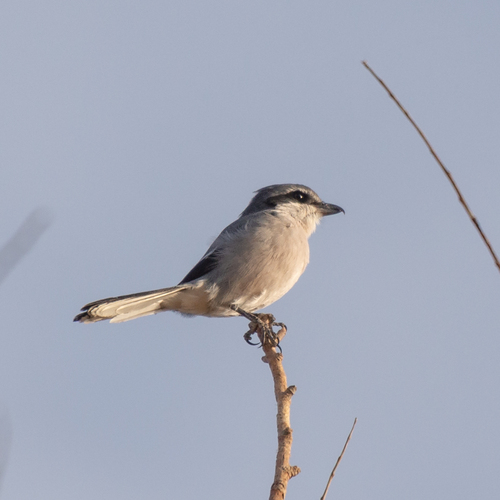
Iberian Grey Shrike (Lanius meridionalis) Iberian Grey Shrike
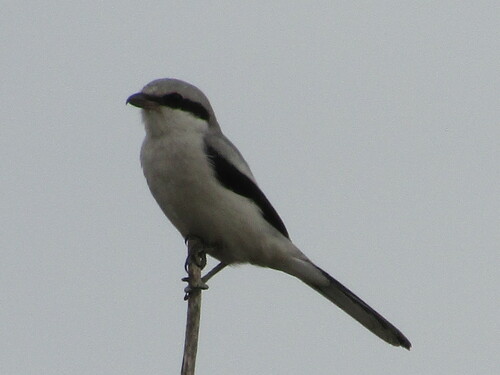
Great Grey Shrike (Lanius excubitor) Great Grey Shrike

Media

Loading…

In short

The most reliable field mark for separating Iberian Grey Shrike from Great Grey Shrike is the overall darker grey upperparts of the Iberian, especially on the crown, nape, and mantle, combined with a broader black mask and a pinkish tinge to the underparts. In flight or at rest, Iberian Grey Shrike shows a moderately large white patch on the primaries but lacks white on the secondaries, while Great Grey Shrike typically has a pearlier grey back and white underparts. Structural differences are subtle but worth noting: Iberian Grey Shrike may have a slightly larger head, a stouter bill, and a thinner tail. Juveniles of both species are less distinctive, so caution is needed with immature birds. Habitat can also help, as Iberian Grey Shrike is endemic to southwestern Europe and prefers different habitats where the two overlap.

Identification tips

  1. Upperparts Color (Adults): Iberian Grey Shrike is noticeably darker grey above, especially on the crown, nape, and mantle, while Great Grey Shrike is a paler, pearly grey. This is a key distinction in good light.
  2. Underparts Tint: Iberian Grey Shrike often shows a greyish-pink wash on the breast and belly, unlike the clean white underparts of Great Grey Shrike.
  3. Black Mask: The black mask is broader in Iberian Grey Shrike, sometimes extending further above and below the eye, and is paired with a more distinct white supercilium. Great Grey Shrike's mask is narrower and the supercilium less obvious.
  4. Wing Pattern (Adults): Iberian Grey Shrike has a moderately large white patch on the primaries but lacks white on the secondaries. Great Grey Shrike typically shows a white spot on the wing, but the notes do not specify secondary pattern; check for any white on the secondaries as a possible Great Grey Shrike clue.
  5. Tail Structure: Iberian Grey Shrike may have a thinner tail, while Great Grey Shrike's tail is described as wedge-shaped with white edges. Tail shape is subtle and best used in combination with other marks.
  6. Bill Structure: Iberian Grey Shrike may have a slightly larger head and a stouter bill compared to Great Grey Shrike, but this is a minor difference and hard to judge unless both species are seen together.
  7. Juvenile/Immature Birds: Juvenile plumage is less distinctive in both species, and the available notes do not provide clear age-specific wing or tail patterns for separation. Exercise caution with young birds, and rely more on structure and context.
  8. Perched vs. In-Flight: Both species perch conspicuously, but in flight, look for the extent and location of white in the wings and the overall tone of the upperparts. Iberian Grey Shrike's darker upperparts and lack of secondary white are helpful.
  9. Habitat and Range: If observed in southwestern Europe, especially in drier, open landscapes, Iberian Grey Shrike is more likely. Great Grey Shrike is more widespread in northern and central Europe and Asia.
  10. Behavior: Both species exhibit typical shrike behaviors—perching in the open, undulating flight, and aggressive posturing. Behavioral cues are not reliable for separation.
  11. Sex and Season: Males and females are similar in both species. Seasonal variation is not highlighted as a key field mark in the available notes.
  12. Pitfalls: Overlapping features, especially in juveniles and immatures, can make identification tricky. Lighting conditions can also affect perception of upperpart color and mask width.
  13. Not Diagnostic: Vocalizations, detailed wing formula, and primary projection are not described as useful for separation in the available notes.
  14. When in Doubt: Prioritize the combination of upperpart darkness, underpart tint, mask width, and wing white pattern for adults. Use habitat and range as supporting context, especially in overlap zones.

Size

Both species are similar in size, with the Great Grey Shrike averaging around 63.4 g in body mass [wikidata]. The Iberian Grey Shrike is described as similar in size to northern Great Grey Shrikes but may have a slightly larger head and a thinner tail. These differences are subtle and not always reliable in the field, especially at a distance or without direct comparison.

Plumage

For adults, Iberian Grey Shrike is much darker grey above, especially on the crown, nape, and mantle, and has a greyish-pink wash on the breast and belly. Its black mask is broader and the white supercilium is more distinct. The white patch on the primaries is moderately large, but there is no white on the secondaries. In contrast, Great Grey Shrike is pearly grey above with a black mask and clear white underparts. Its wings are black with a white spot, and the tail is wedge-shaped with white edges. Juveniles of both species are less distinctive, and age-specific upperwing patterns are not detailed in the available notes, so caution is needed with immature birds.

Behaviour

Both species perch conspicuously and have similar hunting and social behaviors typical of shrikes. Great Grey Shrike's flight is undulating and heavy, often staying low to the ground and landing with an upward swoop. It is also capable of repeated hovering flights, especially during display or territorial interactions. Social signaling includes upright postures, tail and wing flicking, and crest-raising when agitated. There is no specific behavioral note distinguishing Iberian Grey Shrike from Great Grey Shrike in the field.

Habitat

Iberian Grey Shrike is endemic to southwestern Europe and does not overlap broadly with Great Grey Shrike, except in limited contact zones where they select different habitats and do not interbreed. Habitat preference can be a clue: if you are in southwestern Europe, especially in open, dry, or semi-arid landscapes, Iberian Grey Shrike is more likely. Great Grey Shrike occupies a wider range across northern and central Europe and Asia, often in more temperate open habitats.

Submit a better description

Use the same sections as the comparison. Your text is published immediately.

The most reliable field mark for separating Iberian Grey Shrike from Great Grey Shrike is the overall darker grey upperparts of the Iberian, especially on the crown, nape, and mantle, combined with a broader black mask and a pinkish tinge to the underparts. In flight or at rest, Iberian Grey Shrike shows a moderately large white patch on the primaries but lacks white on the secondaries, while Great Grey Shrike typically has a pearlier grey back and white underparts. Structural differences are subtle but worth noting: Iberian Grey Shrike may have a slightly larger head, a stouter bill, and a thinner tail. Juveniles of both species are less distinctive, so caution is needed with immature birds. Habitat can also help, as Iberian Grey Shrike is endemic to southwestern Europe and prefers different habitats where the two overlap.

  1. Upperparts Color (Adults): Iberian Grey Shrike is noticeably darker grey above, especially on the crown, nape, and mantle, while Great Grey Shrike is a paler, pearly grey. This is a key distinction in good light.
  2. Underparts Tint: Iberian Grey Shrike often shows a greyish-pink wash on the breast and belly, unlike the clean white underparts of Great Grey Shrike.
  3. Black Mask: The black mask is broader in Iberian Grey Shrike, sometimes extending further above and below the eye, and is paired with a more distinct white supercilium. Great Grey Shrike's mask is narrower and the supercilium less obvious.
  4. Wing Pattern (Adults): Iberian Grey Shrike has a moderately large white patch on the primaries but lacks white on the secondaries. Great Grey Shrike typically shows a white spot on the wing, but the notes do not specify secondary pattern; check for any white on the secondaries as a possible Great Grey Shrike clue.
  5. Tail Structure: Iberian Grey Shrike may have a thinner tail, while Great Grey Shrike's tail is described as wedge-shaped with white edges. Tail shape is subtle and best used in combination with other marks.
  6. Bill Structure: Iberian Grey Shrike may have a slightly larger head and a stouter bill compared to Great Grey Shrike, but this is a minor difference and hard to judge unless both species are seen together.
  7. Juvenile/Immature Birds: Juvenile plumage is less distinctive in both species, and the available notes do not provide clear age-specific wing or tail patterns for separation. Exercise caution with young birds, and rely more on structure and context.
  8. Perched vs. In-Flight: Both species perch conspicuously, but in flight, look for the extent and location of white in the wings and the overall tone of the upperparts. Iberian Grey Shrike's darker upperparts and lack of secondary white are helpful.
  9. Habitat and Range: If observed in southwestern Europe, especially in drier, open landscapes, Iberian Grey Shrike is more likely. Great Grey Shrike is more widespread in northern and central Europe and Asia.
  10. Behavior: Both species exhibit typical shrike behaviors—perching in the open, undulating flight, and aggressive posturing. Behavioral cues are not reliable for separation.
  11. Sex and Season: Males and females are similar in both species. Seasonal variation is not highlighted as a key field mark in the available notes.
  12. Pitfalls: Overlapping features, especially in juveniles and immatures, can make identification tricky. Lighting conditions can also affect perception of upperpart color and mask width.
  13. Not Diagnostic: Vocalizations, detailed wing formula, and primary projection are not described as useful for separation in the available notes.
  14. When in Doubt: Prioritize the combination of upperpart darkness, underpart tint, mask width, and wing white pattern for adults. Use habitat and range as supporting context, especially in overlap zones.

Both species are similar in size, with the Great Grey Shrike averaging around 63.4 g in body mass [wikidata]. The Iberian Grey Shrike is described as similar in size to northern Great Grey Shrikes but may have a slightly larger head and a thinner tail. These differences are subtle and not always reliable in the field, especially at a distance or without direct comparison.

For adults, Iberian Grey Shrike is much darker grey above, especially on the crown, nape, and mantle, and has a greyish-pink wash on the breast and belly. Its black mask is broader and the white supercilium is more distinct. The white patch on the primaries is moderately large, but there is no white on the secondaries. In contrast, Great Grey Shrike is pearly grey above with a black mask and clear white underparts. Its wings are black with a white spot, and the tail is wedge-shaped with white edges. Juveniles of both species are less distinctive, and age-specific upperwing patterns are not detailed in the available notes, so caution is needed with immature birds.

Both species perch conspicuously and have similar hunting and social behaviors typical of shrikes. Great Grey Shrike's flight is undulating and heavy, often staying low to the ground and landing with an upward swoop. It is also capable of repeated hovering flights, especially during display or territorial interactions. Social signaling includes upright postures, tail and wing flicking, and crest-raising when agitated. There is no specific behavioral note distinguishing Iberian Grey Shrike from Great Grey Shrike in the field.

Iberian Grey Shrike is endemic to southwestern Europe and does not overlap broadly with Great Grey Shrike, except in limited contact zones where they select different habitats and do not interbreed. Habitat preference can be a clue: if you are in southwestern Europe, especially in open, dry, or semi-arid landscapes, Iberian Grey Shrike is more likely. Great Grey Shrike occupies a wider range across northern and central Europe and Asia, often in more temperate open habitats.

Discard your changes?

You have unsaved edits. If you leave now, those changes will be lost.

Iberian Grey Shrike · Great Grey Shrike · My Tricky Birds