
Isabelline Wheatear vs Desert Wheatear
Oenanthe isabellina versus Oenanthe deserti
Play a quiz with Isabelline Wheatear and Desert Wheatear
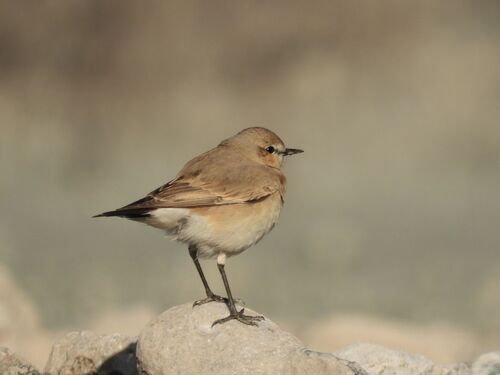 Isabelline Wheatear
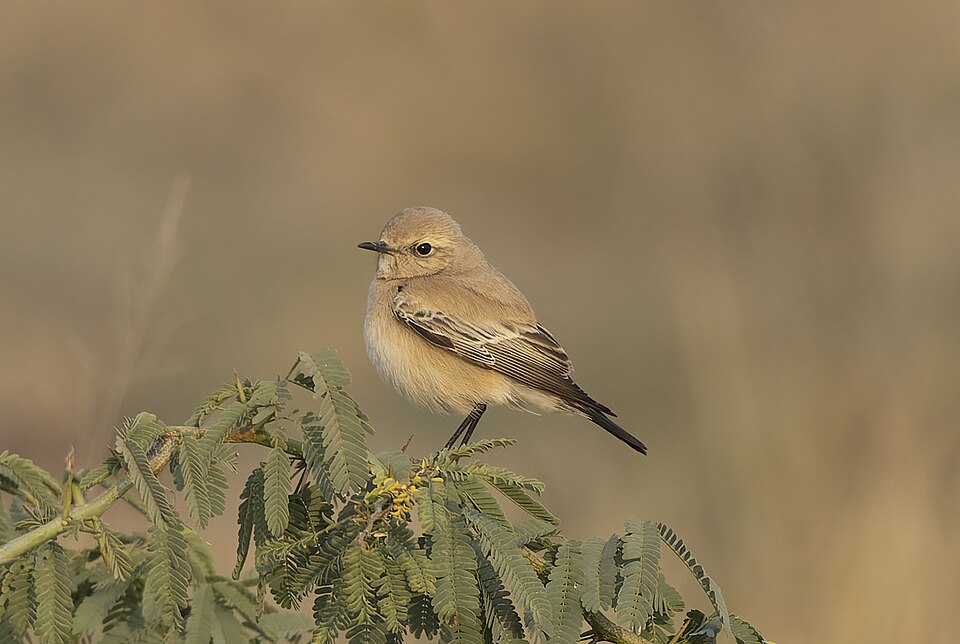 Desert Wheatear
In short
The most reliable field mark to separate Isabelline Wheatear from Desert Wheatear is the tail pattern: Isabelline Wheatear always shows a broad white base to the tail with only the terminal portion black, while Desert Wheatear has an almost entirely black tail with white limited to the base, often appearing all-black from above or behind. This difference is visible in all ages and sexes, both perched and in flight. Isabelline Wheatear is also distinctly paler and larger, with a more upright stance and longer bill, while Desert Wheatear males (and some females) show black on the throat and face, which Isabelline never does. In flight, Isabelline's underwing coverts are white, while Desert's are blackish. Juveniles of both species are more subtly marked but still differ in tail pattern and overall tone.
Identification tips
- Tail pattern is the most reliable mark: Isabelline Wheatear always shows a broad white base to the tail (outer feathers mostly white, central feathers about one-third white), with only the terminal portion black. Desert Wheatear's tail is almost entirely black up to the upper tail-coverts, with only a small white base. This is diagnostic in all ages and sexes, perched or in flight.
- Underwing color in flight: Isabelline Wheatear has white axillaries and underwing coverts, while Desert Wheatear has black axillaries and underwing coverts tipped with white. This is best seen in flight or when preening.
- Face and throat pattern: Adult male Desert Wheatear has black on the chin, throat, lores, and ear-coverts, often extending to the shoulders, especially in spring/summer. Isabelline Wheatear never shows black on the face or throat; its face is pale with a creamy-white supercilium and pale brown ear-coverts. Female Desert Wheatear lacks the black throat but is still darker-faced than Isabelline.
- Overall coloration: Isabelline Wheatear is paler and more isabelline (parchment, pale sandy) overall, with a creamy-white belly and pale buff under tail-coverts. Desert Wheatear is richer, more buff or sandy, especially on the breast and flanks, and appears darker above.
- Juvenile plumage: Juvenile Desert Wheatear is more speckled above (pale centers, brown tips), while Isabelline is smoother and paler. Tail pattern remains diagnostic.
- Size and structure: Isabelline Wheatear is larger, bulkier, and longer-legged, with a longer bill and a more upright stance. Desert Wheatear is smaller, more compact, and shorter-tailed.
- Supercilium and ear-coverts: Isabelline has a creamy-white supercilium and pale brown ear-coverts; Desert's supercilium is pale buff and the ear-coverts are black-tipped in males.
- Rump and upper tail-coverts: Isabelline's rump and upper tail-coverts are white; Desert's are pale buff or sandy brown (females) or pale buff (males), never as white as Isabelline.
- Bill and legs: Both species have black bills and legs, but Isabelline's bill is longer and slightly heavier.
- Perched jizz: Isabelline appears more upright and elongated, often standing tall; Desert is more compact and horizontal.
- Habitat context: If in true desert or very barren sandy/stony areas, Desert Wheatear is more likely; Isabelline prefers steppe, open plains, and less barren ground.
- Association: Isabelline is more likely to be solitary in winter, though both may join other wheatears on passage.
- Seasonal plumage: Male Desert Wheatear's black throat may be partially obscured by white feather tips in winter, so do not rely solely on this mark outside breeding season; tail pattern remains diagnostic year-round.
- Pitfalls: Female and juvenile Desert Wheatear can look pale and may lack obvious black on the face, but the tail pattern and underwing color still separate them from Isabelline.
- Flight views: In flight, focus on the tail and underwing pattern for the quickest separation, especially in mixed flocks or during migration.
Size
Isabelline Wheatear is noticeably larger and heavier (body mass ~29g) than Desert Wheatear (length 14.5–15 cm vs. Isabelline's 15–16.5 cm). Isabelline also appears bulkier and longer-legged, with a longer bill and a more upright posture. Desert Wheatear is more compact and shorter-tailed, often looking daintier in direct comparison.
Plumage
- Juvenile/First-year: Both species are pale and sandy, but juvenile Desert Wheatear is more speckled above due to pale centers and brown tips to the feathers, while Isabelline is smoother and paler overall. The tail pattern is diagnostic at all ages: Isabelline Wheatear has a broad white base to the tail (outer feathers more than half white), while Desert Wheatear's tail is almost entirely black up to the upper tail-coverts, with only the base white.
- Adult male Desert Wheatear: Shows black on the chin, throat, lores, and ear-coverts, extending to the shoulders, especially in breeding plumage. Isabelline Wheatear never has black on the face or throat; its face is pale with a creamy-white supercilium and pale brown ear-coverts.
- Females: Female Desert Wheatear lacks the black throat but is still darker and more buff below, with a sandy brown rump and upper tail-coverts. Isabelline females are paler, with a more uniform sandy or isabelline buff above and below.
- Underwing: Isabelline Wheatear has white axillaries and underwing coverts; Desert Wheatear has black axillaries and underwing coverts tipped with white, a striking difference in flight.
- Tail: In Isabelline, the white base of the tail is extensive, especially on the outer feathers; in Desert, the tail is black to the upper tail-coverts with only a small white base, giving a much darker impression from behind.
Behaviour
Both species are active, ground-feeding insectivores, but Isabelline Wheatear is more likely to be seen striding or hopping upright across open ground, often in solitary or loose association with other wheatears during migration. Desert Wheatear tends to perch on low bushes or tussocks and makes short sallies to the ground, sometimes hovering briefly. Both species may associate with other Oenanthe species on passage, but Isabelline is generally more upright and longer-legged in its movements.
Habitat
Isabelline Wheatear prefers open steppe, arid plains, and high plateaux with sparse vegetation, often in more grassy or loamy areas than Desert Wheatear. Desert Wheatear is more strictly a bird of semi-desert and true desert, favoring sandy or stony ground with very sparse vegetation. Overlap can occur in migration or winter, but Isabelline is rarely found in the most barren desert habitats preferred by Desert Wheatear.