

Isabelline Wheatear vs Western Black-eared Wheatear
Oenanthe isabellina versus Oenanthe hispanica
Play a quiz with Isabelline Wheatear and Western Black-eared Wheatear
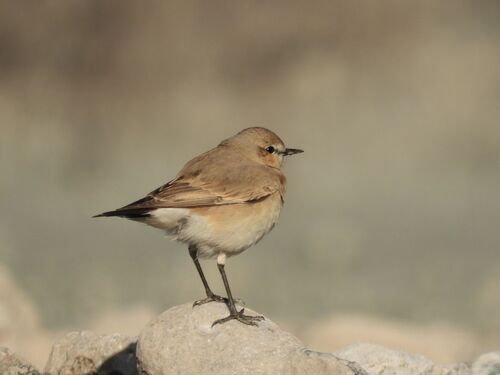 Isabelline Wheatear
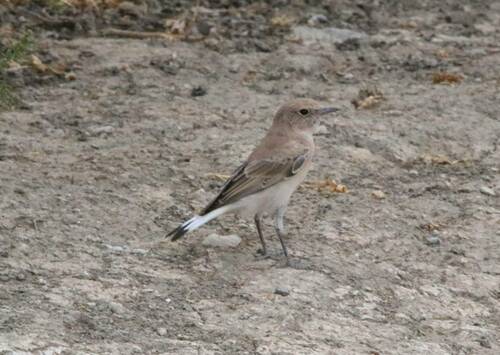 Western Black-eared Wheatear
In short
The most reliable field mark between Isabelline Wheatear and Western Black-eared Wheatear is the overall coloration and tail pattern: Isabelline Wheatear is distinctly paler and more uniformly sandy or isabelline, with a long-legged upright stance and a tail showing extensive white at the base but a broad black terminal band. Western Black-eared Wheatear, especially males in breeding plumage, shows a striking black facial mask, whiter upperparts, and a tail that is white with narrow black at the tip and central feathers. Females and non-breeding birds of both species can be confusing, but Isabelline is always larger, paler, and lacks any strong black mask. In flight or at rest, look for the Isabelline's pale underwing coverts and more extensive white on the tail base, versus the Western Black-eared's blacker wings and more sharply defined tail pattern. Structural differences (size, bill, posture) and subtle plumage details are key, especially outside the male's breeding season.
Identification tips
- Tail pattern (all ages): Isabelline Wheatear shows a broad black terminal band with a large white base on the tail, especially obvious in flight; the outer tail feathers are mostly white, central feathers about one-third white. Western Black-eared Wheatear's tail is mostly white with black restricted to the central pair and a narrow tip, the white often extending to the tip on the inner web.
- Overall coloration: Isabelline Wheatear is much paler, sandy or isabelline above and below, with little contrast; Western Black-eared Wheatear is warmer buff or brown, especially in females and non-breeding birds.
- Facial pattern (breeding male): Western Black-eared Wheatear males have a bold black mask from ear coverts to bill, sometimes a black throat, and a white or nearly white crown and forehead. Isabelline lacks any black mask or throat, instead showing a creamy-white supercilium and pale brown ear coverts.
- Underwing coverts: Isabelline Wheatear has white underwing coverts and axillaries (with dark bases), a subtle but consistent mark if seen well in flight or preening. Western Black-eared Wheatear does not show this feature.
- Size and structure: Isabelline is larger, longer-legged, and more upright in stance; Western Black-eared is smaller, more compact, and less upright. Use this with caution unless both species are present for comparison.
- Bill length: Isabelline Wheatear has a longer bill than Western Black-eared, but this is subtle and best used in combination with other marks.
- Breast and belly: Isabelline's breast is sandy or isabelline buff, belly creamy white; Western Black-eared is white tinged with buff, but usually warmer and more contrasting.
- Supercilium: Isabelline shows a creamy-white supercilium, often more obvious than in Western Black-eared, which may be less distinct or broken by the black mask in males.
- Ear coverts: Isabelline's are pale brown and blend with the rest of the head; Western Black-eared's are often included in the black mask (males) or warmer brown (females).
- Habitat context: In open, barren steppe or high plateau, especially in Central Asia or similar habitats, Isabelline is more likely. In rocky, shrubby Mediterranean terrain, Western Black-eared is expected.
- Sex and season: Males of Western Black-eared in breeding plumage are easiest to separate due to the black mask and whiter crown. Females and non-breeding birds are trickier; rely on tail pattern, overall paleness, and structure.
- Associations: Isabelline is often solitary in winter, sometimes with other Oenanthe species during migration. Western Black-eared's social habits are less distinctive but not solitary in the same way.
- Pitfalls: Female and non-breeding Western Black-eared can look very similar to Isabelline, especially in poor light. Focus on tail pattern and overall paleness.
- Not diagnostic: No clear differences in vocalizations or detailed wing pattern in flight are described in these sources for these two species.
- When in doubt: Prioritize tail pattern, overall coloration, and structure, especially for birds not in full breeding plumage.
Size
Isabelline Wheatear is noticeably larger and bulkier, with a typical body mass of 29.0g [wikidata], and a length of 15–16.5 cm. Western Black-eared Wheatear is smaller and more delicate, though precise mass is not given in the sources. In the field, Isabelline often appears longer-legged and more upright, while Western Black-eared is more compact and less upright. Use these jizz differences with caution, but size and stance can help when seen side by side.
Plumage
-
Juvenile/immature plumage: No explicit details on juvenile wing pattern for either species in the provided notes, so focus must be on overall coloration and tail pattern. Both species have pale lower backs and white upper tail coverts, but Isabelline Wheatear's tail has a broad black terminal band with a large white base (outer feathers more than half white), while Western Black-eared Wheatear's tail is mostly white except for the central pair and a narrow black tip.
-
Adult breeding plumage: Male Western Black-eared Wheatear is distinctive with a black mask from ear coverts to bill, white or nearly white crown and forehead, and blacker wings. Throat may be black or white. Isabelline Wheatear is much paler overall, sandy or isabelline above, with a creamy-white supercilium, pale brown ear coverts, and no black mask or throat. Both sexes of Isabelline are similar and lack strong facial contrast.
-
Non-breeding/female plumage: Both species become browner and buffier, but Isabelline remains paler and more uniform, with a sandy or parchment tone, while Western Black-eared (especially females) is warmer brown above and below, and may show some facial contrast. The axillaries and underwing coverts of Isabelline are white, while Western Black-eared's are not described as such.
-
Tail pattern: Isabelline: broad black terminal band, large white base (outer feathers mostly white). Western Black-eared: tail mostly white, black restricted to central feathers and tip, white often extending to tip on inner web.
Behaviour
Isabelline Wheatear is more upright and long-legged, often seen standing tall on open ground, moving with long hops. Western Black-eared Wheatear is more compact and less upright. Both species are active and restless, but Isabelline may appear more solitary, especially in winter, while Western Black-eared is not described as associating with other species. Both are typical open-country wheatears, but Isabelline's gait and posture are more strikingly upright.
Habitat
Isabelline Wheatear favors open, barren steppe, high plateaux, arid regions, and semi-arid ground with sparse vegetation, often in Central Asia, southern Russia, and similar habitats in winter. Western Black-eared Wheatear is not described in detail here, but typically prefers rocky slopes, scrub, and open country in southern Europe and the Mediterranean. If in classic steppe or high plateau, Isabelline is more likely; in rocky Mediterranean terrain, Western Black-eared is expected.
Isabelline Wheatear · Western Black-eared Wheatear · My Tricky Birds