

Key West Quail-Dove vs Bridled Quail-Dove
Geotrygon chrysia versus Geotrygon mystacea
Play a quiz with Key West Quail-Dove and Bridled Quail-Dove
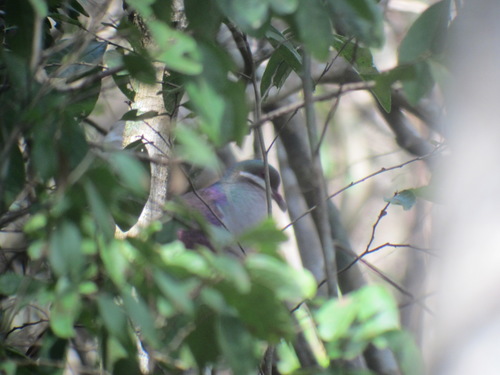 Key West Quail-Dove
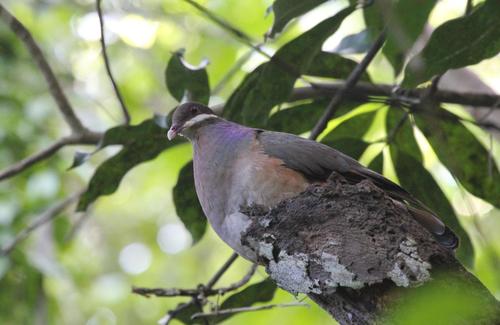 Bridled Quail-Dove
In short
The most reliable field mark to separate Key West Quail-Dove from Bridled Quail-Dove is overall coloration: Key West shows a rich dark rust-colored back and wings with purplish-red iridescence, while Bridled is mostly brown with less intense iridescence and a cinnamon-tinged folded wing. Both species have a bold white facial stripe, but the Bridled Quail-Dove also has a small white throat patch and a more contrasting cream belly. In the field, Bridled is noticeably bulkier. Immature and adult plumages are similar in both, so focus on overall color, iridescence, and size. Both species can be confused when seen briefly or in poor light, but careful attention to these differences will help avoid mix-ups.
Identification tips
- Overall Coloration: Key West Quail-Dove is dark rust-colored on the back and wings, while Bridled Quail-Dove is mostly brown. This is the most immediate field mark at all ages.
- Iridescence: Key West shows purplish-red iridescence on the mantle, back, rump, and inner wing coverts, and amethyst or bronze-green gloss on the crown and nape. Bridled males have green to violet iridescence on the head, nape, and upper back, but females are duller. If you see strong purplish-red tones, favor Key West; greenish or bluish iridescence, especially on the head, suggests Bridled (especially males).
- Facial Pattern: Both have a bold white facial stripe, but only Bridled has a small white patch on the throat. Look for this throat patch in good light.
- Belly Color: Bridled has a contrasting cream belly, while Key West is more uniform below. If the belly stands out as pale, suspect Bridled.
- Folded Wing Markings: Bridled shows some cinnamon on the folded wing, which can be a subtle but helpful mark if seen well. Key West lacks this feature.
- Tail Color: Bridled has a dark brownish gray tail, which may contrast with the rest of the plumage. Key West's tail is not specifically described but is likely less contrasting.
- Size and Structure: Bridled is heavier and bulkier (211 g vs 169 g). If the bird looks especially robust, it is likely Bridled.
- Sex Differences: Bridled males are more iridescent than females, but both sexes are browner than Key West. Do not rely on iridescence alone for sexing, but note that a very dull Bridled may be a female.
- Age: No distinctive juvenile or immature marks are described for either species; all ages are best separated by overall color and iridescence.
- Voice: Key West gives a single-pitched moan; if you hear this, it supports Key West, but Bridled's call is not described, so absence of this call does not confirm Bridled.
- In-flight Views: No unique upperwing or flight marks are noted for either species, so rely on overall color and size even in flight.
- Lighting Pitfalls: In poor light, both can appear similar. Try to get multiple angles to assess iridescence and belly color.
- Facial Stripe: Both species have a bold white facial stripe, so do not use this mark alone for identification.
- Geographic Range: Both are Caribbean species, and the notes do not specify range differences, so do not use location alone for separation.
- Habitat and Behavior: Both species share similar habitats and ground-dwelling behavior; these are not reliable for separation.
Size
Bridled Quail-Dove is significantly heavier, averaging about 211 g compared to Key West's 169 g. This size difference is often apparent in the field, with Bridled appearing bulkier and more robust. Both are similar in length (Key West: 27–31 cm), but Bridled's greater mass gives it a stockier impression. If seen together, Bridled will look noticeably larger and heavier-set.
Plumage
- Juvenile/Immature/First-year: No age-specific upperwing or flight marks are described for either species, so focus on overall color and iridescence at all ages.
- Adults: Key West Quail-Dove has a dark rust-colored back and wings with purplish-red iridescence, and amethyst or bronze-green gloss on the crown and nape. Its white facial stripe is bold, but the rest of the face is relatively plain. Bridled Quail-Dove is mostly brown, with a bold white facial stripe below the eye and a small white throat patch. The male Bridled shows green to violet iridescence on the head, nape, and upper back (less in females), and the folded wing has cinnamon markings. The belly of Bridled is cream, contrasting with the darker upperparts, while Key West is more uniformly colored. The tail of Bridled is dark brownish gray, not described for Key West but likely less contrasting.
Behaviour
No distinctive behavioral differences are described between these two species. Both are ground-dwelling quail-doves with similar habits, so behavior alone is unlikely to be diagnostic in the field.
Habitat
No specific habitat differences are provided in the notes. Both species occur in the Caribbean and may overlap in similar forested or brushy habitats. Habitat is not a reliable separator based on the available information.
Voice
Key West Quail-Dove has a single-pitched moaning call similar to White-tipped Dove. No vocalization details are provided for Bridled Quail-Dove, so voice is not a reliable separator based on current information.