

Lanceolated Warbler vs Common Grasshopper Warbler
Locustella lanceolata versus Locustella naevia
Play a quiz with Lanceolated Warbler and Common Grasshopper Warbler
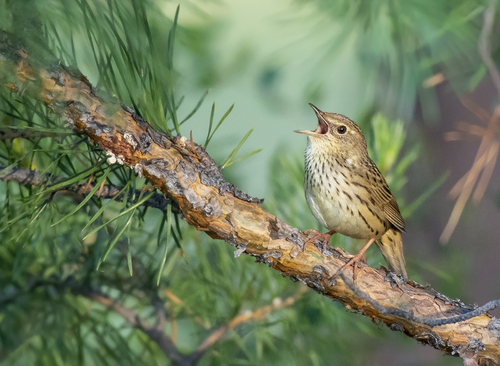 Lanceolated Warbler
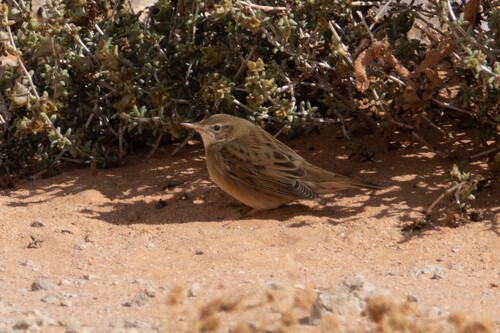 Common Grasshopper Warbler
In short
The most reliable field mark between Lanceolated Warbler and Common Grasshopper Warbler is the pattern and density of streaking on the underparts: Lanceolated Warbler shows fine, sharp, lance-shaped streaks on whitish-grey underparts and undertail, while Common Grasshopper Warbler has sparser, less sharply defined dark spots and streaks on a cream or yellowish-buff background. Juvenile Lanceolated Warblers are yellower below, which can cause confusion with young Grasshopper Warblers, but the streaking remains finer and more extensive in Lanceolated. Both species are small, secretive Locustella warblers with streaked brown upperparts, but careful attention to underpart pattern, tail, and subtle structural cues is key. Voice is not diagnostic in the field for most observers due to their similar 'reeling' songs, but habitat and range can help in context.
Identification tips
- Underpart streaking: Lanceolated Warbler always shows fine, dense, sharply defined dark streaks on whitish-grey underparts and undertail coverts; Grasshopper Warbler has sparser, less sharply defined spots and streaks, mainly on the breast and flanks, with a cream or yellowish-buff ground color. This is the single most reliable field mark for all ages.
- Juvenile coloration: Juvenile Lanceolated Warblers are yellower below than adults but retain the fine, dense streaking; juvenile Grasshopper Warblers are also buffy or yellowish below but with much less streaking. If you see a yellowish bird with extensive, sharp streaks, it's likely Lanceolated.
- Undertail coverts: Both species have streaked undertail coverts, but Lanceolated's are more sharply and densely marked. When the bird fans or flicks its tail, look for the density and sharpness of these streaks.
- Upperparts: Grasshopper Warbler has pale olive-brown upperparts with each feather centrally streaked darker; Lanceolated is more uniformly streaked brown above. This is subtle and best used in good light.
- Tail color and pattern: Grasshopper Warbler's tail is reddish-brown with faint transverse bars in some individuals. Lanceolated's tail is less described but not noted as reddish or barred; focus on undertail streaking instead.
- Facial pattern: Grasshopper Warbler shows greyish cheeks and a faint eye-stripe behind the eye. Lanceolated's face is less distinctly marked, so a strong eye-stripe or cheek contrast may point to Grasshopper.
- Leg color: Grasshopper Warbler has pale yellowish-brown legs and feet; Lanceolated's leg color is not described as distinctive, so this is of limited use.
- Behavior: Both are skulking, but Grasshopper Warbler is noted for high-stepping, long strides along stems, and frequent tail fanning. If you see this gait and tail display, Grasshopper is more likely.
- Song: Both have a similar reeling trill, but unless you are highly experienced or can analyze recordings, do not rely on voice for separation.
- Habitat: In Europe, Grasshopper Warbler is much more likely in drier, bushy habitats, while Lanceolated is rare and prefers wetter grasslands. In migration, check local records for likelihood.
- Flight views: If flushed, both fly weakly and drop quickly into cover. No distinctive upperwing or flight pattern is described for either, so rely on underpart streaking if glimpsed.
- Sex and season: Sexes are similar in both species. In autumn, beware of juvenile Lanceolateds appearing yellower below, but remember the streaking remains diagnostic.
- Pitfalls: Do not rely on overall color alone, as both can appear brown and streaked above with pale underparts. Always check the density and sharpness of underpart streaking.
- Range: Outside of the core breeding ranges, check local status—Lanceolated is rare in western Europe, so a Locustella in a hedgerow is almost always Grasshopper Warbler.
- When in doubt: If the underpart streaking is not clearly visible, try to obtain multiple views, especially of the undertail coverts and flanks, and note any behavioral cues.
Size
Both species are small Locustella warblers and are very similar in size, with Common Grasshopper Warbler averaging about 12.5 cm in length and weighing 11.5–16 grams [wikipedia]. No direct size difference is likely to be useful in the field; both appear compact and slender with long tails.
Plumage
Juvenile and first-year birds of both species can be confusing, especially in autumn. Lanceolated Warbler (all ages) shows very fine, dense, sharply defined dark streaks on the whitish-grey underparts and undertail coverts, giving a distinctly 'lanceolate' (spearhead-shaped) look. This streaking is present even in juveniles, though the ground color is yellower. Common Grasshopper Warbler has a cream or yellowish-buff underside with only a few, less sharply defined dark brown spots and streaks, mainly on the breast and flanks, and streaked undertail coverts. The upperparts of both are brown and streaked, but Grasshopper Warbler's back is paler olive-brown with each feather centrally streaked darker, while Lanceolated is more uniformly streaked brown. The wings of Grasshopper Warbler are brown with paler edges, and the tail is reddish-brown with faint bars in some birds; Lanceolated's tail pattern is less described, but undertail streaking is a key mark. Sexes are similar in both species.
Behaviour
Both species are extremely skulking, moving through dense grass or low vegetation and rarely flying far. Grasshopper Warbler is noted for its high-stepping gait and long stride as it moves along stems, often with tail raised and fanned to show streaked undertail coverts. It may also feign injury to distract predators. Lanceolated Warbler's behavior is less described but is similarly secretive and ground-oriented. Both may be glimpsed flitting low or running through cover, diving back into vegetation quickly.
Habitat
Lanceolated Warbler breeds from northwest European Russia across the Palearctic to northern Japan, favoring damp grasslands and marshy areas. Common Grasshopper Warbler breeds across much of temperate Europe and the western Palearctic, using rough grass and bushy habitats, including fens, clearings, hedgerows, heaths, moors, and young plantations. Both winter far from their breeding grounds, but Grasshopper Warbler winters in Africa and locally in India, while Lanceolated winters in Southeast Asia. Overlap in habitat is possible in migration, but Grasshopper Warbler is more likely in drier, bushy sites, while Lanceolated prefers wetter grassland.
Voice
Both species have a long, high-pitched 'reeling' song that is extremely similar in structure and tone, making them hard to separate by ear for most observers. The Grasshopper Warbler's song is a continuous trill of remarkable speed and complexity, ventriloquial and far-carrying, and is easily confused with Lanceolated Warbler's song, which is also a reeling trill. Alarm calls are not described for Lanceolated but are ticking in Grasshopper Warbler. In practice, song is not a reliable field separator without experience or audio analysis.
Lanceolated Warbler · Common Grasshopper Warbler · My Tricky Birds