

Long-tailed Koel vs White-tailed Tropicbird
Urodynamis taitensis versus Phaethon lepturus
Play a quiz with Long-tailed Koel and White-tailed Tropicbird
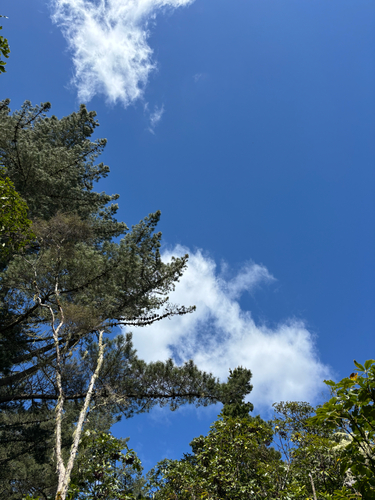 Long-tailed Koel
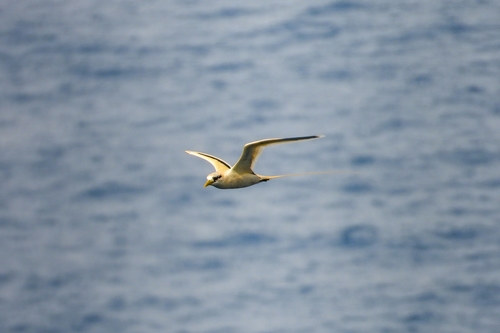 White-tailed Tropicbird
In short
The most reliable field mark is the overall color and wing pattern in flight: juvenile Long-tailed Koels show brown upperparts with white spotting and a white-tipped tail, while all ages of White-tailed Tropicbird are strikingly white with a black eye-mask and bold black inner wing bar. The tropicbird is much larger in wingspan and has extremely long, filamentous white tail streamers (adults), while the koel's tail is long but softly rounded and never streamer-like. Bill color is also a strong separator: the koel has a short, dark, slightly hooked bill, while the tropicbird's bill is long, slender, and yellow to orange. Habitat and context are usually decisive: koels are forest birds of New Zealand and the Pacific, while tropicbirds are marine, rarely seen inland.
Identification tips
- Juvenile upperwing pattern: Juvenile Long-tailed Koel shows brown upperparts with white spotting on the wing and a white-tipped tail; juvenile White-tailed Tropicbird is mostly white with a finely barred back, black eye-mask, and black inner wing bar, lacking brown or spotting. Use this for any brownish immature bird in flight.
- Adult tail shape: Adult White-tailed Tropicbird has extremely long, filamentous white tail streamers that double its length; Long-tailed Koel has a long but softly rounded tail, never streamer-like. Streamers are visible even at a distance.
- Overall color: Koel is brown above with streaked white underparts; tropicbird is clean white above and below (except for black mask and wing bar). Any brown or streaked bird is not a tropicbird.
- Bill shape and color: Koel has a short, dark, slightly hooked bill; tropicbird's bill is long, slender, and yellow to orange-red (adults) or green-yellow (juveniles). Bill color is diagnostic at close range.
- Facial pattern: Tropicbird shows a bold black eye-mask; koel has a supercilium bordered by a dark eye-stripe, but never a mask.
- Wing pattern in flight: Tropicbird shows a bold black bar on the inner wing (all ages); koel shows white spotting on brown wings (juveniles) or plain brown wings (adults), never a black bar.
- Underparts: Koel has coarse black-brown streaking on white underparts; tropicbird is pure white below.
- Size and jizz: Tropicbird is much larger, with a broader wingspan and a more graceful, buoyant flight; koel is smaller, more compact, and flies directly.
- Habitat: Koel is found in forests, plantations, and gardens, never at sea; tropicbird is marine, rarely seen inland or away from oceanic islands.
- Behavior: Koel is solitary and secretive, often high in the canopy; tropicbird is aerial, often seen soaring or plunge-diving over water.
- Vocalization: Koel's call is a loud, shrill whistle or scream, often repeated; tropicbird's call is a high-pitched, screamed series, usually near breeding sites.
- Context: If the bird is seen inland, in trees, or in New Zealand forest, it is almost certainly a koel. If seen over open ocean or on a remote island, especially with tail streamers, it is a tropicbird.
- Sex and age: Both species are sexually similar, but tropicbird males average longer tail streamers. Juvenile tropicbirds lack streamers and have a green-yellow bill, but are still mostly white with a black mask and wing bar.
- Common pitfalls: Immature tropicbirds lacking streamers may be mistaken for other white seabirds, but never show brown or streaked plumage. Juvenile koels are sometimes mistaken for other cuckoos, but their brown-and-white spotting and white-tipped tail are distinctive.
- When marks fail: In poor light or at great distance, use habitat and overall shape: streamer-tailed, white, oceanic birds are tropicbirds; brown, streaked, forest birds are koels.
Size
White-tailed Tropicbird is substantially larger overall: adults reach 71–80 cm in length (including extremely long tail streamers), with a wingspan of 89–96 cm. Long-tailed Koel is 40–42 cm long (including its long tail) and has a wingspan of 47–52 cm. The tropicbird is both longer and broader-winged, and its tail streamers alone can double its apparent length. The koel is lighter and more compact, with a stouter build and shorter wings relative to body length.
Plumage
- Juvenile/immature birds: Juvenile Long-tailed Koel is brown above with white spotting on the wings, a white-tipped tail, and buff underparts with dark streaking; the head and neck are buff with brown streaks, and a bold dark eye-stripe is present. Juvenile White-tailed Tropicbird lacks the long tail streamers, has a green-yellow bill, and a finely barred (not spotted) back, but is still mostly white overall with a black eye-mask and black inner wing bar. The koel's brown and white-spotted upperparts are unique among these two.
- Adults: Adult Long-tailed Koel is dark brown above with white spotting on the wings and a white-tipped, softly rounded tail; underparts are white with coarse black-brown streaking. Adult White-tailed Tropicbird is pure white with a black eye-mask, bold black bar on the inner wing, and extremely long, filamentous white tail streamers. The koel never shows the tropicbird's clean white plumage, black mask, or tail streamers.
- Bill: Koel's bill is short, dark, and slightly hooked; tropicbird's bill is long, slender, and yellow to orange-red.
Behaviour
Long-tailed Koel is a solitary, secretive forest bird, usually staying high in the canopy or dense cover, moving with strong, direct flight but rarely seen in open spaces. It is a brood parasite, never seen near water. White-tailed Tropicbird is a highly aerial, oceanic species, often seen soaring or gliding over open water, making dramatic plunges for fish; it breeds on remote islands, often seen in pairs or small groups, and is never found in dense forest. In flight, the tropicbird is buoyant and graceful, with long wings and trailing streamers, while the koel is more direct and lacks streamers.
Habitat
Long-tailed Koel is strictly terrestrial, breeding in New Zealand's native forests, pine plantations, and occasionally gardens, but always associated with trees and never marine environments. White-tailed Tropicbird is exclusively marine, breeding on tropical islands and foraging over open ocean; it is never found inland or in forested habitats. If seen in dense forest or away from the coast, it is almost certainly a koel.
Voice
Long-tailed Koel has a loud, shrill, and intense whistle or scream, often described as a 'screamer' or 'screecher', and is very vocal during the breeding season. White-tailed Tropicbird gives a high-pitched, screamed 'keee-keee-krrrt-krrt-krrt', but is generally less vocal and its calls are heard mostly near breeding colonies. Koel's call is more persistent and territorial, while the tropicbird's is more sporadic and associated with display flights.
Long-tailed Koel · White-tailed Tropicbird · My Tricky Birds